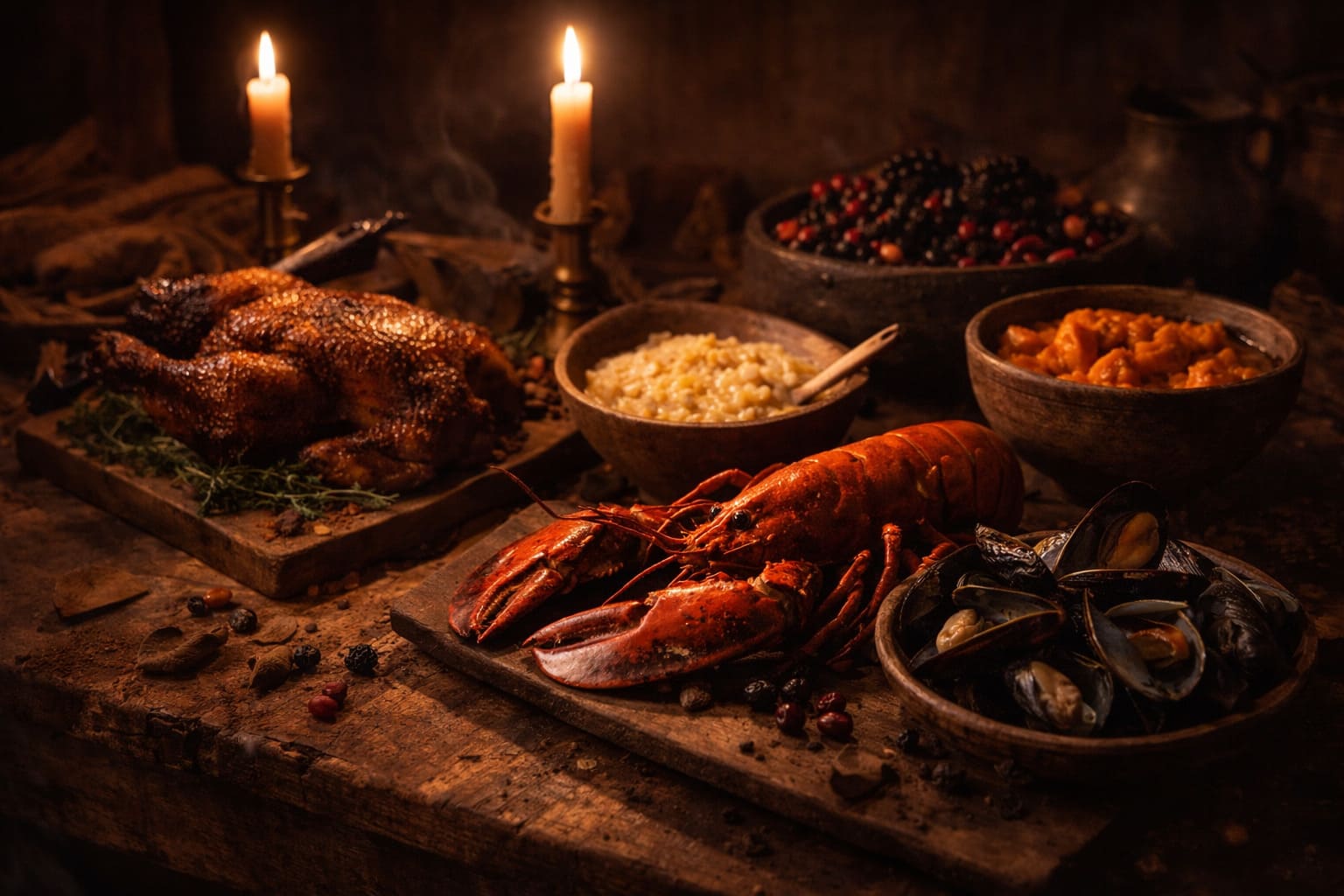
The first Thanksgiving food at Plymouth in autumn 1621 was a pile of wild fowl and five deer, eaten over about three days by roughly fifty English survivors and some ninety Wampanoag men. Only two eyewitness documents survive, and neither mentions turkey, cranberry sauce or pumpkin pie. The familiar menu was assembled much later.
The first Thanksgiving food, as the only witnesses tell it
The Pilgrim Hall Museum in Plymouth states that there are 2, and only 2, primary sources for the events of autumn 1621. One is a letter by Edward Winslow, printed in a pamphlet known as Mourt's Relation. The other is William Bradford's history, Of Plimoth Plantation.
Winslow wrote that after the harvest was in, the governor "sent foure men on fowling." In one day those four killed as much fowl as, with a little help, "served the Company almost a weeke." That is the whole bird count. He does not say which birds.
Then come the guests. "Many of the Indians" came among the colonists, "and amongst the rest their greatest king Massasoyt, with some ninetie men, whom for three dayes we entertained and feasted." The Wampanoag then "went out and killed five Deere" and gave them to the governor, the captain and others.
That is the menu in Winslow's own words: fowl, venison and three days of feasting. He adds that the colonists were so far from want that they often wished their readers in England could share the plenty.
What Bradford adds, and what he does not
Bradford never describes the feast at all. He writes about the same season, though, and his list of what the place offered is useful: cod and bass caught by every family, a great store of fowl as winter approached, "great store of wild turkeys, of which they took many," venison, and Indian corn at about a peck of meal a week per person.
So wild turkey was around Plymouth, and it may well have reached a plate that autumn. But no surviving document places it on the feast table. A third voice, William Hilton, arrived on the ship Fortune in November 1621, after the feast, and wrote home about flocks of turkey, quail, pigeons and partridges. He had not been there for the meal either.
The same sources are silent on what a modern table takes for granted. Nobody mentions cranberries, potatoes or pumpkin pie. Reference accounts of the holiday add that there could have been no pies in 1621 because the colony had no butter, wheat flour or sugar. The deer were likely stewed rather than roasted whole, and corn dishes such as cornmeal or succotash are guesses, plausible but unrecorded. For how sugar later remade the American dessert table, see the history of sugar.
Who was actually at the table
The guest list was lopsided in a way pictures rarely show. Pilgrim Hall counts 53 English survivors of the Mayflower voyage: 22 men, 4 married women, and a large number of adolescents and young children. Against them stood about ninety Wampanoag men with Massasoit. Bradford himself calls the harvest small.
Winslow does not call the event a thanksgiving. He describes a harvest rejoicing in which the colonists "exercised our Armes" while the Wampanoag were among them. Accounts differ on whether the Wampanoag were formally invited or arrived after hearing the shooting, and Winslow's text does not settle it.
How a one-off meal became "the first Thanksgiving"
Nothing suggests the feast was repeated each year. The first civil day of thanksgiving in the New England tradition was declared at Plymouth in 1623, and such days of prayer, sometimes with fasting, were called as events demanded. Harvest thanksgivings became regular in New England by the 1660s, but they grew from that religious habit, not from a yearly reenactment of 1621.
The label came later. Historians say nobody called the 1621 meal "the first Thanksgiving" until the 1830s. In 1841 the Reverend Alexander Young published Winslow's letter in his Chronicles of the Pilgrim Fathers and described the event in a footnote as the first Thanksgiving, the harvest festival of New England. That publication is thought to have spread the idea. Jane G. Austin's 1889 novel Standish of Standish pushed it further into popular memory.
The editor who wrote the menu
The dishes came from a different story. Sarah Josepha Hale, a New Hampshire writer, edited Godey's Lady's Book from 1837 to 1877. In her 1827 novel Northwood she wrote a Thanksgiving dinner with roast turkey, gravy and stuffing, chicken pie, pumpkin pie, pickles, cakes and preserves, with cider, currant wine and ginger beer to drink. It was a nineteenth-century New England table, not a Plymouth one.
From 1846 she campaigned for a national Thanksgiving holiday, writing to presidents including Taylor, Fillmore, Pierce, Buchanan and Lincoln, and using her magazine to print Thanksgiving recipes. Her early letters did not persuade anyone. Lincoln, who had already proclaimed Thanksgivings after Union victories in 1862, proclaimed the last Thursday of November, November 26, as a national day of thanks in 1863, after Gettysburg and Vicksburg. His Secretary of State, William H. Seward, wrote the document. For the bird that settled in the centre of that menu, read why turkey became the Thanksgiving bird.
A date that moved, and a holiday that stayed hard
The date itself was argued over as late as the Great Depression. In 1939, November had five Thursdays, and Franklin Roosevelt set Thanksgiving on the fourth, November 23, to lengthen the Christmas shopping season. Critics called it "Franksgiving." Congress settled the matter in 1941, and Roosevelt signed a law on December 26 fixing the holiday on the fourth Thursday of November. Roosevelt's 1939 proclamation was also the first by a president to tie the holiday explicitly to the 1621 event.
For many Native people the story has a different ending. In 1970, Wamsutta Frank James was barred from giving a speech at Plymouth's ceremonies, and a National Day of Mourning was organized in response. The 1621 meal itself followed a first winter in which, as Bradford's history records, some of the Mayflower passengers died. For more on feasting after hardship, see wartime food history.
Questions people ask
Did the Pilgrims eat turkey at the 1621 harvest feast?
Nobody can say for sure. Edward Winslow's account of the Plymouth feast names only "fowle" and five deer. William Bradford, writing about the same season, says wild turkeys were plentiful and often caught, so turkey may have been eaten, but no surviving document puts it on the feast table.
Was there pumpkin pie at the first Thanksgiving?
No. Neither eyewitness account mentions pie, and the colony had no butter, wheat flour or sugar for pastry in 1621. Pumpkin pie appears in a Thanksgiving dinner in Sarah Josepha Hale's 1827 novel Northwood, more than two centuries after the Plymouth harvest meal.
Who made Thanksgiving a national holiday?
Abraham Lincoln proclaimed the last Thursday of November, November 26, 1863, as a national day of Thanksgiving. Editor Sarah Josepha Hale had campaigned for the holiday since 1846, and Secretary of State William H. Seward wrote the proclamation. Congress fixed the fourth Thursday in 1941.
How long did the first Thanksgiving last?
Edward Winslow wrote that the colonists entertained and feasted Massasoit and about ninety Wampanoag men for three days. The Pilgrim survivors numbered 53. His letter does not call the event a thanksgiving, and the name came into use for the 1621 meal only in the nineteenth century.
Filed under War & Famine
Want more stories like this?
One food history story, every week. No spam, just the stories behind what the world eats.