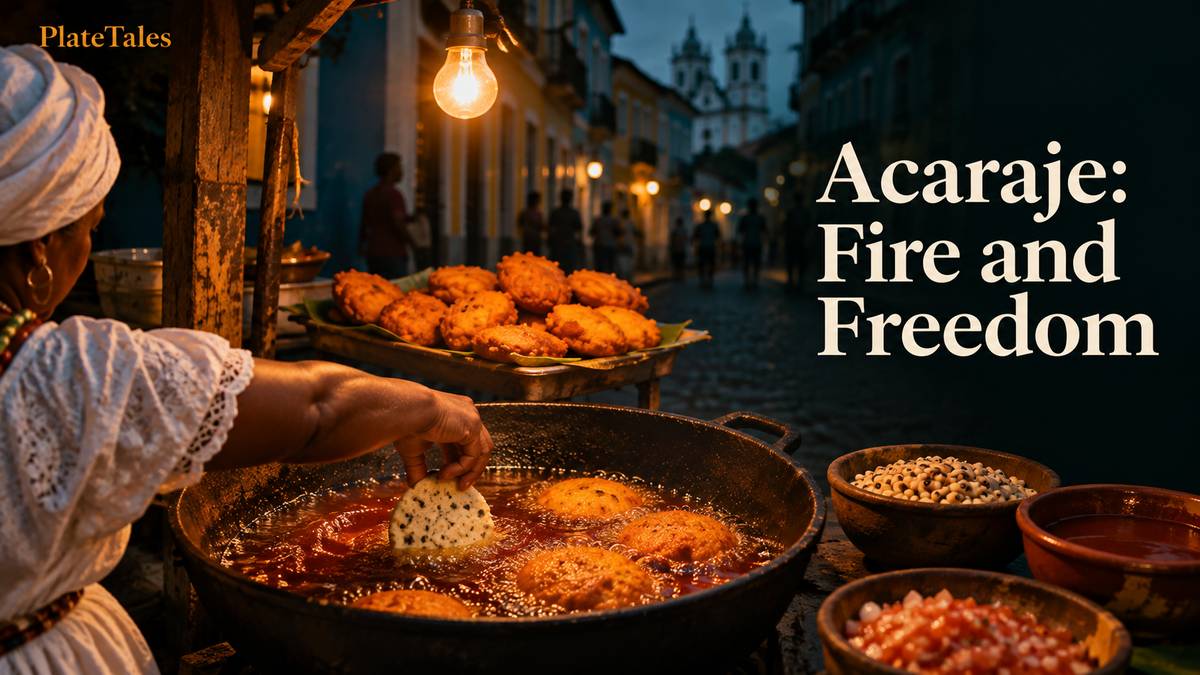
Acaraje is a deep-fried fritter of ground black-eyed peas, sold on the streets of Salvador, Bahia, and it is the direct descendant of the Yoruba akara of West Africa. Enslaved Yoruba people carried the dish across the Atlantic, and in Brazil it became both a Candomble offering and a street food sold by women in white.
The tidy version of that story has a few loose threads. Nobody can give a year for the dish's arrival, and the claim that its sales bought freedom rests on a general pattern more than on a ledger. What the sources do support is still a good story.
Where does the word acaraje come from?
In Yoruba, the fritter is called akara, and the fritter's origin is placed in Yorubaland, which today spans parts of Nigeria, Benin and Togo. The Brazilian name is usually traced to the Yoruba phrase akara n'je, "come and eat akara", said to be the cry of women selling the fritters in the street. That is the common explanation, and it has the feel of a vendor's call, but it comes to us as received etymology, not as a documented first use.
A second reading of the word glosses akara as "ball of fire", with je meaning "to eat". Accounts also record that "acara" once named an oil-soaked cotton wick that candomble initiates swallowed to show they were in trance. The two accounts do not contradict each other so much as show how many meanings one word can carry once it crosses an ocean.
Akara is related to other bean fritters. One account compares it to falafel and suggests that Arab traders spread the dish into Africa, where cowpeas replaced fava beans and chickpeas. That is a hypothesis, put forward without a date.
What the dish looks like at each end of the route
In Nigeria, akara is a common street food, and versions fried in vegetable oil are more usual there than versions fried in palm oil. Other peoples have their own names for it: kosai among the Hausa, koose in Ghana.
In Salvador, the fritter is fried in dende (palm) oil in front of the customer, then split open and stuffed with vatapa and caruru, and often shrimp and pepper. A close relative, abara, is the same batter steamed instead of fried, much like the moi moi of Nigeria.
So the technique and the batter crossed the water. What changed was the oil, the fillings, and above all the job the food was given.
Acaraje as an offering to Iansa
In Candomble, acaraje is a ritual food. The first piece in a rite goes to Exu. Large round acaraje are made for Xango, smaller ones for Iansa, and fritter-sized ones for the child spirits called Ere. For orixas who are forbidden palm oil, there is a version fried in another oil.
Acaraje is tied especially to Iansa, and linked to a myth involving Xango, Oxum and Iansa. Manuel Querino's 1916 book on Bahian cooking, A arte culinaria na Bahia, is an early written description of the dish.
Most women who prepare it are practitioners of the religion, and they wear white. A 2022 article in the University of Chicago's student journal Vaeranda, drawing on scholarship by Lima and Watkins, says vendors perform rites at the start of the day to purify their workspace. Rita Maria Ventura dos Santos, president of the vendors' association, is quoted there saying the dish "became commercialized, but its essence comes from religion."
The women who sold it
The baianas de acaraje are the vendors, and they are recognizable at once: white cotton dress, white headscarf, a tray or stall from which they fry to order. They first appeared selling acaraje in the 19th century.
The freedom story is the part that gets repeated most. Enslaved women in Salvador and Rio de Janeiro commonly sold food and crafts on the street, the Vaeranda article explains. They handed most of the takings to the people who held them in bondage and kept a share, which the article connects to saving money for manumission. The earnings supplemented income and in some cases bought the freedom of enslaved family members, until slavery ended in Brazil in 1888.
Notice the careful wording. The sources describe a system in which street sellers could earn something and some bought freedom. They do not give us a named woman and a named price for acaraje in particular. When popular articles say the fritter "bought freedom", they are compressing that system into one dish. The claim is plausible and the pattern is real, but the sharp version is stronger than the evidence.
From street stall to national heritage
The modern recognition is easier to date. In 2004, the national heritage institute IPHAN registered the craft of the baianas de acaraje as intangible heritage, and the same act listed the dish itself. (Some accounts give a different year, but 2004 is the date used here.)
The vendors' association, ABAM, had been founded in 1992 and now counts almost 4,000 members across Brazil. November 25 was set as the National Day of the Baiana de Acaraje. A Memorial das Baianas opened in Salvador in 2009, and the Vaeranda article says it gets more than 25,000 visitors a month.
Heritage status did not remove the tension between a sacred food and a commercial one. Salvador now has more than 500 acaraje vendors. In October 2023, Rio de Janeiro declared acaraje part of its own cultural heritage, and a news article on that decision carried a headline pointing to disagreement among Bahians about it.
The World Cup that nearly pushed them out
The best-documented clash is from 2014. Brazil's World Cup Law created exclusion zones of two kilometers around stadiums, where FIFA and its sponsors held exclusive sales rights. The baianas who had sold outside Salvador's stadium were suddenly in the wrong place.
ABAM ran a campaign, with a hashtag that set McDonald's against acaraje, and shared by nearly 2,000 people. A petition collected over 17,000 signatures, and the baianas delivered it to President Dilma Rousseff at the opening of the Arena Fonte Nova in Salvador. FIFA agreed to let six baianas sell outside the stadium. No acaraje was sold inside it.
For more on food that moved with enslaved Africans and changed in Brazil, see feijoada, and for another West African dish with a long argument over its origin, jollof rice. The wider thread runs through soul food and the site's migration stories.
Questions people ask
What is the difference between akara and acaraje?
Akara is the Yoruba bean fritter of Nigeria, Benin and Togo, often sold as street food and fried in vegetable oil. Acaraje is its Brazilian descendant in Salvador, Bahia, fried in dende oil, split open and filled with vatapa, caruru and shrimp. Acaraje also carries a religious role in Candomble that akara does not usually have in Nigeria.
What does the word acaraje mean?
Acaraje is usually traced to the Yoruba phrase akara n'je, meaning "come and eat akara", said to be the call of women selling the fritters on Brazilian streets. The Yoruba akara is also glossed as "ball of fire" and je as "to eat". These are accepted etymologies, not documented first uses.
Who are the baianas de acaraje?
The baianas de acaraje are the women of Bahia, usually in white cotton dresses and headscarves, who fry and sell acaraje from street stalls in Salvador. Many practice Candomble. Brazil's heritage institute IPHAN registered their craft as national intangible heritage in 2004, and November 25 is their national day.
Did selling acaraje help enslaved women buy their freedom?
Enslaved women in Salvador and Rio de Janeiro sold food on the street, gave most of the money to those who held them, and kept some, which the sources link to saving for freedom. Earnings bought the freedom of some enslaved family members before abolition in 1888. No source read here documents a specific case tied to acaraje alone.
Filed under Migration Stories, Street Food
Want more stories like this?
One food history story, every week. No spam, just the stories behind what the world eats.