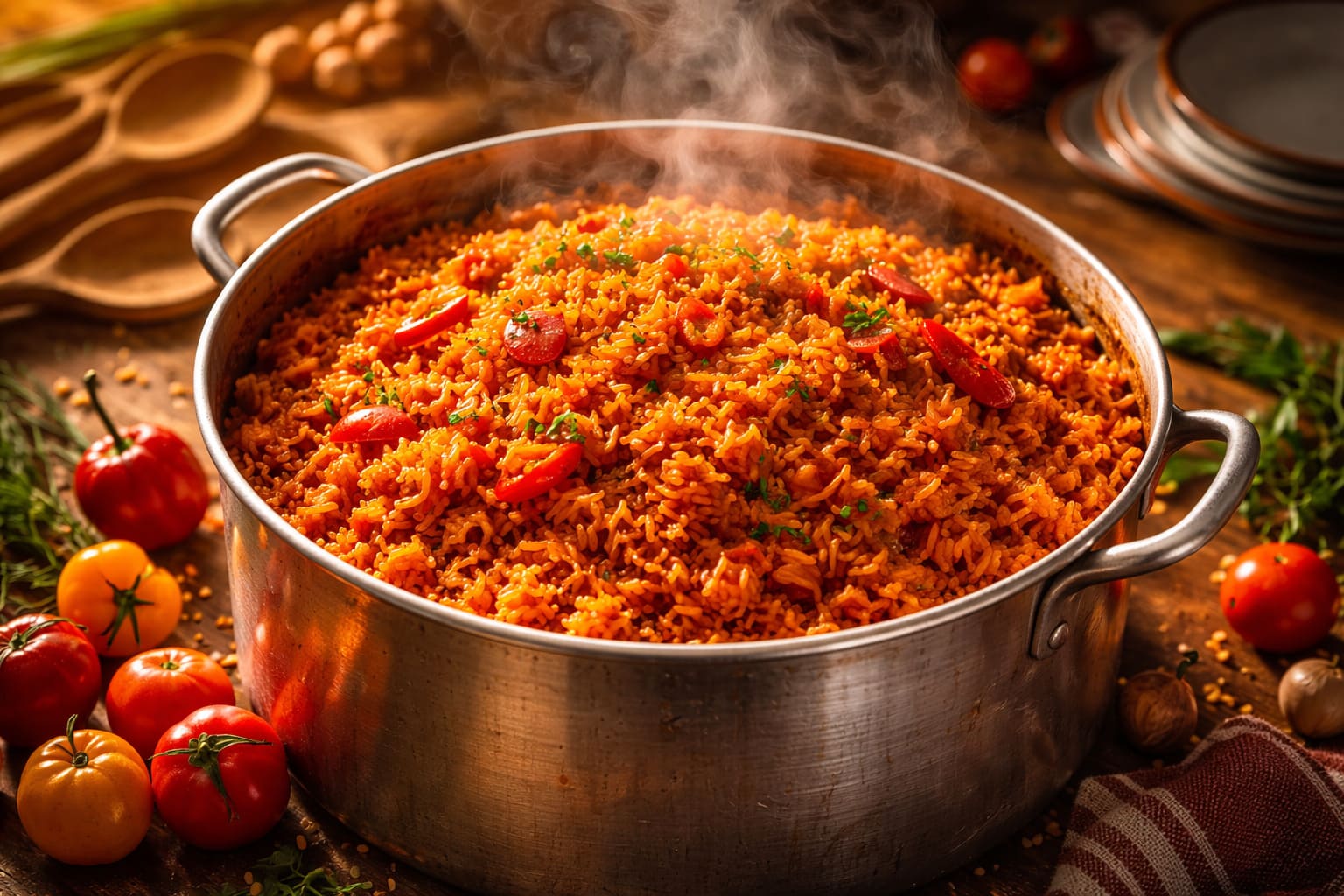
Jollof rice origin points to Senegal, not Nigeria or Ghana. The dish most food historians trace it to is ceebu jen (also spelled thieboudienne), a one-pot meal of fish and broken rice from the fishing communities of Saint-Louis, Senegal. The English name "jollof" comes from the Wolof people, and the version most West Africans argue about today is a descendant of it.
That answer annoys nearly everyone, which is part of the fun.
Where the name comes from
"Jollof" is the Wolof people's name, in English spelling. The Jolof Empire, a confederacy that ruled parts of what is now Senegal, Mali, The Gambia and Mauritania from about the 12th century, carries the same name. Inside Senegal, Mauritania and The Gambia the dish is called ceebu jen or benachin. French-speaking West Africa says riz au gras, and in Mali it is zaame.
So the name points to the Wolof world, and that part is solid. What it does not do is date the dish. A medieval empire shares a word with a recipe; that does not mean anyone in the 1300s ate it.
Jollof rice origin in Saint-Louis, and the cook named Penda Mbaye
UNESCO's entry for ceebu jen, inscribed in 2021, says the dish originated in the fishing communities on the island of Saint-Louis. Reference works place it in the 19th century. Oral histories go further and name a cook, Penda Mbaye, who is said to have run out of barley and used rice instead.
Treat the name with care. The story comes from oral tradition, and the sources we could open give no document, date or household for her. It may be true. It may also be the kind of single-inventor story that dishes collect after the fact.
What the ingredients say is firmer. The Senegalese dish is made with broken rice, fish and vegetables, and the modern recipe uses tomatoes, tomato paste and chili peppers, all of which came from the Americas. A tomato-red rice dish cannot be older than the arrival of tomatoes in West Africa. Along with curry powder, thyme and Asian rice varieties, those American ingredients are one reason the dish is usually dated no earlier than the 19th century, an argument that draws on Stanley Alpern's 1992 article in History in Africa.
An older, wider story, or a newer, colonial one?
Two historians push the story in opposite directions.
James C. McCann, a historian of African food and agriculture, argued in Stirring the Pot (2009) that a simple spread out of Senegal to the rest of the coast is unlikely. He suggested the dish moved with the Mali empire, carried by Djula traders along with rice farming and Islam.
The agronomist Marc Dufumier, writing in Le Monde in 2018, went the other way and proposed a recent, colonial cause. Peanut farming for export pushed rice fields aside, and cheap broken rice shipped from Southeast Asia filled the gap. Cooks had to learn to use a grain they did not know. On that reading, the Senegalese staple is partly a product of the colonial economy.
Fran Osseo-Asare, in Food Culture in Sub-Saharan Africa (2005), traces the dish to the rice-growing region and names ceebu jen as the original. The three do not fully agree, and none of the pages we read produces a dated document that settles it. The disagreement is over whether the dish is an old trade-route food or a recent product of colonial farming, and honest historians leave that open. For the wider history of the grain, see the story of rice.
How one dish became many
Wherever the dish went, the pot changed. Each country now has its own habits, and each defends them.
In Senegal and The Gambia, broken rice and fish stay central, and smoked snails are a traditional ingredient. Ghanaian cooks usually use jasmine rice with beef, goat or chicken, and serve it with plantains and often shito, a hot pepper sauce. Nigerian cooks tend to use parboiled long-grain rice or a basmati such as Golden Sella, with scotch bonnet peppers, thyme and stock cubes; coconut jollof is common in some riverine and Igbo communities. In Cameroon it is often called fried rice. Sierra Leonean cooks may use tomato paste where others use red palm oil.
Party jollof is the form people defend hardest. It is cooked over a wood fire in huge pots, which gives it a smoky taste and a crust at the bottom of the pot, comparable to the Persian tahdig or the Spanish socarrat. A saying you hear repeated: a party without jollof is just a meeting.
The wars
The rivalry between Nigeria and Ghana probably began in kitchens long before anyone recorded it, but it went public in the mid-2010s. In June 2014 the British chef Jamie Oliver posted an "experimental" jollof recipe with cherry tomatoes, coriander, lemon and parsley, none of which belong in a traditional pot. The online outrage, tagged #jollofgate, forced his team to issue a statement.
The anger was aimed at an outsider, and it briefly united West Africans. Then they turned on one another. World Jollof Day has been marked every 22 August since 2015. In 2016 the Ghanaian musician Sister Deborah released "Ghana Jollof," a song that mocked the Nigerian version, and the same year a fight over a shortage of jollof at a Ghanaian political rally was widely mocked by Nigerians. Sierra Leone, Liberia and Cameroon also enter the argument. Scholars have called the whole thing gastronationalism.
Senegal, where the dish most likely began, is the country least often heard in the shouting.
What the arguing left behind
Senegal got its answer in 2021, when UNESCO put ceebu jen on its Representative List of the Intangible Cultural Heritage of Humanity, and the entry calls the dish an affirmation of Senegalese identity. Google marked jollof with a Doodle on 3 November 2022.
Neither decision ended the wars. Ghanaian cooks still reach for jasmine rice, Nigerian cooks still smoke their party pots over wood, and each side still calls the other's pot the wrong one. For how a plate becomes a flag, read how food shaped cultural identity, or browse more cultural identity stories.
Questions people ask
Which country invented jollof rice?
Senegal is the usual answer. UNESCO says ceebu jen, the Senegalese fish-and-broken-rice dish that jollof descends from, originated in the fishing communities of Saint-Louis, and it was inscribed in 2021. Historians disagree on when and how the dish spread to Ghana, Nigeria and the rest of West Africa.
Where does the word jollof come from?
Jollof comes from the Wolof people of Senegal and The Gambia. It echoes the name of the Jolof Empire, a confederacy that ruled parts of Senegal, Mali, The Gambia and Mauritania from about the 12th century. The name does not prove the dish is that old.
What is the difference between Ghanaian and Nigerian jollof?
Ghanaian jollof usually uses jasmine rice with beef, goat or chicken and is served with plantains and shito. Nigerian jollof tends to use parboiled long-grain rice or Golden Sella basmati, with scotch bonnet peppers and thyme, and party versions are smoked over wood fires.
Who was Penda Mbaye?
Penda Mbaye is a cook from Saint-Louis, Senegal, whom oral histories credit with creating ceebu jen after running out of barley and using rice instead. The story comes from oral tradition, and the sources reviewed here give no date or document confirming it.
Filed under Origin Stories, Migration Stories, Cultural Identity
Want more stories like this?
One food history story, every week. No spam, just the stories behind what the world eats.