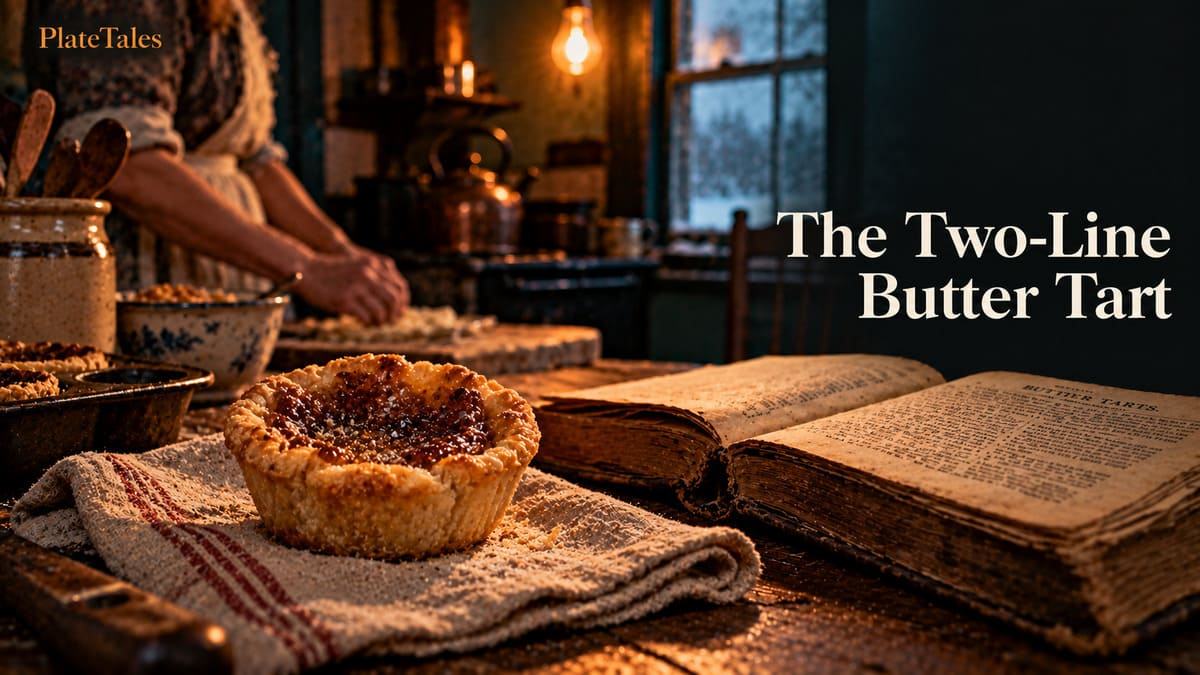
The earliest printed butter tart recipe we can point to is a two-line "Filling for Tarts" on page 88 of the Royal Victoria Cook Book, published in Barrie, Ontario, in 1900. The butter tart history that people repeat, with French brides and Scottish borderers, is mostly guesswork around that one page. The page is real. The family tree is not.
The two lines on page 88
The Royal Victoria Cook Book was compiled by the Women's Auxiliary to the Royal Victoria Hospital in Barrie and printed in 1900 by S. Wesley. Local women contributed the recipes, and sales raised money for hospital comforts for patients. The Simcoe County Archives, which holds a copy, says the book was chosen for ordinary home cooks, and that explains how little the entry says. Cooks were expected to know how to make plain pastry and how hot to bake it. Only the filling needed writing down.
It sits in the "Pies" section under the title "Filling for Tarts." The word butter is not in the title. The recipe has sugar, eggs, butter and a cup of currants, according to one food historian's reading of the page. Nothing else in it tells the baker what to call the result.
The hospital itself was young. The Barrie General Hospital opened in June 1897 on High Street with 13 beds and was soon renamed Royal Victoria Hospital to mark Queen Victoria's Diamond Jubilee. The cookbook came three years later.
Who was Mrs. Malcolm MacLeod?
The recipe is credited to Mrs. Malcolm MacLeod. The Simcoe County Archives identifies her as Mary Ethel (Cowie) MacLeod. The 1901 census lists a Malcolm MacLeod family at 12 Toronto Street, Barrie, and records her birth as December 15, 1855, in rural Ontario. She died in Toronto on April 19, 1915, and her obituary ran on page 5 of The Northern Advance on April 22.
That is nearly all that survives. There is no diary, no family story about the tarts, no claim that she invented anything. She sent in a filling, as many neighbours did, and the book happened to be kept. "First published" is the careful phrase. It does not mean first made. Women had been baking such tarts at home for years before any of them thought a hospital fundraiser needed the instructions.
Where did butter tarts originate? The theories
Three explanations circulate, and none has a document behind it.
| Theory | What it says | What the evidence shows |
|---|---|---|
| Filles du roi | About 800 women sent from France to Quebec in the late 1600s adapted home recipes, using maple syrup, giving the sugar pie | A plausible story. No recipe links the two |
| Scottish border tarts | Settlers from the Scotland-England border brought dried-fruit tarts | The most widely accepted ancestor, but the Border tart is apparently not documented before 1900 |
| Pecan pie | The tart came north from the American South, or both share a British parent | Speculation |
Quebec's sugar pie, the tarte au sucre, is a close cousin in spirit: a sweet filling of butter and sugar in a pastry shell. The Sidney Museum in British Columbia lists the French-bride and sugar-pie ideas as theories and says plainly that the exact origin is unknown. Accounts differ on the brides: they are possible, not certain.
The Scottish side has more going for it. The Ecclefechan tart, named for a village in Dumfriesshire, is a dried-fruit and nut tart, and the tartlet form exists. But a blogger who went through the early printed record found the line between an Ecclefechan tart, a Border tart and an Ontario butter tart hard to draw. Shape and crust do not settle it. He also noted that the butter tart turns up in the record earlier than the Border tart does, which makes the neat theory that "butter" is a corruption of "Border" attractive and unproven.
An older British butter tart
The phrase itself is old. The same researcher found a "Butter Tart" in The Queen's Royal Cookery, dated 1709 or 1713, made with beaten egg, macaroons and butter under pastry. In 1857 Thomas Wright's Dictionary of Obsolete and Provincial English listed "butter-tart" as a regional word. Neither is the Canadian tart. They show that British cooks were putting butter in tarts long before Barrie, and that the name was not Canadian to begin with.
The paper trail after 1900
Once the recipe is in print, it multiplies. The same researcher's timeline runs as follows.
- December 1908: the Vogue Cook Book, Toronto, gives the core recipe from a contributor signed Mrs. G.M.B. Another contributor, from Plattsville, leaves out the egg.
- 1911: the Canadian Farm Cook Book prints six Ontario recipes, five with currants.
- 1913 and 1915: the Five Roses Cookbook carries a version (page 79 in the 1915 edition). Its national distribution helped carry the tart across the country.
- 1914: a Brooklyn newspaper, the Daily Star, prints a boiled "butter tarts" recipe, closer to butterscotch.
- 1937: the Flesherton Advance prints two recipes, one baked and one boiled.
One trap is worth naming. A December 1908 date sometimes gets attached to the Barrie book. That date belongs to the Vogue Cook Book, according to the bibliographer Elizabeth Driver as cited by that researcher. The Barrie book is 1900.
What counts as a real butter tart?
The traditional English Canadian version is butter, sugar and eggs in a pastry shell. It resembles the French-Canadian sugar pie but has no flour in the filling, and it runs looser than pecan pie because it has no cornstarch. Raisins, walnuts or pecans are common additions, and whether they belong is a matter of national debate. The raisin question is polarizing.
The 1900 page already had currants, so the dried-fruit camp can claim the oldest paper. The plain camp can claim that the 1900 book never uses the word butter at all. Both are right, which is why the argument has lasted.
For readers who like to trace sugar and its cousins through pastry, the history of sugar covers the ingredient this whole family of tarts depends on. The tart also belongs to the quieter category of recipes that survive because women wrote them down for each other, a theme in lost recipes from our grandmothers. And the way a migrant dish gets claimed by a new country is a bigger pattern, explored in how immigration changed American food.
From hospital fundraiser to festival
By the 1920s and 1930s the tart was popular across Ontario. Today it is promoted as a regional attraction. Ontario's Best Butter Tart Festival in Midland draws more than 60,000 people in a day. Its contest sold over 50,000 tarts in 2014 and over 300,000 in 2025. Wellington North holds a trademarked "Butter Tart Trail," and a rival tour in the Kawarthas led to a naming dispute that Canadian Living called "The Butter Tart Wars." It ended when the Kawarthas group renamed its route the Kawarthas Northumberland Butter Tart Tour. The first Taste-Off was held in Peterborough on April 28, 2013.
In 2019 Canada Post issued a butter tart stamp in its Sweet Canada series. The recipe that started the paper trail is still in the Simcoe County Archives, two lines long, on page 88.
Questions people ask
Who wrote the first butter tart recipe?
The earliest known published butter tart recipe is a two-line "Filling for Tarts" credited to Mrs. Malcolm MacLeod, whose first name was Mary. It appeared on page 88 of the Royal Victoria Cook Book, printed in Barrie, Ontario, in 1900. Earlier unpublished versions probably existed in home kitchens, but none has been found.
Did French settlers invent the butter tart?
No document shows it. One theory says the filles du roi, about 800 women who moved from France to Quebec in the late 1600s, adapted French recipes with maple syrup and gave rise to the sugar pie, which later influenced the butter tart. It is plausible, but the exact origin of the Canadian butter tart remains unknown.
Is the butter tart related to Scottish tarts?
Probably, though it is unproven. Scottish Ecclefechan tarts and Border tarts, both filled with dried fruit, are the most widely accepted ancestors of the Ontario butter tart. Researchers find the line between them hard to draw, and the Border tart is apparently not documented in print before 1900.
Where is the original butter tart recipe kept?
The original Royal Victoria Cook Book, with Mrs. Malcolm MacLeod's butter tart filling on page 88, is held by the Simcoe County Archives in Ontario. The book was compiled by the Women's Auxiliary to the Royal Victoria Hospital in Barrie and published in 1900 to raise money for patients' comforts.
Filed under Origin Stories
Want more stories like this?
One food history story, every week. No spam, just the stories behind what the world eats.