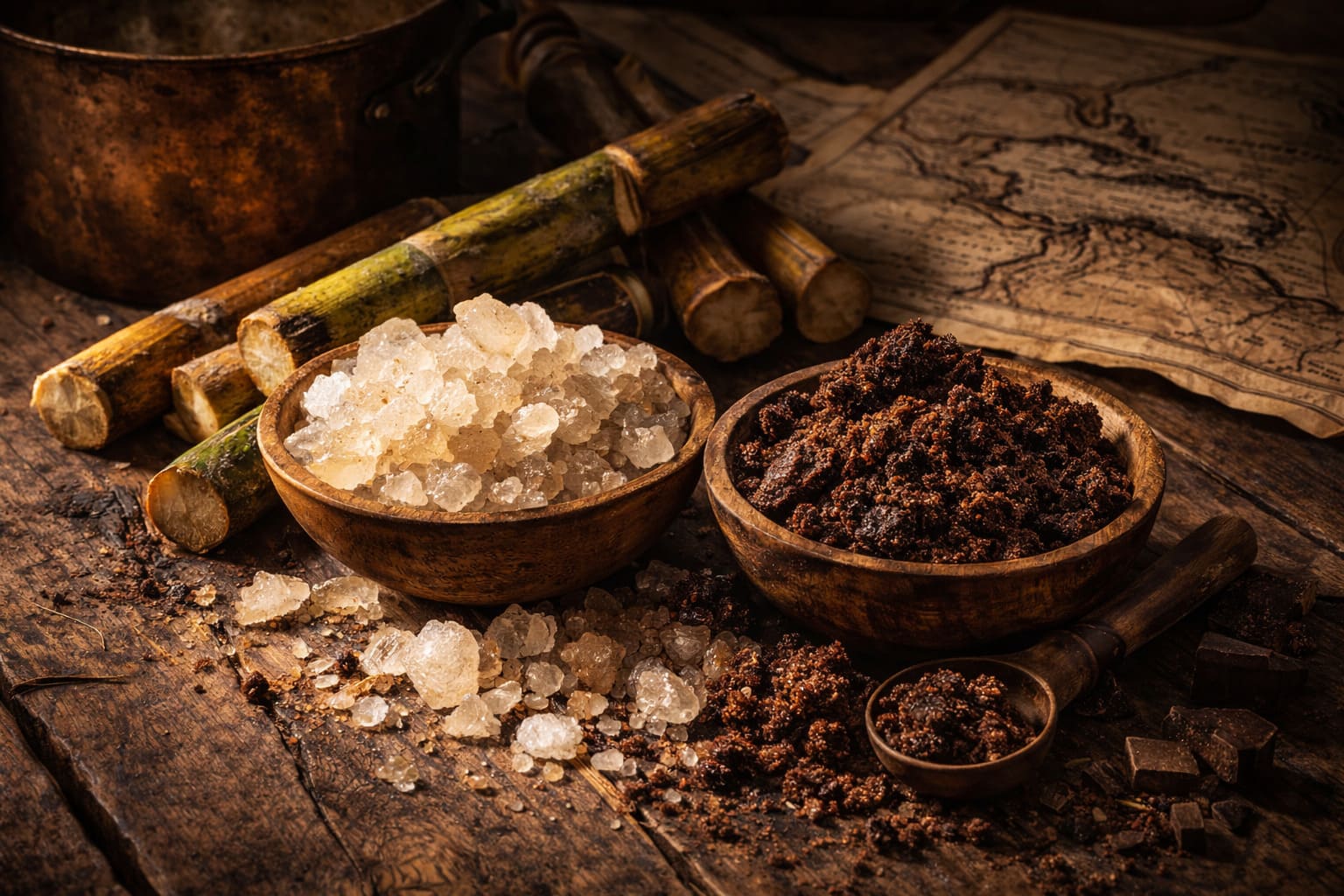
The history of sugar starts with a grass domesticated by Pacific islanders and ends with a crop that, between the fifteenth and nineteenth centuries, pulled millions of enslaved Africans across the Atlantic. Crystallized sugar was first made in India, probably around 350 AD, then carried west by Arab growers, Venetian merchants and Portuguese planters, and finally planted in the Americas from 1493. Cheap sugar for Europe was paid for with forced labor.
A grass from the Pacific, a crystal from India
Sugarcane (Saccharum officinarum) was first cultivated by people on the islands of the southern Pacific, according to Britannica, and most of today's commercial canes descend from a noble cane bred from a wild species called S. robustum. Dates for the earliest breeding are still argued over. One standard account puts it in New Guinea around 4000 BC. For a long time the cane was chewed, not refined.
Making granulated crystals out of the juice was a separate invention. The usual account places it in India around 350 AD. Two Sanskrit words survive in English: khanda, the crystals, gave us "candy", and sharkara is thought to be the root of "sugar". Buddhist monks are said to have carried the method to China. Chinese records describe missions sent to India from 647 to learn how it was done, after the Tang emperor Taizong showed an interest.
The Greeks heard of the plant much earlier. Alexander the Great's admiral Nearchus reportedly learned of it in India in 325 BC, according to Arrian's account of the campaign. Hearing about a plant is not the same as eating its sugar, and for centuries Europe saw very little of it.
How sugar moved west: Arab growers, Venetian buyers
By the sixth century AD the crop had reached Persia, and Arab expansion carried it around the Mediterranean. The anthropologist Sidney Mintz, whose 1985 book Sweetness and Power remains the standard study, wrote that wherever the medieval Arabs went "they brought with them sugar, the product and the technology of its production."
Europeans met it through the crusader states. Early in the twelfth century Venice acquired estates near Tyre to produce sugar, and William of Tyre, writing later that century, called it "very necessary for the use and health of mankind." By the fifteenth century Venice was Europe's main refining and distribution centre. Sugar was still a luxury. At a feast given by Gaston de Foix at Tours in 1457, guests were shown the first recorded sugar sculptures, a tradition of banquet showpieces that lasted into the twentieth century.
More on the long-distance trade behind such luxuries is in silk road foods and the history of cinnamon.
The Atlantic islands where the plantation was rehearsed
The plantation model that later spread across the Americas was tried first on islands off Africa. Henry the Navigator introduced cane to Madeira in 1425, and the Spanish planted it in the Canary Islands after conquering them. By 1492 Madeira was producing more than 1.4 million kilograms of sugar a year. Enslaved Africans were already working sugar plantations on Madeira and the Canaries by about 1450, as well as in the Azores and Cape Verde.
Then came the Americas. Columbus took cane seedlings to Hispaniola on his second voyage in 1493. The first harvest there came in 1501, mills were running in Cuba and Jamaica by the 1520s, and about 3,000 small mills had been built in the New World before 1550. Brazil became the centre of production. Portuguese slave trading to Brazil began around 1560.
What cane cutting required
Sugar asked more of its workers than tobacco or cotton did. It also demanded more capital and technical skill, because cut cane has to be crushed and boiled quickly or it spoils. Even now, Britannica notes, weeding is still largely done by hand with a hoe.
Dutch growers brought cane from South America to Barbados after 1625. In time sugar made up 93 percent of Barbados's exports and 97 percent of those of Britain's Leeward Islands. Saint-Domingue, the French colony that became Haiti, was the world's largest sugar producer from the mid-1740s, until slavery ended and the colony declared independence in 1804.
The scale of the trade is hard to hold in the mind. The most recent estimate, by the historian David Eltis, is about 12.75 million Africans loaded onto slave ships bound for the Americas, with up to 2 million dying on the voyage. Sugar was one of several crops they were forced to grow, and the figures here do not give a clean share for sugar alone. The plantation system itself was first tried on sugar, on the Atlantic islands.
Guadeloupe or Canada, and the price of an island
Sugar islands counted for a great deal in the eighteenth century. By 1750 sugar was the most valuable commodity in European trade, about a fifth of European imports, and from the 1740s to the 1820s it was Britain's most valuable import. Britain consumed five times as much sugar in 1770 as in 1710.
That explains a well-known argument at the end of the Seven Years' War. Britain had captured both Guadeloupe and Martinique, and in the debate over the peace it weighed Guadeloupe's sugar output against Canada, which was expensive to hold. In the Treaty of Paris of 1763 Britain kept Canada and handed the islands back to France. The popular version, that France chose a sugar island over Canada, reverses who was holding what. Both sides, though, treated the island as the bigger prize.
Britain's own sugar wealth ended in a payment to the wrong people. The Slavery Abolition Act of 1833 set aside 20 million pounds, about 40 percent of the Treasury's annual income, to compensate slave owners. Around 45,500 owners received money. The enslaved received nothing. Taxpayers kept servicing the debt until 2015, when the government redeemed the last of the gilts.
Beet sugar, and a drink in every cup
Cane was no longer the only source. In 1747 the German chemist Andreas Sigismund Marggraf announced that beets contained sugar, and his student Franz Karl Achard first made beet sugar in 1783. In 1813 Napoleon banned sugar imports and ordered 32,000 hectares planted with beets. By 1899 beet sugar supplied about two-thirds of the world's sugar. Machines helped too: Norbert Rillieux designed a multiple-effect evaporator, with the first working model dated 1845.
With supply rising, sugar left the banquet table. It sweetened tea, coffee and chocolate, and Mintz argued in Sweetness and Power that it also helped fund industrialization and changed what Europeans ate. For the two drinks that carried most of it, see the history of tea and the history of coffee.
Questions people ask
Where did sugar originally come from?
Sugarcane was first cultivated by peoples of the southern Pacific islands, with New Guinea the usual starting point. Making crystallized sugar from the juice was developed in India, probably around 350 AD. From there cane growing spread to Persia, the Mediterranean, Madeira and the Canary Islands, and in 1493 Columbus took it to Hispaniola.
How is sugar connected to slavery?
Sugar plantations in Madeira and the Canary Islands used enslaved Africans by about 1450, and the same system was carried to Brazil and the Caribbean. Sugar demanded heavy labor and capital. Historian David Eltis estimates about 12.75 million Africans were loaded onto slave ships for the Americas, with up to 2 million dying on the voyage.
Did France really keep Guadeloupe instead of Canada?
Not quite. Britain had captured Guadeloupe and Martinique, and in the 1763 Treaty of Paris it returned them to France while keeping Canada. British negotiators did weigh Guadeloupe's sugar output against the cost of holding Canada, so the story reflects a real debate, but France was not the one choosing.
When did beet sugar begin?
Andreas Sigismund Marggraf announced in 1747 that beets contain sugar, and his student Franz Karl Achard made the first beet sugar in 1783. Napoleon banned sugar imports in 1813 and ordered 32,000 hectares of beets planted. By 1899 beets supplied about two-thirds of the world's sugar.
Filed under Trade Routes
Want more stories like this?
One food history story, every week. No spam, just the stories behind what the world eats.