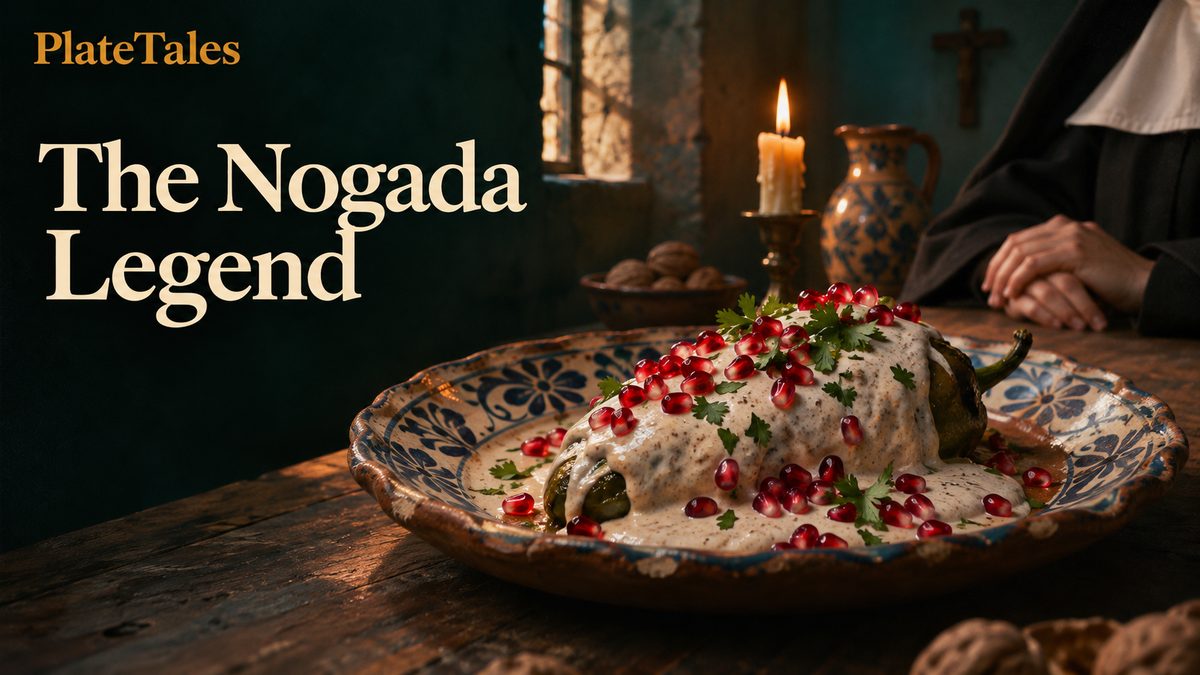
The history of chiles en nogada, as most Mexicans tell it, starts on 28 August 1821, when Augustinian nuns in Puebla invented the dish for Agustin de Iturbide and gave it the green, white and red of the flag. The banquet is real. The date, the invention and the flag are far shakier, and the dish itself seems to be older than the story.
Chiles en nogada history: the story everyone tells
The popular version goes like this. Iturbide, leading the Army of the Three Guarantees (the Trigarante army), came through Puebla after the Treaties of Cordoba. The nuns of the Convent of Santa Monica made a poblano chile stuffed with a mixture of meat and fruit, covered it in a white walnut sauce, and scattered parsley and pomegranate seeds on top. Green, white, red. They served it on 28 August, which happens to be the feast of San Agustin, the patron saint of the nuns' order.
Infobae's account of the legend adds that Iturbide ate it as the last course of a 14-course banquet. It is a very good story. It has a hero, a convent, a saint's day and a flag, and it fits on a postcard.
Where the dates stop agreeing
Eduardo Merlo Juarez, an archaeologist and researcher at INAH-Puebla, gives a different date. According to Mexico Desconocido, he places Iturbide's passage through Puebla on 2 August 1821, on his way to Cordoba, Veracruz, to sign the treaties. Puebla's own tourism writing repeats the same arrival date: the Guia Oca page on the dish gives 2 August 1821 as the day Iturbide arrived.
That leaves the 28 August date with a problem. If the soldiers were gone by the start of the month, the San Agustin feast cannot have been the occasion. Mexico Desconocido makes the same point from the kitchen side. Late August is walnut harvest time, which matches the saint's day, "pero no con la entrada de Iturbide a Puebla." The harvest fits the festival, not the visit.
The article's verdict is measured: the banquet for Iturbide happened, and the nuns of Santa Monica (it calls them Augustinian Recollects) took part, but the chile en nogada "no fue creado especificamente para el." It was not made for him.
A dessert before it was a dinner
The most interesting piece of evidence is what the dish was. Merlo says recipes for stuffed chiles with nut sauce turn up in cookbooks from the 18th century on. In those, according to Mexico Desconocido, it was not a main course but a dessert: a chile stuffed with sweet fruit and covered in walnut sauce, with no meat at all. Nobody knows when the picadillo of minced meat arrived and turned it into a plate you would eat for lunch.
The sources do not agree on the exact year of the oldest recipe. Guia Oca says Merlo found records of a similar recipe dating to 1741. Infobae speaks more loosely of Puebla recipe books and documents "que datan de 1700." Some accounts mention a 1714 recipe and a 1780 cookbook, but those claims are poorly backed. A fair summary is that stuffed chiles in nut sauce were being written down in colonial Puebla well before 1821, and that the exact first page has not been pinned down.
The sauce itself has a long pedigree. The name nogada comes from the Castilian walnut, the nogal de Castilla, brought by the Spanish after the Conquest, and the sauce is linked to Spanish and Sephardic nut-based cooking. Some anthropologists, Infobae notes, even suggest a simpler version with sweet chiles stuffed with fruit may have existed before the Spanish arrived, though that is a theory, not a document. If you want the wider story of Mexican ingredients meeting Spanish ones, the history of chocolate follows a similar road, and so does the history of tacos.
Who gave the dish its flag?
Here is the part that surprises people. The link between the three colors and the national flag appears to be much younger than 1821. Some accounts say that version of the colors arose in the 1930s, and credit a tourist cookbook, La Tipica Cocina Poblana, with popularizing the origin myths in the 1930s and 1940s. Treat that as a lead, since the cookbook itself was not opened. What the other pages do show is how many versions were already circulating by then.
Artemio de Valle-Arizpe, a writer steeped in the viceregal period, told one in his book Sala de Tapices. In his telling, three young women of Puebla whose sweethearts were soldiers prayed to the Virgin of the Rosary and San Pascual Bailon and then made a dish in the colors of the uniforms. Infobae says other tellers credit Bishop Antonio Joaquin Perez Martinez with proposing it. And there are other readings of the colors that have nothing to do with a flag: white for the Catholic faith, red for the union of Europeans and Americans, green for independence.
So the flag, the nuns, the soldiers, the saint and the bishop are all stories laid over the same plate. None of them is supported by a document from 1821 that the sources read here point to.
Why it is eaten in August and September
The season is real and has nothing to do with legend. The dish is made in central Mexico in August and the first half of September, when pomegranates are in season. Walnuts ripen around the same time. A dish that needs fresh walnuts for the sauce and pomegranate seeds on top is going to be a late-summer dish whatever it is called.
That timing is also why it ended up tied to 16 September. Mexican Independence Day lands at the end of the pomegranate window, and a patriotic dish in three colors lands neatly in the same weeks. A Mexican government agriculture page calls it the emblematic dish of the national holidays, and says ladies of Puebla society served it to Iturbide. It attributes the dish's origin to the Clarisas (Poor Clares) around 1600, which is yet another claim: some histories credit the Poor Clares and others the Augustinians of Santa Monica. Nobody agrees on the nuns either.
The dish is a point of pride in Puebla, and nothing here takes that away. How a recipe becomes a national symbol is a story in itself, and how food shaped cultural identity covers more of it.
What the Puebla guides admit
Mexico Desconocido accepts the banquet but not the invention. Guia Oca, a Puebla guide, says the nuns may have invented the dish because San Agustin was their patron saint, then adds that the origin is uncertain. The same guide says that over the following centuries the dish was cooked in July, August and September, so the season outlived the legend's single date. A city guide, in other words, shrugs.
Questions people ask
Did nuns really invent chiles en nogada for Iturbide?
Probably not for him. Mexico Desconocido reports that the banquet for Agustin de Iturbide in Puebla did happen, with nuns of the Convent of Santa Monica involved, but that chiles en nogada was not created specifically for him. Eduardo Merlo Juarez says recipes for it appear in cookbooks from the 18th century.
When did Iturbide actually reach Puebla?
According to Eduardo Merlo Juarez, as reported by Mexico Desconocido, Agustin de Iturbide passed through Puebla on 2 August 1821, on his way to Cordoba, Veracruz, to sign the treaties. The popular legend instead gives 28 August 1821, the feast day of San Agustin, which is the date the sources dispute.
Was chiles en nogada always a main course?
No. Mexico Desconocido says that in the older recipes described by Eduardo Merlo Juarez, chiles en nogada was a dessert: a chile stuffed with sweet fruit and covered in walnut sauce, with no meat. It is not known when the meat picadillo was added and the dish became a main course.
Why is chiles en nogada served in late summer?
Chiles en nogada is made in central Mexico in August and the first half of September, when pomegranates are in season. Walnuts for the sauce ripen at a similar time, and Mexico Desconocido links the late-August walnut harvest to the feast of San Agustin on 28 August.
Filed under Origin Stories, Cultural Identity
Want more stories like this?
One food history story, every week. No spam, just the stories behind what the world eats.