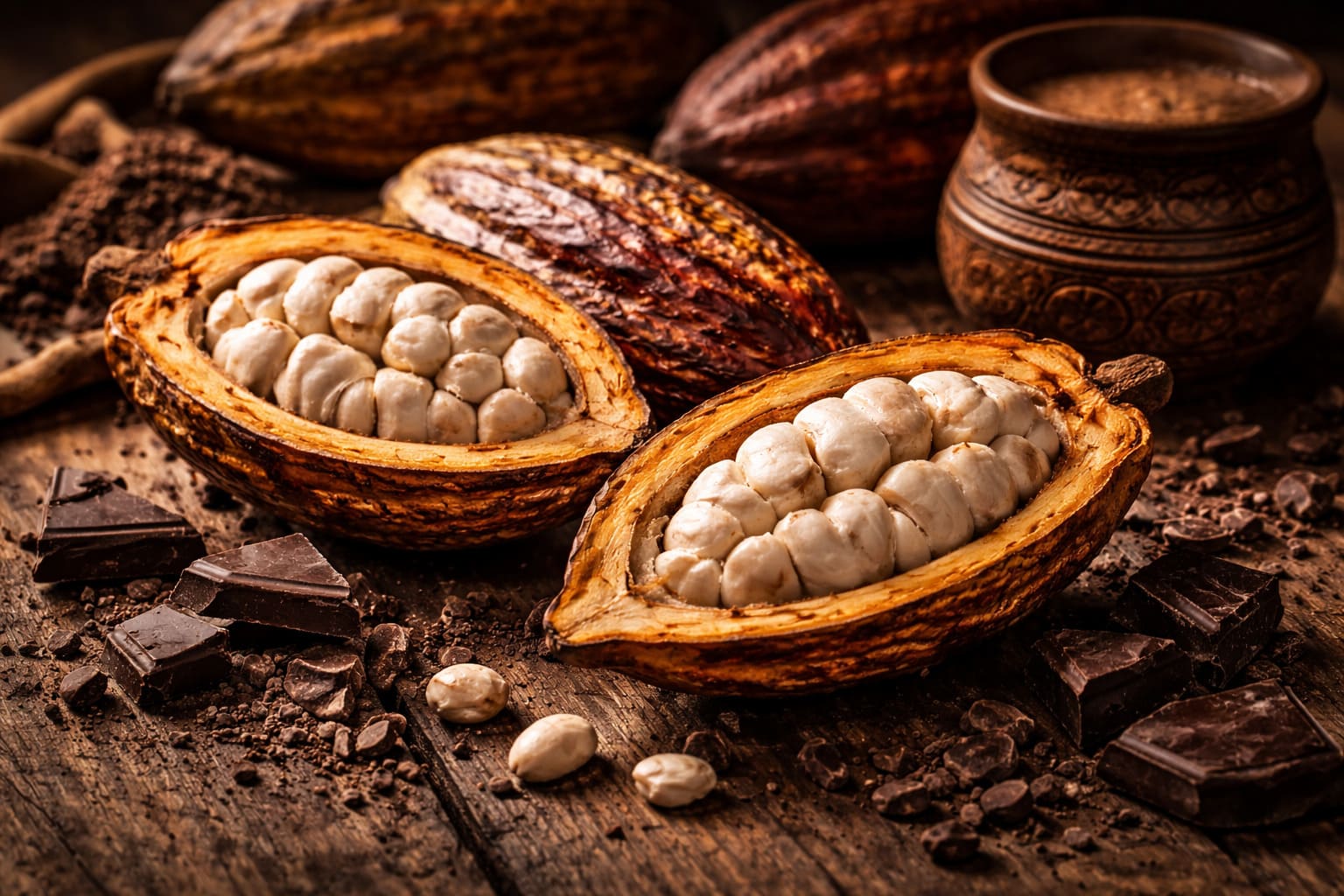
The history of chocolate starts in the upper Amazon, not Mexico. Cacao was in use in what is now southeast Ecuador about 5,300 years ago, Maya and Aztec drinkers made it famous, and Spain sweetened it. A cocoa press in 1828 and a run of Victorian and Swiss inventions then turned a drink into a bar.
Cacao use began in Ecuador, not Mexico
The old textbook version put the first cacao in Mesoamerica, with the Olmec. In 2018 a team led by Sonia Zarrillo reported cacao starch grains, theobromine residues and ancient DNA from the Santa Ana-La Florida site in southeast Ecuador, dated to about 5,300 years ago. They called it the earliest evidence of cacao use in the Americas and pointed to the upper Amazon as the oldest known centre of cacao domestication. The tree's greatest genetic diversity sits there too.
Mesoamerica comes later, but it is where the drink took the shape people now recognize. Surveys of the archaeology list cacao traces in Chiapas by about 1900 BC, in Veracruz by about 1750 BC, and in Oaxaca bowls and jars from roughly 1851 to 1045 BC. The Olmec at San Lorenzo may at first have fermented the pulp around the seeds rather than brewing the beans. By around 600 BC the Maya were drinking chocolate, and cacao beans served as money among them by at least 400 BC.
Britannica adds a detail from the Maya themselves: dignitaries were buried with bowls of the stuff, and the word ka-ka-w inscribed on those vessels helped scholars crack the Maya writing system.
What the Aztecs did with the beans
The Aztec capital could not grow cacao, so it came in from outside. The Aztecs conquered the Soconusco region largely for its cacao, and about 1.5 million trees were being tended there when the Spanish arrived. Long-distance traders called pochteca hauled loads of 24,000 beans, weighing 50 to 60 pounds, on their backs.
Drinking it was mostly an elite habit: royalty, nobles and those traders. Soldiers were the exception, since they got cacao as rations. Women generally prepared the drink. Annatto colored it red, which tied it to blood in the Aztec imagination, and chocolate was served to sacrifice victims.
Much of the glamour attached to Aztec chocolate is later decoration. Modern "Aztec" recipes often include cinnamon, a spice that reached Mesoamerica only with the Spanish. Mole poblano, often tied to the Aztecs, was invented after the conquest and outside their territory. Tales of Aztec aphrodisiac chocolate come from Spanish writers, and the reports are considered unreliable.
How chocolate reached Spain
The tidy story says Montezuma served Hernan Cortes a cup in 1519 and Cortes carried the idea home. Britannica says it is commonly thought but "there appears to be no evidence", and historians of chocolate find no evidence that Cortes brought it to Spain either. Britannica notes that Columbus took cocoa beans to Spain after his fourth voyage in 1502, though little was made of them.
A stronger candidate is 1544, when Kekchi Maya representatives from Guatemala brought gifts, chocolate among them, to the court of Prince Philip. The first recorded commercial shipment of cocoa beans to Spain, from Veracruz, dates to 1585.
The Spanish colonists did not take to the foam at first. Chocolate was changed to suit them: sweetened, spiced with flavors they knew, and served warm. Britannica names cinnamon and vanilla. The sugar story belongs to a separate trade, told in the history of sugar, and the vanilla one in the history of vanilla.
London's chocolate houses
In 1657 a Frenchman opened a shop in London selling solid chocolate for making the drink, at 10 to 15 shillings a pound. Only the wealthy could pay that. Fashionable chocolate houses followed in London, Amsterdam and other capitals. White's opened in 1693 as White's Chocolate-House, and the Cocoa-Tree in 1698. Both were used for political meetings and high-stakes gambling, and some grew into private clubs.
Chocolate served in English coffee houses too, to anyone who could pay, as the history of coffee and the history of tea also show. About 1700 the English began adding milk. High import duties on raw cocoa kept prices up until the mid-19th century, when the duty fell to a flat penny a pound and chocolate became popular.
From a drink to a bar, 1828 to 1879
Four steps turned the drink into something you could bite.
| Year | Who | What |
|---|---|---|
| 1828 | Coenraad van Houten, Netherlands | Patented a press that removed much of the cocoa butter, leaving a cake that could be ground to powder |
| 1847 | J. S. Fry and Sons, England | Combined cocoa butter, chocolate liquor and sugar into sweet eating chocolate |
| 1875 or 1876 | Daniel Peter, Switzerland | Added dried or powdered milk, making milk chocolate |
| 1879 | Rodolphe Lindt | Invented conching, which smooths the gritty mass |
The dates need care. Van Houten was not the first to build such a press: Nicolas de Blegny had described one in 1687. Fry's is credited with introducing eating chocolate to Britain in 1847, and that is a credit given in the sources rather than a settled fact. Britannica dates Peter's milk chocolate to 1876, other histories to 1875, so the year stays hedged. Milk had been tried in chocolate before, but it was expensive and spoiled easily.
Lindt kept conching a trade secret for more than 20 years. Before it, chocolate was gritty. The leftover cocoa butter had no market at first and came into wide use only from the 1860s. By 1890 one worker could make about fifty times as much chocolate as before the Industrial Revolution.
The same era has its own scandals. Cadbury, one of the firms that sold adulterated chocolate in the 19th century, helped bring food standards laws. Rival bars were also the start of the boxed chocolate and the chocolate Easter egg. Frozen desserts took a similar route to the mass market, as the history of ice cream shows.
Who grew the cacao
In the 1900s Cadbury looked into labor on Portuguese cacao plantations. Agent Joseph Burtt's 1908 report called the system "de facto slavery". In 1909 Fry's, Cadbury and Rowntree's boycotted the plantations in Portuguese territory. Cadbury moved its buying to the Gold Coast, now Ghana, which became the largest producer in 1911.
West Africa still dominates. Ivory Coast and Ghana together supply about 60 percent of the world's cocoa.
Questions people ask
Where did cacao first come from?
Cacao was first used and domesticated in the upper Amazon, in what is now southeast Ecuador. A 2018 study of the Santa Ana-La Florida site found cacao starch grains, theobromine residues and ancient DNA there dating to about 5,300 years ago, earlier than any known Mesoamerican evidence.
Did Cortes bring chocolate to Spain?
There is no evidence he did, although the story is repeated often. Britannica points instead to Kekchi Maya envoys who brought chocolate to Prince Philip's court in 1544. The first recorded shipment of cocoa beans to Spain, from Veracruz, came in 1585.
When was milk chocolate invented?
Swiss maker Daniel Peter added dried milk to chocolate in the 1870s, which gave the first milk chocolate. Britannica dates it to 1876, other histories to 1875. Milk had been tried in chocolate earlier, but it was costly and hard to keep fresh.
Why did Europeans sweeten chocolate?
Spanish colonists disliked the bitter, foamy Mesoamerican drink at first. They sweetened it, spiced it with flavors they knew such as cinnamon and vanilla, and served it warm. That sweet hot version became popular at the Spanish court and spread across Europe in the 17th century.
Filed under Trade Routes, Accidental Inventions
Want more stories like this?
One food history story, every week. No spam, just the stories behind what the world eats.