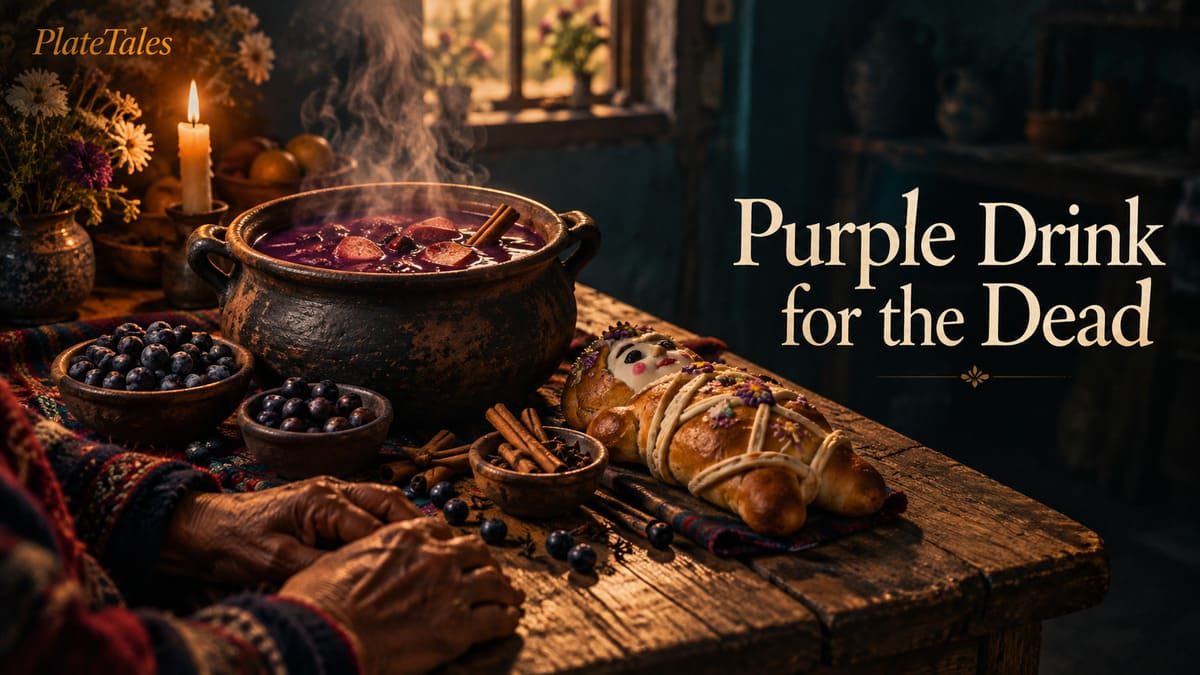
Colada morada is a thick, spiced purple drink that Ecuadorians make for November 2, the Catholic Day of the Dead, and eat with guaguas de pan, sweet wheat breads shaped like swaddled babies. Its history is a blend of Andean and Spanish customs, but the exact dates are murky: the popular claim of an Inca-era recipe rests on thin sourcing, and nobody can point to a clear first written recipe.
What is on the table on November 2
In the highlands of Ecuador, the second of November belongs to the dead. Families visit cemeteries, and in Kichwa communities they gather at the graves with food. Two items turn up almost everywhere: a pot of colada morada and a bread doll.
The drink is built on purple corn flour, which gives it body. Some cooks use cornstarch instead. Into the pot go fruit such as naranjilla, pineapple, strawberry, babaco, guava and mortiño, the Andean wild blueberry, along with cinnamon, clove, ishpingo (an Amazonian relative of cinnamon), allspice, orange leaf, lemongrass and lemon verbena. Sugar or panela sweetens it. Accounts say a version can hold up to 25 ingredients, which is why no two households taste quite the same.
The bread is called a guagua de pan. In Quechua and Aymara, wawa means baby and t'anta means bread, and the Quechua dictionaries behind that translation include Ludovico Bertonio's Aymara dictionary of 1612. Ecuadorian families bake or buy the figures, trade them with relatives and friends, and give them to godchildren. The breads are decorated with sugar paste and candies, and some are filled with guava sweet, manjar blanco or jam. A lecturer at the Pontifical Catholic University of Ecuador (PUCE) told the university's Conexion magazine in 2025 that families take the figures to the graves of their loved ones on November 2, and that the Spanish added sugar, wheat flour and icing to what had been an Indigenous funerary custom.
Colada morada history: where the ancient recipe story comes from
The version you will read on most Ecuadorian food pages goes like this. Before the Spanish, highland peoples marked the rainy season and honored their dead. They made a drink from ground purple corn and llama blood, and shared it with the remains of ancestors dug up for the occasion. The Quitu-Cara are named as one such group, and one account gives the ceremony a name, Aya Marcay Quilla, glossed as the month of carrying the dead.
Some of this has a real backdrop. The Inca kept the mummies of dead rulers and relatives, and offered them food, drink and clothing. Ancestor veneration was a core part of Andean society long before the Inca state. A November rite for the dead is plausible.
But the specific claims are another matter. The Aya Marcay Quilla origin rests on a blog and on a 2017 paper by Villareal and Abad, and other accounts lean on Ecuadorian news outlets. No colonial or earlier document turned up in the sources read for this story that describes a purple-corn drink with llama blood at a funerary feast. That does not make the claim false. It means the llama-blood recipe is a tradition that has been repeated, not a documented fact, and you should treat the details with caution.
How All Souls' Day arrived
The Spanish brought a calendar. Saint Odilo of Cluny is credited with fixing the commemoration of the faithful departed on November 2 for the monasteries tied to Cluny, with almsgiving, prayers and Masses for souls in purgatory. From Cluny it spread to other Benedictine houses and then across the Western church. The Diocese of Liège adopted it under Bishop Notger, who died in 1008, and Rome and Italy took up November 2 in the 13th century.
Food for the dead was already part of this Christian world. Orthodox churches bless koliva, a dish of boiled wheat with honey, in memory of the departed. Children in England went souling for soul cakes. In Brittany a supper was left out for the souls, and in the Tyrol cakes were left for them. So a bread offering for the dead was familiar to the missionaries, which may be one reason the Andean and Spanish customs fit together so easily.
Scholars of Mexico's Day of the Dead disagree about how much is Indigenous and how much is European. Elsa Malvido traces the custom to medieval Europe, while Octavio Paz saw a continuation of Aztec festivals. Ecuador's case has not been argued as loudly, but the same split applies.
When wheat met the Andean offering
Wheat did not grow in the Andes before the Spanish arrived, so a bread doll made from wheat flour must be a colonial invention at the earliest. Accounts say that after the conquest, wheat bread dolls replaced the squash (zapallo) tortillas that Indigenous people cooked on clay griddles for this celebration. Some accounts describe the colada as a hybrid of Indigenous and Spanish culture and suggest its name comes from the older mazamorra morada, because the cooked corn flour was strained through a sieve. Both of those details are reported, not documented in a dated source we could read. The PUCE lecturer likewise says Indigenous people, after the Spanish banned the parading of mummified leaders, began making bread mummies instead, but that is one academic's account with no document cited, so treat it as tradition.
The 1767 Jesuit memoir that some writers cite as the earliest account could not be verified here, so it stays out of this story. If you want a date you can stand behind, the Bertonio dictionary of 1612 shows that t'anta and wawa were Andean words by the early 17th century, though it does not tell us about the bread dolls.
The shape of the bread is a good clue to its role. The figures are described as dolls of the dead wrapped in a blanket, and in Peru and Bolivia altars may carry ladders for souls to climb to heaven and animal figures such as llamas and horses to help them cross rivers. The bread stands in for the person. It is a way of feeding someone who is gone. For more on wheat bread in history, see the story of bread.
One bread, many countries
Guaguas de pan are not only Ecuadorian. They are made in southern Peru, western Bolivia and northern Argentina, where they are called t'anta wawas. In Salta, Jujuy and Tucumán they are baked in late October. In Bolivia they are exchanged for prayers at altars. In Pasto, Colombia, the same bread appears on June 29, the feast of Saints Peter and Paul, stacked in structures called castles. In Azuay, Ecuador, they also appear at Christmas.
What sets Ecuador apart is the pairing. The drink and the bread belong together there, with the bread torn and dipped in the colada. Spices such as cinnamon arrived with the Spanish trade, which is another sign that the modern drink is a mix of old and new ingredients. For other foods tied to remembrance and holy days, browse ritual foods.
Questions people ask
What is colada morada made of?
Colada morada is an Ecuadorian drink thickened with purple corn flour, or sometimes cornstarch. Cooks add fruit such as naranjilla, pineapple, strawberry, babaco, guava and mortiño, plus cinnamon, clove, ishpingo and allspice, and sweeten it with sugar or panela. Recipes vary widely from home to home.
What does guagua de pan mean?
Guagua de pan means bread baby. In Quechua and Aymara, wawa means baby and t'anta means bread. The sweet wheat bread in Ecuador is shaped like a small child wrapped in a blanket and decorated with sugar paste, and it is eaten on November 2 with colada morada.
Is colada morada really an Inca recipe?
It is not proven. Ecuadorian sources say highland peoples made a purple-corn drink for the dead before the Spanish, but the claim cites a blog, a 2017 paper and news outlets, not a dated colonial document. Inca ancestor veneration is well documented, while the specific recipe for colada morada is not.
When do Ecuadorians eat colada morada?
Ecuadorians traditionally drink colada morada on November 2, Day of the Dead or All Souls' Day. Shops and bakeries sell it through October and November, but the custom centers on that date, when families visit cemeteries and eat guaguas de pan with the drink.
Filed under Ritual Foods
Want more stories like this?
One food history story, every week. No spam, just the stories behind what the world eats.