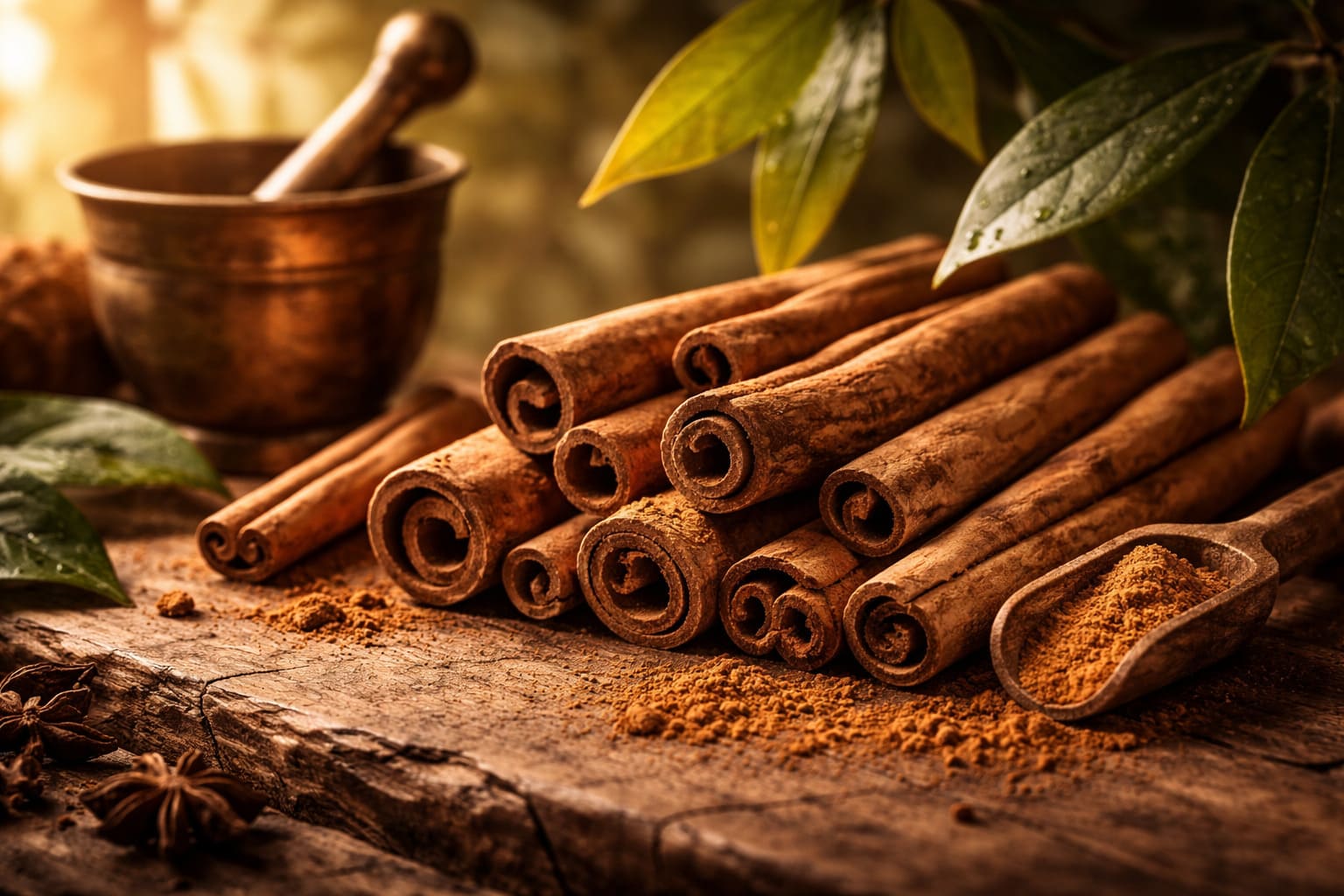
Cinnamon is the dried inner bark of trees in the genus Cinnamomum, and its history is mostly a history of who controlled the supply. "True" cinnamon, Cinnamomum verum, comes from Sri Lanka and southern India. Egypt was importing it by about 2000 BC, Rome paid fortunes for it, and Portuguese, Dutch and British traders in turn fought over the island that grew it.
What were the Egyptians doing with cinnamon in 2000 BC?
Cinnamon reached Egypt as early as about 2000 BC, and the Egyptians used it to embalm mummies. From the Ptolemaic period on, it went into kyphi, an incense. How it got there is murkier. Later writers placed it in China or Arabia, and the muddle comes partly from confusing true cinnamon with its relative cassia, Cinnamomum cassia, which grows in China.
That confusion was not an accident of ignorance alone. Whoever carried the bark had every reason to keep buyers guessing about where it grew.
Giant birds, winged serpents and a Roman correction
Herodotus, in the fifth century BC, put cinnamon and cassia in Arabia, guarded by winged serpents, and repeated a tale of giant "cinnamon birds" that built their nests from the sticks. Pliny the Elder, writing in the first century AD, did not buy it. He called the bird stories an invention of traders meant to raise prices, and described cinnamon being carried around the Arabian Peninsula on rafts, using the winter trade winds.
The prices were real enough. Pliny reported that a Roman pound of cinnamon or cassia could cost up to 1,500 denarii, about fifty months of labour. In 301 AD Diocletian's Edict on Maximum Prices capped a pound of cassia at 125 denarii, at a time when it listed an agricultural labourer's pay at 25 denarii a day. That is five days of wages for the cheaper, coarser cousin.
Did Nero really burn a year of cinnamon?
The usual story says that at the funeral of his wife Poppaea Sabina in AD 65, Nero burned a year's supply of the city's cinnamon. The sources say "reportedly", and so should we. Nobody has an inventory of Rome's cinnamon stores for AD 65, so treat the story as a measure of how Romans thought about the spice, not as an accounting. What the price figures above show is that burning it would have meant burning something close to a fortune.
The long guess about where it grew
For the next thousand years Europeans mostly did not know. The French chronicler Joinville, in 1248, reported that cinnamon was netted at the source of the Nile. Marco Polo avoided specifics. The first mention of it growing in India is credited to Maimonides, around 1180, and by about 1270 and 1292 the writers al-Qazwini and John of Montecorvino were linking it to Sri Lanka.
Meanwhile Venetian traders controlled its distribution out of Alexandria. When the Mamluks and Ottomans disrupted that trade, it became one of the pressures that pushed Europeans to look for sea routes to Asia. The same pressure drove the hunt for black pepper, and the overland side of the story is told in Silk Road foods.
Portugal, then the Dutch, take the island
In the 1500s the Portuguese controlled Sri Lankan cinnamon. Ferdinand Magellan, sailing for Spain, found a closely related species in the Philippines, which later competed with the Sri Lankan product.
The Dutch arrived in 1638, when they set up a trading post on the island. In that year they also signed a treaty with Rajasinghe II, king of Kandy, and the encyclopedia article on Kandy credits that treaty with leading to the Portuguese expulsion. The Dutch captured Galle in 1640 and, by 1658, the Portuguese were gone. The Dutch East India Company then reformed the wild harvest and began growing its own trees.
Kandy did not stay a friend. Under the settlement the Dutch were allowed to peel cinnamon in Kandyan lands without paying for it, and Kandyan chiefs later encouraged or backed rebellions by cinnamon peelers in Dutch territory. Those revolts helped lead to the Kandy-Dutch war of 1761 to 1766.
What happened to the Kandy deal and the British takeover
The Kandyan side of the story keeps the dates straight. Portugal had been in Ceylon since the early sixteenth century, annexed the Jaffna kingdom in 1621 and tried to occupy Kandy, but Kandyan guerrilla fighting in the mountains beat it back. After the Dutch took Galle in 1640 they also took Kalpitiya harbour, which Kandy considered a breach of the 1638 treaty. The Dutch answered that they were owed for helping against the Portuguese. In 1796 the English East India Company took over the Dutch possessions, and in 1815 the Kandyan Convention ceded Kandy to the British.
British hands and a Kerala estate
In 1767 Lord Brown of the British East India Company founded the Anjarakkandy estate in Kerala, India, which later became Asia's largest cinnamon estate. The British took Ceylon from the Dutch in 1796. By then the idea of a single island holding a spice hostage was fading, because the bark could be grown and bought elsewhere. Sugar, tea and vanilla were going through their own versions of the same shift.
Cinnamon or cassia: what is in the jar?
Most of what is traded internationally today is cassia, from C. cassia or related species such as C. burmanni, C. loureiroi and C. citriodorum. Ceylon cinnamon has thin bark and a lighter colour. Cassia bark is thicker, about 2 to 3 millimetres. The two get sold under one name, and testing of market samples has suggested that some "Ceylon" cinnamon is actually adulterated with cassia.
The 2023 production figures show how far the map has moved. The world total was 238,403 tonnes. China produced 91,892, Vietnam 65,341, Indonesia 55,213 and Sri Lanka 22,410. Those four countries made about 98 percent of it, and the island that once decided Europe's prices came fourth.
Questions people ask
Where does true cinnamon come from?
True cinnamon, Cinnamomum verum, comes from Sri Lanka and southern India. It is the dried inner bark of the tree. In 2023 Sri Lanka produced 22,410 tonnes of the world's 238,403 tonnes of cinnamon and cassia combined, far less than China, Vietnam or Indonesia.
What is the difference between cinnamon and cassia?
Cassia comes from Cinnamomum cassia and related species grown mainly in China and Southeast Asia. Its bark is thicker, about 2 to 3 millimetres, while Ceylon cinnamon has thin bark and a lighter colour. Most cinnamon traded internationally today is cassia, not Ceylon cinnamon.
How expensive was cinnamon in ancient Rome?
Pliny the Elder reported that a Roman pound of cinnamon or cassia cost up to 1,500 denarii, about fifty months of labour. Later, in 301 AD, Diocletian's price edict capped a pound of cassia at 125 denarii, when an agricultural labourer earned 25 denarii a day.
Who controlled the cinnamon trade in Sri Lanka?
The Portuguese controlled Sri Lankan cinnamon in the 1500s. The Dutch East India Company set up a post in 1638 and had expelled the Portuguese by 1658, then began cultivating its own trees. The British took Ceylon from the Dutch in 1796.
Filed under Trade Routes
Want more stories like this?
One food history story, every week. No spam, just the stories behind what the world eats.