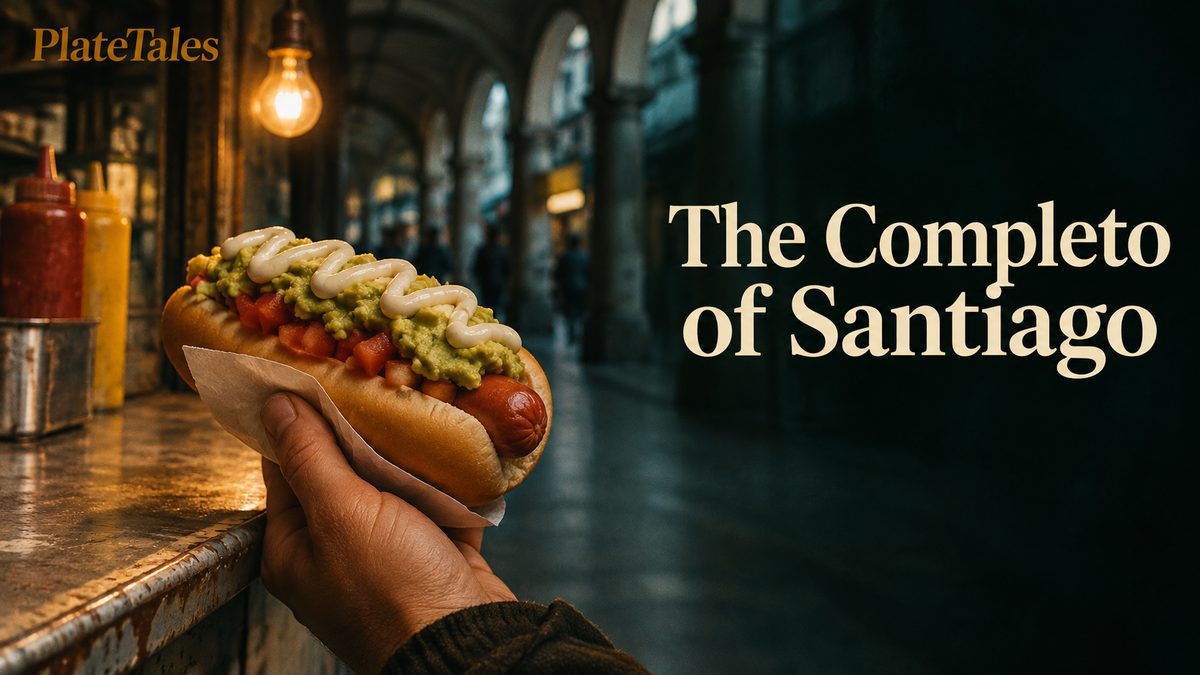
The completo, Chile's loaded hot dog, has a traceable history: it began in the 1920s or 1930s in central Santiago, where a restaurateur named Eduardo Bahamondes brought the American hot dog home from a trip to the United States and then changed it until Chileans would eat it. The avocado, tomato and mayonnaise that now define the dish were his answer to a public that did not take to the plain original.
The exact year is the weak point. Sources split between 1920 and 1930, and none of the pages we could read gives a document that settles it.
Who was Eduardo Bahamondes?
Not much is written about him as a person. The tourism page for Santiago names him Eduardo Bahamondes Muñoz and says he travelled to the United States, learned of the hot dog there and carried the idea back to Chile. Accounts say he had gone on business and saw the "hot dog" there, which is the same trip the tourism page describes, told in fewer words.
A historian at the University of Santiago, Cristóbal García-Huidobro, tells it a little more precisely in an article for Diario Usach. According to that account the owner of Quick Lunch Bahamondes had visited New York, where he saw sausages served on bread, and he called the long roll a "flauta" (flute).
Completo history at the Portal Fernández Concha
Back in Santiago he opened a place called Quick Lunch Bahamondes at the Portal Fernández Concha, the arcade that faces the Plaza de Armas. The English name was deliberate: the whole idea was an American-style counter meal, eaten fast.
This is where the date argument matters. The tourism page puts Bahamondes's trip and the start of the business in 1930. The Usach article ties the arrival of the hot dog in Chile to 1920. Another account says only that the completo first appeared in the 1920s in the soda fountains (fuentes de soda) of central Santiago. A fair summary is that the dish dates to between about 1920 and 1930, and that the later date is tied to the restaurant itself.
Chilean hot dog history: why the plain one failed
The original version did not suit Chilean tastes. That is the part every source agrees on. Bahamondes answered by piling on tomato and avocado, and the public gradually accepted it. The classic completo is built from chopped tomato, plenty of mayonnaise, sauerkraut and a sauce called salsa americana, all on top of the sausage and the bun.
Sauerkraut, or chucrut, was already in Chile because of German immigrants in the 19th century, so a topping that looks like an import was in fact local by then. Another point from the Usach historian: other restaurants copied the preparation, and that copying is what made it popular. He also insists that "el completo, es un sándwich", which is a claim about what the food is and not about where it came from.
A completo is also big, and that is part of its appeal: one can be twice the size of an American hot dog.
Why it is called the italiano
The version most people order now is the completo italiano, or just the italiano. It carries chopped tomato, mashed avocado and mayonnaise, and its name comes from the resemblance of red, green and white to the colors of the Italian flag.
The Santiago tourism page adds a claim about who made it: it credits the "Italiano Chileno" to the Italian-Chilean Devillaine family. After the founder died, the page says, the business became a cooperative that could not keep going, and it was sold to a family led by José Devillaine, who already ran restaurants. The page gives no dates for any of this. So the avocado-and-tomato idea is attributed to Bahamondes by some accounts, while the italiano name and its refinement are credited to the family that later owned the place. Those two accounts do not necessarily conflict, but we found nothing that separates them.
The restaurant still exists as El Portal Ex Bahamondes, and the Usach article lists it as a place that still serves the dish.
The family of completos
The italiano is one branch. The others:
| Name | What is on it |
|---|---|
| Completo | tomato, plenty of mayonnaise, sauerkraut, salsa americana |
| Dinamico | tomato, avocado, mayonnaise, sauerkraut or salsa americana |
| A lo pobre | fried onion, french fries, fried egg |
| Tomate mayo | only tomato and mayonnaise |
| As (or chilenito) | grilled beef, chicken breast or pork loin instead of a sausage |
The "a lo pobre" name is borrowed from lomo a lo pobre, a dish associated with low-wage workers. Chile has the third-highest per capita mayonnaise consumption in the world, which fits a topping so heavy on it, and people often prefer mayonnaise made at home. Homemade versions sometimes use a marraqueta, split lengthwise, in place of the standard bun.
If the hot dog's own history interests you, the story of how the hot dog developed in America is the other half of this one. The completo also fits the pattern in how immigration changed American food: a dish crosses a border, meets a different public and becomes something new. And sausage in a roll has a long relative in the sandwich.
A holiday invented by a hot dog chain
Chileans celebrate the Dia del Completo every May 24. It sounds ancient. It is not. According to Days of the Year, the day began in 2009, when the fast-food chain Dominó proposed a special day to promote its completos, and it caught on across the country. Diario Usach connects the date to the 1920 arrival of the hot dog, though the chain's own origin for the holiday is the one with a stated year.
Dominó still turns up in the Usach list of places worth visiting, described as constantly creating new completo variations. Fuente Suiza in Nunoa and La Antigua Fuente on the Alameda, which makes its own mayonnaise, are named alongside it.
Questions people ask
What is in a completo italiano?
A completo italiano is a Chilean hot dog in a bun topped with chopped tomato, mashed avocado and mayonnaise. It is the most popular version of the completo. The three toppings are red, green and white, which is where the name comes from.
Why is the Chilean hot dog called italiano?
The Chilean completo italiano is named for its colors. Chopped red tomato, green avocado and white mayonnaise resemble the Italian flag. A Santiago tourism page separately credits the Italian-Chilean Devillaine family, who later owned the original restaurant, with the "Italiano Chileno."
When is Dia del Completo in Chile?
Dia del Completo falls on May 24 each year in Chile. Days of the Year says it began in 2009, when the Dominó fast-food chain proposed a day to promote its completos. It is a promotional holiday that caught on, not an official historical anniversary.
Where was the first completo served?
The first completo is traditionally placed at Quick Lunch Bahamondes, a restaurant at the Portal Fernández Concha facing the Plaza de Armas in Santiago. Its owner, Eduardo Bahamondes, had seen hot dogs in the United States. The restaurant survives today as El Portal Ex Bahamondes.
Filed under Migration Stories, Street Food
Want more stories like this?
One food history story, every week. No spam, just the stories behind what the world eats.