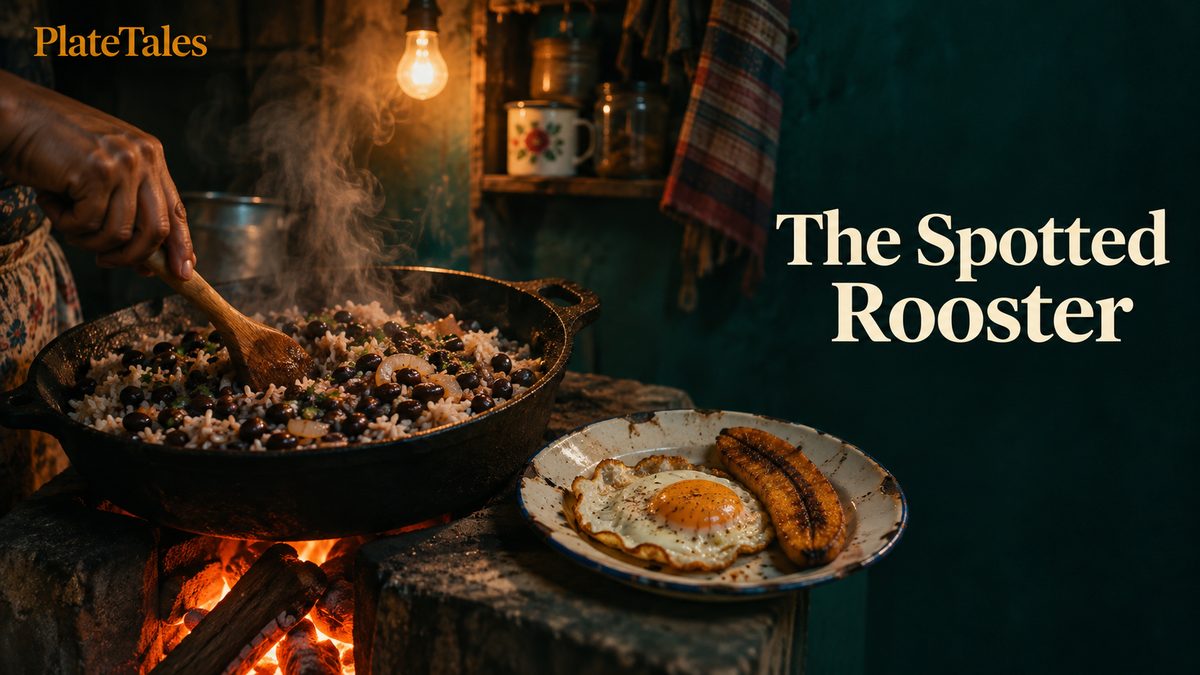
The gallo pinto origin is disputed, and the honest answer is that neither Costa Rica nor Nicaragua can prove it invented the dish. Most accounts agree on one point: rice and beans cooked together came to Central America with Afro-Caribbean cooking, and both countries then made the result their own. Each tells a different, tidier story about where the name and the habit began.
What gallo pinto is, and why the name is odd
Gallo pinto means "spotted rooster" in Spanish. The name describes the look of white rice stained by black or red beans, a speckled mix that someone once compared to a bird's feathers. That explanation is the usual one, but it is an anecdote. Accounts differ on the origin of the word, and the Royal Spanish Academy accepts both spellings: the one-word gallopinto is preferred in Nicaragua, the two-word form in Costa Rica.
The dish itself is simple. Rice and beans are fried together, usually with onion, and eaten most often at breakfast with eggs, cheese or sour cream, and tortillas or fried plantain. In both countries it is called a national dish, and people on both sides take that seriously.
Three ingredients, three continents
Beans came from the Americas, where Indigenous farmers had grown them long before any European arrived. Rice began in Asia and reached Spain through the Arabs, appearing in Spanish recipes of the 15th and 16th centuries. Spanish colonists carried it across the Atlantic. By the 18th century, rice growing had gained some importance in Central America.
The third ingredient is a method, and it is the one most often credited to Africa. Rice has been grown in West Africa for a very long time, and rice with beans is still a normal breakfast in Ghana and parts of West Africa. The dish has a whole family of relatives around the Atlantic: moros y cristianos and congri in Cuba, casamiento in El Salvador and Honduras, tacu-tacu in Peru, Hoppin' John in the American South, and feijoada in Brazil, a related but different dish. Gallo pinto sits in that family. Nobody has found a single document that says "here, on this date, it began."
The Afro-Caribbean thread
The anthropologist Theresa Preston-Werner traced the social history of gallo pinto in a 2009 article on Costa Rican foodways. As summarized by Travel Noire, she places the start of the dish on plantations along the Caribbean side of Costa Rica and Nicaragua, among Africans brought from West Africa, from places such as Senegal, Gambia, Ghana, Guinea and Benin. Other historians cited in the same piece point to waakye, a Ghanaian dish of rice cooked with red or black-eyed beans, as a possible ancestor.
The date in that summary, the 17th century, deserves some caution. It comes through a travel-site retelling rather than the paper itself, and the later, better-documented arrivals are the 19th-century ones. Jamaican and other Caribbean workers came to Costa Rica from the 1870s to build the railway to the Atlantic coast. They settled around Limón, which still has the country's largest Afro-Caribbean population. On that coast the dish is called "rice and beans," and it is cooked with coconut milk and habanero chile. It was once the Sunday and special-occasion lunch in Limón.
That is not quite the same plate as the gallo pinto of San José, and the difference matters. It suggests two related dishes that later merged in the national imagination, with the Atlantic coast version keeping its own name and its own pot. Travel Noire adds that people in the region often overlook or play down the African part of the story. If you want the wider pattern of rice-and-bean dishes following enslaved and migrant cooks, our piece on jollof rice follows a related West African trail.
The Costa Rican story: a hen in San Sebastián
Costa Rica's favorite explanation is a good one, and it has a place and a saint. A farmer in San Sebastián, a district of San José, planned to kill a speckled hen for the feast day of Saint Sebastian. Friends and neighbors heard about it and took it as an invitation to dinner. One hen would not feed them all, so he served rice and beans instead. The neighbors laughed about it, the joke stuck, and the name spread across the country.
Costa Rica's account ties the dish to the 1930s in San José. Preston-Werner's view is that whether the story is literally true matters less than what it says about how Costa Ricans wanted to explain their own food. A tale set in a Hispanic, central-highland village has no Caribbean coast in it at all. That may be the point of telling it.
The Nicaraguan story: older, and from the coast
Nicaragua's account runs the other way. It holds that a dish of this kind arrived much earlier, brought by enslaved Africans, and so predates any 1930s San José anecdote. Nicaragua cooks it mainly with red beans known locally as seda ("silk"), long-grain white rice, and onion sautéed in vegetable oil. It is the main side dish at fritangas, the stands that sell fried and grilled food, and it is regarded as national heritage. Day-old rice is common, and sour cream, tortilla, eggs and cheese often come with it.
On Nicaragua's own Caribbean coast, the dish is again called rice and beans and made with coconut milk. So both countries have the same two-track pattern: a coastal version with coconut, and a Spanish-speaking interior version without it.
A novel from the banana coast
The earliest literary evidence usually named is the novel Mamita Yunai by the Costa Rican writer Carlos Luis Fallas. It follows Costa Rican and Nicaraguan laborers on banana plantations, and the dish appears there as something workers met on the coast and carried home. Preston-Werner argues that its presence in the book shows rice and beans was everyday food on the Caribbean coast by the early 20th century. That is a useful date because it is a document, but it does not say who cooked the dish first. It shows workers from both countries eating it side by side.
Regional versions inside Costa Rica
Even within one country, the dish is not one thing. In the Valle Central, gallo pinto is moister and less greasy, usually made with black beans, chile, culantro and onion, and often finished with Salsa Lizano. The Lizano company created that sauce in 1920, and by one account it has become part of the dish's identity. In Guanacaste, near the Nicaraguan border, the dish is greasier and toastier, usually made with red beans, more lard and garlic, and no culantro. By one account, the style traces to Spanish conquistadors who entered through Nicoya from Nicaragua. A Costa Rican gallo pinto, in other words, already contains a Nicaraguan one.
The Gallo Pinto War
The argument eventually left kitchens and entered government publicity. In 2003 Costa Rica cooked and served nearly 1,000 pounds of gallo pinto, and the event was recorded in the Guinness Book of World Records. Nicaragua answered with a 1,200-pound batch. The rivalry, sometimes called the Gallo Pinto War, became an annual Gallo Pinto Day. Neither country has produced a document that settles the older question, so the record pots remain the only contest with a clear measurement.
Questions people ask
Is gallo pinto from Costa Rica or Nicaragua?
Both countries claim gallo pinto, and no source settles it. Costa Rica's story places it in 1930s San José, around a speckled hen in San Sebastián. Nicaragua says a similar dish came much earlier with enslaved Africans. Most accounts agree the roots are Afro-Caribbean, so the dish belongs to a wider region.
Who invented gallo pinto?
No one person is known to have invented gallo pinto. The Costa Rican tale of a farmer in San Sebastián, San José, who served rice and beans instead of a hen is a folk story, not a documented event. Researchers such as Theresa Preston-Werner trace the dish to Afro-Caribbean cooks on the Caribbean coast of Central America.
What does gallo pinto mean?
Gallo pinto means "spotted rooster" in Spanish. The usual explanation is that white rice mixed with black or red beans looks speckled, like a bird's feathers. This is an anecdotal explanation, and accounts differ on the true origin of the name. The dish is sometimes shortened to pinto.
How does Nicaraguan gallo pinto differ from the Costa Rican kind?
Nicaraguan gallo pinto is traditionally made with red beans called seda, long-grain rice and onion cooked in vegetable oil, often with day-old rice. Costa Rica's Valle Central version usually uses black beans, chile, culantro and onion, often finished with Salsa Lizano. Guanacaste in Costa Rica prefers red beans and more fat.
Did Nicaragua or Costa Rica set the gallo pinto record?
In 2003 Costa Rica served nearly 1,000 pounds of gallo pinto, recorded in the Guinness Book of World Records. Nicaragua then prepared 1,200 pounds in reply. The contest became an annual Gallo Pinto Day, and the rivalry is sometimes called the Gallo Pinto War.
Filed under Origin Stories, Cultural Identity
Want more stories like this?
One food history story, every week. No spam, just the stories behind what the world eats.