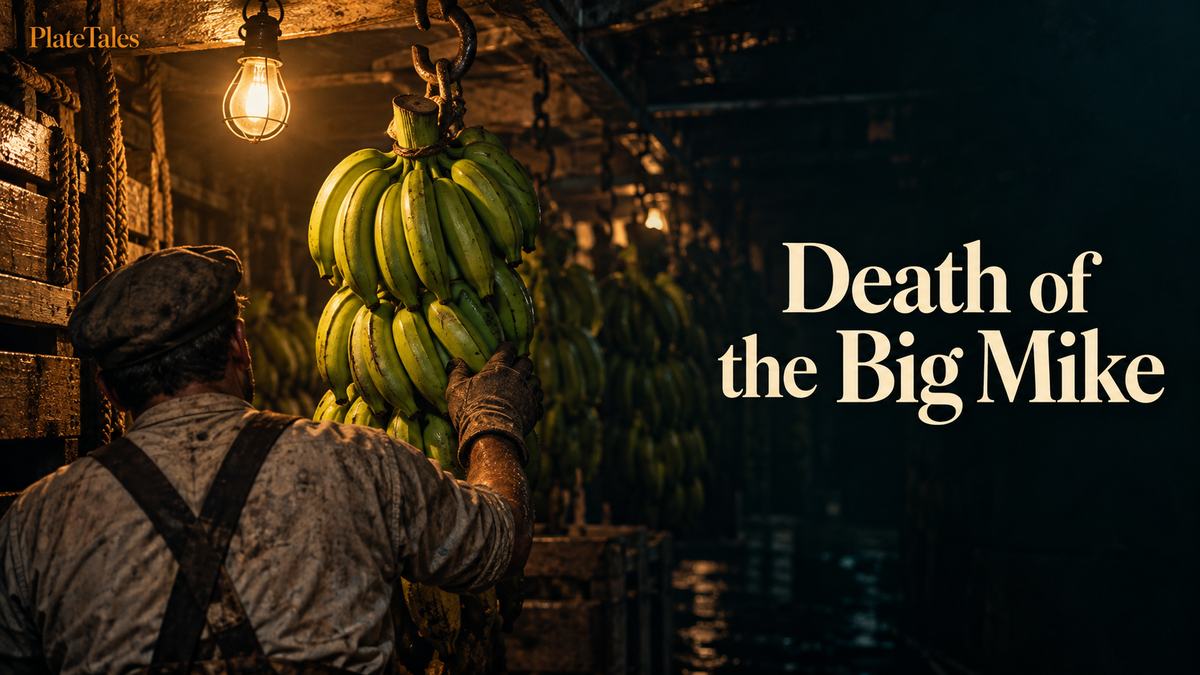
Bananas changed because a soil fungus killed the old one. Until the late 1950s, the banana in American and European shops was the Gros Michel. Panama disease made it impossible to grow on the big export plantations, and the trade switched to the Cavendish, a variety named for the Duke of Devonshire after his head gardener, Joseph Paxton, got one to flower in a Chatsworth hothouse in 1835.
So the banana on your counter is a different fruit from the one your great-grandparents peeled. The old one came in huge bunches of large fruit with a skin that could take rough handling. The new one bruises easily, which changed how bananas are shipped and sold.
Why did bananas change in the 1950s and 1960s?
The short version is money and dirt. The first export plantations in Central America were cut out of rainforest on well-drained river soils, and they were planted almost entirely with Gros Michel. The plant pathologist Randy Ploetz, in a 2005 history for the American Phytopathological Society, writes that "in many ways, Gros Michel is an ideal export banana."
The bunches were so tough that they could be shipped whole. A photo in his paper shows Gros Michel stems being sold off a wagon in the United States, still whole. The fruit was not cut from the bunch, into the smaller clusters called hands, until the customer bought it.
Its weakness was a fungus, now called Fusarium oxysporum f. sp. cubense (the "f. sp." marks a strain that attacks one particular host). It lives in the soil, gets into the plant through the roots, and once a field is infested it stays infested. Ploetz's figures are grim. Between 1940 and 1960, 30,000 hectares (about 74,000 acres) were lost in the Ulua Valley of Honduras.
Operations of 4,000 hectares in Suriname and 6,000 hectares around Quepos in Costa Rica were completely lost within a decade. Counting losses up to 1960 plus the cost of setting up the plantations, he puts the damage at about $400 million.
For decades the companies dealt with it by moving. They abandoned the infected farm, cleared new forest, planted Gros Michel again and waited for the fungus to arrive. By the 1950s, Ploetz writes, most first-class banana soils were infested and untouched land was becoming rare. There was nowhere left to move to.
When exactly did the switch happen?
The sources do not agree, which is why search results give everything from the late 1950s to 1965. ProMusa, the banana research network, says Gros Michel was replaced in the late 1950s. Dan Koeppel, writing in Popular Science in 2005, says it filled American cereal bowls "until the early 1960s."
Ploetz says the transition "started in the mid-1900s" and that it coincided with the 1962 publication of Robert Stover's monograph on the disease. It was a rolling change, company by company and farm by farm. A range of late 1950s to early 1960s is as precise as the evidence allows.
What happened to the Gros Michel banana?
It did not go extinct. "Gros Michel still exists. It hasn't vanished from the face of the earth," the flavor historian Nadia Berenstein told Science Friday in 2017. It is still grown in Central America on land the fungus has not reached. What vanished was its place in the export trade.
How it reached the Americas is a thinner story. The usual account, which traces back to Koeppel's 2008 book Banana, says the French naturalist Nicolas Baudin left corms (the underground stems bananas grow from) at a botanical garden on Martinique. In 1835 a French botanist, Jean Francois Pouyat, is said to have carried the fruit on to Jamaica.
It was first called "Figue Baudin" and later "Poyo", after its importer. Where the name Gros Michel ("Big Mike") came from, nobody knows.
The disease was found in Australia first
The fungus was recorded long before it ruined Central America. In 1876 J. Bancroft, in a report for the government of Queensland in Australia, guessed from his microscope work that a fungus was to blame. He also warned that healthy-looking suckers could carry it.
In 1910 Erwin F. Smith isolated the fungus from banana tissue sent to him from Cuba and named it Fusarium cubense, after the island. The name Panama disease came later. Panama, Ploetz notes, was one of the first countries hit by a major epidemic.
Why was every plant a copy of the last one?
Commercial bananas are triploids, meaning they carry three sets of chromosomes instead of the usual two. They cannot reproduce sexually and have no working seeds. So growers plant suckers, the shoots that sprout from the base of an existing plant.
Every Gros Michel on every plantation was genetically the same plant. A fungus that could kill one could kill all of them. Bancroft's warning about suckers turned out to be the whole problem in small: the planting material carried the disease from farm to farm.
Where did the Cavendish banana come from?
The Cavendish name goes back to Chatsworth House in Derbyshire. Chatsworth's own account says Paxton, head gardener to the 6th Duke of Devonshire, obtained a specimen imported from Mauritius around 1830. He grew it in a heated pit of loam and well-rotted dung, and in 1835 "it finally flowered."
The crop came the following May, and one banana won a medal at that year's Horticultural Society show. Paxton named the plant Musa cavendishii after his employers, and ProMusa dates the published name to 1837, in Paxton's Magazine of Botany. The Duke later sent two cases of plants with a missionary bound for Samoa.
There is a good legend attached. Paxton is supposed to have been inspired by a banana painted on the Chinese wallpaper in one of the bedrooms. In 2013 a botanist at the Royal Botanic Garden Edinburgh identified the painted plant as Musa coccinea, an ornamental banana with no edible fruit. Chatsworth itself now calls Paxton's interest in exotic plants the "much more likely" explanation.
Chatsworth also claims that almost every banana eaten in the Western world descends from a plant grown there. Treat that one with care. Other accounts hold that bananas reached the Canary Islands, an early source of Britain's supply, with Portuguese sailors in the fifteenth century. Paxton named and publicized the variety. Whether his plant is the literal ancestor of the supermarket banana is not established.
What is established is why the trade wanted it. The Cavendish resists Race 1, the strain of the fungus that destroyed Gros Michel. It is also more delicate, and switching to it rebuilt the business.
Bunches now had to be cut into hands at packing plants, washed, sprayed and boxed, far gentler treatment than throwing whole stems into a ship's hold. The cardboard box of bananas is, in a real sense, a product of Panama disease.
Why does banana flavoring not taste like banana?
The popular answer is that banana candy was modeled on the Gros Michel, so it tastes like a fruit we no longer eat. The chemistry gives the theory a little support. Gros Michel contains more isoamyl acetate, the compound that does most of the work in artificial banana flavor, than the Cavendish does.
The dates do not support it. Berenstein, who has worked through nineteenth-century flavor trade literature, found banana flavor formulas from the 1860s and advertisements for fruit essences, banana among them, from the early 1850s. That is well before most Americans had tasted a fresh banana.
Early flavor chemists were not copying any particular variety. They mixed compounds that smelled fruity, and the label was partly marketing. British noses linked isoamyl acetate to the Jargonelle pear, while American suppliers sold it as banana flavor. The candy tastes like a nineteenth-century idea of banana, which happens to sit a little closer to the Gros Michel.
Where does the phrase "banana republic" come from?
The fruit companies did more than grow bananas. Minor Keith began building railroads in Costa Rica in 1871 and planted bananas along the tracks. He married the daughter of the country's president, was called "The Uncrowned King of Central America", and was a founder of the United Fruit Company.
Ploetz writes that the company was "especially notorious for meddling in national politics." In the worst cases, elected presidents who opposed it were replaced in coups.
The phrase itself came from fiction. William Sydney Porter, who wrote as O. Henry, fled Texas in July 1896 rather than stand trial over missing bank funds, and spent about six months in Honduras, until January 1897. In Cabbages and Kings, published in 1904, he set his stories in an invented country called Anchuria.
In the chapter "The Admiral" he writes of "this small, maritime banana republic," whose forgotten constitution required a navy it did not have. By 1950 Pablo Neruda had made the company itself the target of his poem "La United Fruit Co." in Canto General. The phrase now means any unstable country that lives off one export and the foreign firms that buy it.
Are bananas going extinct now?
Not as a fruit, but the Cavendish is in the position Gros Michel was in. Ploetz wrote in 2005 that after decades of Cavendish growing well in the old Gros Michel soils, it had been presumed highly resistant. "This illusion was shattered in the early 1990s," when a new strain, Tropical Race 4 (TR4), struck Cavendish plantations in Sumatra and peninsular Malaysia.
In 2005, before the new strain had reached the Americas, Ploetz told Popular Science: "Given today's modes of travel, there's almost no doubt that it will hit the major Cavendish crops." On August 8, 2019, Colombia's agriculture authority confirmed TR4 in La Guajira on the Caribbean coast, after samples were tested in the Netherlands.
Six farms were quarantined and most plants on 175 hectares were destroyed. It was the first official report in Latin America. In April 2021 the fungus turned up on a half-hectare organic farm in Piura, and Peru declared a national emergency.
Like the potato in Europe, the banana is planted from pieces of itself rather than from seed, which leaves a whole crop open to one disease. The plantation system it grows in is the same kind that built the Caribbean sugar islands. Breeding a new seedless banana that shippers will accept is slow work, and the Gros Michel planters already learned that infested soil cannot simply be replanted.
Back in Derbyshire, Chatsworth still grows bananas under glass. Its plants produce between 30 and 100 bananas a year.
Questions people ask
Is the Gros Michel banana extinct?
No. The Gros Michel still exists and is still grown in Central America on land the fungus has not reached. What vanished was its place in the export trade, which moved to the Cavendish by the late 1950s and early 1960s after Panama disease ruined the big plantations.
What is Panama disease in bananas?
Panama disease is caused by a soil fungus, Fusarium oxysporum f. sp. cubense. It enters the banana plant through the roots, and once a field is infested it stays infested. It wrecked Gros Michel plantations in Honduras, Suriname and Costa Rica, and Ploetz puts the damage up to 1960 at about $400 million.
Why is the Cavendish banana now at risk?
Commercial bananas are planted from suckers, so every plant is a genetic copy of the last. The Cavendish resists Race 1, the strain that destroyed the Gros Michel, but a new strain, Tropical Race 4, struck plantations in Sumatra and Malaysia in the early 1990s and was confirmed in Colombia in 2019.
Is artificial banana flavor based on the Gros Michel?
Probably not. The Gros Michel does contain more isoamyl acetate, the main compound in artificial banana flavor, than the Cavendish. But flavor historian Nadia Berenstein found banana flavor formulas from the 1860s and advertisements from the early 1850s, long before most Americans had tasted a fresh banana, so chemists were not copying any one variety.
Filed under Trade Routes, Forgotten Recipes
Want more stories like this?
One food history story, every week. No spam, just the stories behind what the world eats.