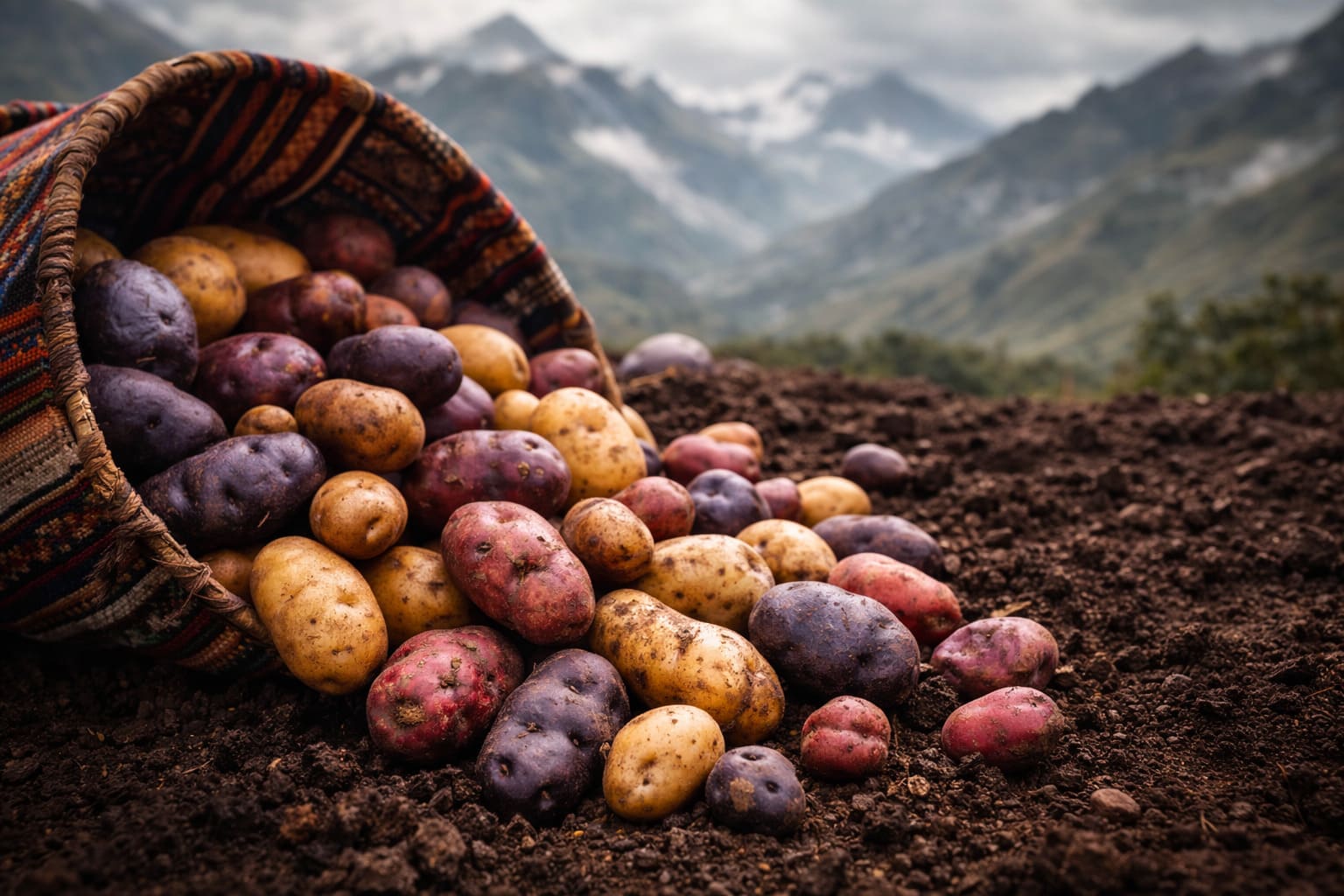
Potatoes arrived in Europe from the Andes in the second half of the 16th century, and their history in Europe is a slow story: two centuries as a garden curiosity and famine food, then a rapid rise into a staple, most dramatically in Ireland, where dependence on one crop ended in the famine of the 1840s. Several of the best-known tales about that rise are legends.
From the Andes to a Spanish port
The potato was domesticated by Indigenous peoples of the central Andes, probably more than 7,000 years ago according to Britannica, which describes hundreds of varieties adapted to different elevations and a freeze-dried form called chuno that could be stored for years and carried on long journeys and military campaigns. Spanish soldiers met the crop in the 1530s. A military report of 1537 is the first European mention, and in 1552 Gonzalo Jimenez de Quesada described "a type of truffle" in houses in what is now Colombia.
The arrival date in Europe is fuzzy. The potato reached Spain around 1570 and the British Isles between 1588 and 1593. The earliest written trace is a delivery receipt dated 28 November 1567 for a shipment from Las Palmas in the Canary Islands to Antwerp. The record is a shipping receipt, not a celebration.
Why it took two centuries to catch on
The usual explanation is fear. The potato belongs to the nightshade family, and Europeans did call it a devil's plant in places. But the plant also fit badly into the way farming worked. In northern Europe, open-field customs tied farmers to grain on shared strips, which left potatoes to the small garden plot. For a long time they were grown as a novelty in botanical gardens, as fodder for animals, or as something to eat when bread ran out.
Some of the colorful reasons given for the delay are weaker than they look. A widely repeated claim says the parliament of Besancon banned potatoes in 1630 because they supposedly caused leprosy. Accounts of the life of the French potato promoter Antoine-Augustin Parmentier find no primary source for any such French ban. The old claim that Scottish ministers rejected the potato because the Bible never mentions it could not be confirmed in any source read for this article, so it stays out.
What the evidence does show is a shift after about 1750. Officials and landowners in France and the German states began turning fallow land into potato fields. Famines in the early 1770s, government pressure and cold-climate losses to other crops all pushed the same way. Britannica puts the Irish milestone earlier: by the end of the 17th century the potato was a major crop in Ireland, and by the end of the 18th it was one in continental Europe, particularly Germany.
Frederick the Great did not bring the potato to Prussia
In Germany he is Der Kartoffelkonig, the Potato King, and visitors still leave raw potatoes and paper crowns on Frederick the Great's grave at Sanssouci in Potsdam. The story is that peasants would not touch the tuber, so Frederick posted guards around a royal potato garden and pulled them back at night, letting locals steal what looked like a prized crop.
Jurgen Luh, a historian at the Prussian Palaces and Gardens Foundation, told the Associated Press in 2025 that the guarded-garden tale is nonsense. Potatoes had been grown in Bavaria since 1647, he said, and Frederick's great-grandfather, the Elector Frederick William, brought them to Brandenburg in the 1650s, reportedly for the look of the leaves. Royal menus show Frederick preferring Italian food and French wine. "He never ate it," Luh said.
The king did issue decrees. Fifteen are on record, starting on 9 April 1746 in response to famine in Pomerania, and the best known is a circular of 24 March 1756 to officials in Silesia. Later ones came with growing instructions and recipes, and pastors were pressed into spreading the word. The effect was limited. Luh says the potato did not become widespread in Prussia and central and eastern Europe until after the Napoleonic wars ended in 1815, decades after Frederick died in 1786.
Parmentier and the field at Neuilly
Parmentier is the French counterpart, and his story has more solid ground. An army pharmacist in the Seven Years' War, he was captured by the Prussians and ate potatoes in captivity, at a time when the French mostly knew them as pig feed. He proposed potatoes as food in a contest run by the Academy of Besancon, dated 1772 with the prize in 1773, and the Paris Faculty of Medicine declared them edible in 1772. In 1774 he published a chemical study of the potato.
His publicity is where the legends gather. Parmentier did get 54 arpents of poor ground near Neuilly, and he did give bouquets of potato blossom to the king and queen. He is also said to have held dinners attended by Benjamin Franklin and Antoine Lavoisier. But the best-known trick, guards who accepted bribes so that locals could steal cuttings, was credited to him only after his death, by Julien-Joseph Virey, and accounts of his life call it almost certainly untrue, since the same ruse is attributed to other people.
What helped more than any stunt was hunger. A year of bad harvests in 1785 showed northern France that potatoes could stand in for bread. Parmentier's name now lives on in hachis Parmentier, the French cottage pie.
Did the potato really change Europe's population?
Historians do credit the potato with supporting population growth, and it is easy to see why: it produced a lot of food on small plots, and it grew in places where grain was risky. The Britannica entry says its spread helped diversify diets and supported agricultural and population growth. It is harder to find a clean number. Claims that Europe's population tripled because of potatoes, or that one acre fed a family of six, circulate without a source, so this article leaves them out. The solid figures come from Ireland, where the 1841 census counted just over 8 million people, with the potato covering about a third of arable land by 1845.
Elsewhere the crop arrived late. In Russia, peasants and landlords took to planting potatoes in fallow fields after a grain failure in 1838-39. The potato's biggest effect on Europe was often not triumph but insurance, a second crop for years when the first one failed. For more on how wars and shortages shape what people eat, see wartime foods history and siege food history.
Ireland, 1845: one variety, one disease
Ireland took the potato further than any other country. Cultivation leaned heavily on a single high-yielding but bland and blight-prone variety called the Lumper, and genetic variety was low. The water mold Phytophthora infestans spread through the Americas and reached Europe in 1844. On 13 September 1845 the Gardeners' Chronicle announced it in Ireland. Estimated crop loss in 1845 was between a third and a half of cultivated acreage, and in 1846 about three-quarters of the harvest was lost.
The Great Famine of 1845 to 1849 killed about one million people and sent at least another million abroad. Between 1845 and 1855, at least 2.1 million people left Ireland, and in the worst year about 250,000 emigrated. The population fell by 20 to 25 percent between 1841 and 1871. Many of those emigrants went west, a flow explored in how immigration changed American food.
The blight was a natural disaster; the scale of the deaths was a matter of policy. Prime Minister Robert Peel secretly bought about 100,000 pounds of American maize in November 1845, but the cornmeal was hard to mill and the poor called it Peel's brimstone. Lord John Russell's government, which took over in June 1846, refused to block food exports to England on laissez-faire principles. In January 1847 it turned to workhouse relief and soup kitchens, and in June 1847 the Poor Relief (Ireland) Act barred anyone holding at least a quarter acre from help, which pushed families off their land. Charles Trevelyan, who administered relief, described the clearing of small farms in private letters as a way to a satisfactory settlement of the country.
The grain figures show why the memory stung. In 1845 Ireland's grain exports exceeded imports by about 3.1 million quarters; by 1847, imports exceeded exports by about 3.5 million. The food that came in came late.
In 1845, as the Gardeners' Chronicle was reporting the blight, nobody yet knew that Ireland's population, just over 8 million at the 1841 census, would not recover for generations.
Questions people ask
When did potatoes first arrive in Europe?
Potatoes reached Spain around 1570 and the British Isles between 1588 and 1593. The earliest written record is a delivery receipt dated 28 November 1567 for a shipment from Las Palmas in the Canary Islands to Antwerp. Spanish soldiers had first met the crop in the Andes in the 1530s.
Did Frederick the Great introduce potatoes to Germany?
No. Historian Jurgen Luh says potatoes were grown in Bavaria from 1647 and reached Brandenburg in the 1650s, and that Frederick the Great never ate them. He did issue potato decrees, the first in 1746 and a well-known one on 24 March 1756, but they were largely ignored. The guarded-garden story is a legend.
Why were Europeans suspicious of potatoes?
The potato is in the nightshade family, and Europeans sometimes called it a devil's plant. Farming customs in northern Europe also kept it in small garden plots rather than open fields. For a long time it was a botanical novelty, animal fodder or famine food. Claims of a French or Scottish ban rest on little evidence.
How many people died in the Irish Potato Famine?
The Great Famine of 1845 to 1849 killed about one million people from hunger and disease, and about another million emigrated. The blight Phytophthora infestans arrived in Ireland in 1845, where farmers relied heavily on one variety, the Lumper. Ireland's population fell by 20 to 25 percent between 1841 and 1871.
Who was Antoine-Augustin Parmentier?
Parmentier was a French army pharmacist who ate potatoes as a Prussian prisoner during the Seven Years' War and later promoted them in France. He published a chemical study of the potato in 1774 and gave potato blossom bouquets to the king and queen. His dish, hachis Parmentier, still carries his name.
Filed under Trade Routes
Want more stories like this?
One food history story, every week. No spam, just the stories behind what the world eats.