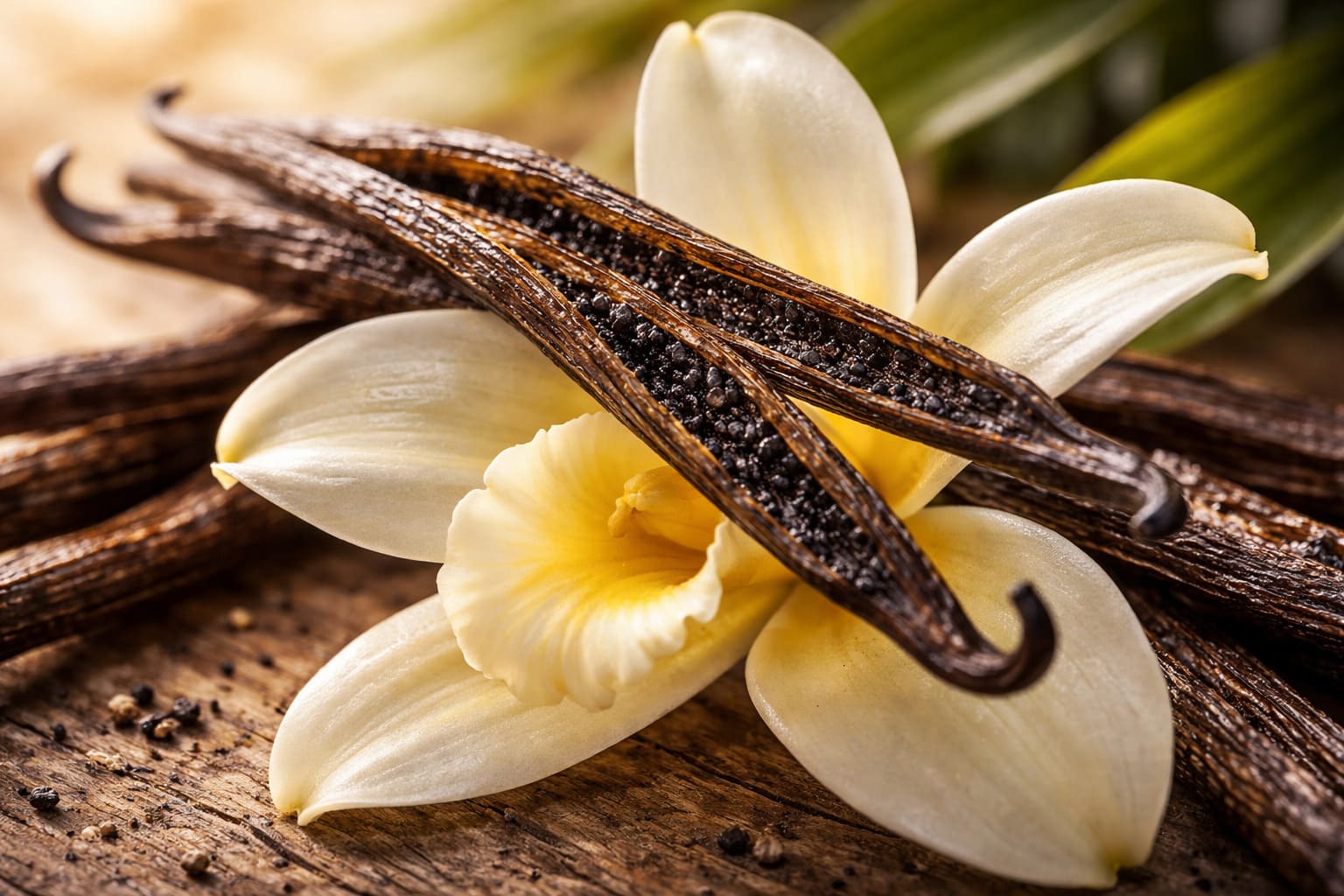
The history of vanilla begins with the Totonac people of what is now Veracruz, Mexico, who were among the first to cultivate the vanilla orchid, and turns on the year 1841, when a twelve-year-old enslaved boy named Edmond Albius found a fast way to pollinate it by hand on the island of Réunion. That trick let the crop leave Mexico. Today most of it grows in Madagascar and Indonesia.
Where does vanilla come from?
Vanilla is the cured seed pod of an orchid vine, and the species most of the world uses, Vanilla planifolia, is native to Mexico and Central America. The Totonac of present-day Veracruz are among the first people known to have farmed it. One botanical source dates their cultivation to "at least 1185", a figure that rests on a single scientific review, so treat it as a best estimate and not a birth certificate.
The Aztecs, who invaded the Totonac lands in 1427 according to the sources we read, took vanilla into their own cooking and mixed it into a cacao drink. The old translation of the Nahuatl name tlilxochitl as "black flower" has been questioned; "black pod" now looks more likely. If you want the cacao half of that drink, it has its own tale in the history of chocolate.
Did Cortés really bring vanilla to Europe?
The standard line is that Hernán Cortés carried vanilla and chocolate to Spain in the 1520s. It is repeated everywhere, but the support is thin: the sources we found lean on a society web page quoting old cookbooks, not on a document from Cortés himself. What is safe to say is that vanilla reached Europe through the Spanish Atlantic trade in the sixteenth century, first as a chocolate flavoring.
A popular add-on says the apothecary of England's Queen Elizabeth, Hugh Morgan, was the first to use vanilla on its own. We found no source that holds that up. One reference work mentions an apothecary of the queen making vanilla sweetmeats without chocolate, with no citation behind it. Leave the name out.
Why vanilla would not set pods anywhere else
For roughly three centuries, European gardeners could coax vanilla vines to grow in hothouses and colonial plantations, and the vines even flowered. The flowers then dropped without making a single pod.
The reason is the flower's design. A thin flap called the rostellum sits between the male anther and the female stigma, so the flower cannot easily pollinate itself, and in the wild only a small share of flowers are ever pollinated (one source puts it near 1 percent, without a citation). Each bloom lasts about a day, sometimes less, and has to be fertilized within about 12 hours of opening.
You will often read that a stingless Melipona bee does this job in Mexico. That has never been substantiated. Bees and hummingbirds visit the flowers, but nobody has shown that they are the reliable pollinators of the story.
Morren, Richard and a boy named Edmond
In 1837 the Belgian botanist Charles Morren published an artificial pollination method for vanilla. It worked, but it was too slow to pay. Jean Michel Claude Richard later claimed he had found the trick three or four years before Edmond Albius did; the sources we read call that claim false.
French planters had shipped vanilla to Réunion and Mauritius around 1819, and for two decades the vines flowered and bore nothing. Then, in 1841, Edmond did what the botanists could not do at scale.
Who was Edmond Albius?
Edmond was born around 1829 in Sainte-Suzanne on Réunion. His mother, who was enslaved, died giving birth to him. He belonged to Ferréol Bellier Beaumont, a planter who taught him botany. In 1841, aged about twelve, he worked out that a thin stick or blade of grass, plus a quick press of the thumb, could lift the rostellum and push the pollen against the stigma. A museum account says he used a small piece of bamboo. Either way, the method was quick enough to use on a whole plantation. Nearly all vanilla is still pollinated this way.
Réunion briefly became the world's largest supplier. French colonists carried the method to Madagascar. By 1898 Madagascar, Réunion and the Comoros together produced about 80 percent of the world's vanilla.
Edmond did not share in the money. When France abolished slavery in its colonies in 1848, he moved to Saint-Denis and worked as a kitchen servant, and he took the surname Albius, from the Latin for white, after the color of the orchid. He was later convicted of stealing jewelry and sentenced to ten years in prison; the governor commuted the sentence after five. Locals tried and failed to win him a reward or a pension. He died in poverty in Sainte-Suzanne in 1880.
Why real vanilla costs so much
Hand work is only the start. A cutting needs about three years before it flowers. Growers pollinate only five or six of the roughly twenty flowers on each cluster, because over-pollinating lowers bean quality. The pods then need about six months to mature on the vine, and curing follows in four stages: killing, sweating, drying and conditioning. Conditioning alone takes five to six months. Cured beans average about 2.5 percent vanillin.
Prices have swung wildly. A cartel of producers held prices from its founding in 1930 until the mid-1980s, and when it dissolved prices fell by about 70 percent, to near US$20 a kilogram. Cyclone Hudah in April 2000 pushed them up, and by 2004 they had reached about US$500 a kilogram, then dropped to around US$40 by mid-2005. After Cyclone Enawo in 2017 they hit roughly US$500 again, according to press reports cited in the reference work we read.
In 2023, world raw production was 7,433 tonnes. Madagascar grew 3,113 tonnes, about 42 percent, and Indonesia 1,833 tonnes, about 25 percent. The old line that Madagascar grows 80 percent of the crop echoes the 1898 figure above and no longer matches the recent numbers we found.
The 1874 laboratory shortcut
In 1858 the French chemist Théodore Nicolas Gobley isolated vanillin, the main flavor molecule, from vanilla extract. In 1874 Ferdinand Tiemann and Wilhelm Haarmann worked out its structure and made it from coniferin, a compound from pine bark. They founded a company and began industrial production in Holzminden, Germany. Later makers used clove oil, then waste from paper pulping from the 1930s, and today most synthetic vanillin is made from petrochemicals.
The scale is lopsided. A source dated 2001 put yearly demand for vanillin at about 12,000 tons, of which only about 1,800 tons came from vanilla pods. Natural extract carries more than vanillin alone, but if you want it in your ice cream, the story of that dessert is in the history of ice cream, and the sugar that sweetens it is told in the history of sugar.
Gaëlle Bélem's 2023 novel Le fruit le plus rare is based on Edmond Albius's life.
Questions people ask
Who discovered how to pollinate vanilla by hand?
Edmond Albius, an enslaved boy of about twelve on the French island of Réunion, developed a fast hand-pollination method for vanilla in 1841, using a thin stick and his thumb. Charles Morren had published a slower method in 1837, and Jean Michel Claude Richard's later claim to have beaten Albius is called false by the sources we read.
Why is vanilla so expensive?
Natural vanilla is costly because the orchid is pollinated flower by flower, by hand, within about 12 hours of the bloom opening. A vine needs around three years to flower, pods take about six months to ripen, and curing adds several more months. Cyclones and shifts in a producer cartel have also pushed prices sharply up and down.
Where is most vanilla grown today?
Madagascar leads. In 2023 it grew about 3,113 tonnes of the world's 7,433 tonnes of raw vanilla, around 42 percent, and Indonesia grew about 1,833 tonnes, around 25 percent. Vanilla itself comes from Mexico, where the Totonac people of Veracruz cultivated it long before Europeans arrived.
When was artificial vanillin first made?
Ferdinand Tiemann and Wilhelm Haarmann worked out the structure of vanillin and made it from coniferin, a compound found in pine bark, in 1874. Théodore Nicolas Gobley had first isolated vanillin from vanilla extract in 1858. Sources disagree on when synthetic vanillin first went on sale, with some dating it to 1874 and others to 1894.
Filed under Trade Routes
Want more stories like this?
One food history story, every week. No spam, just the stories behind what the world eats.