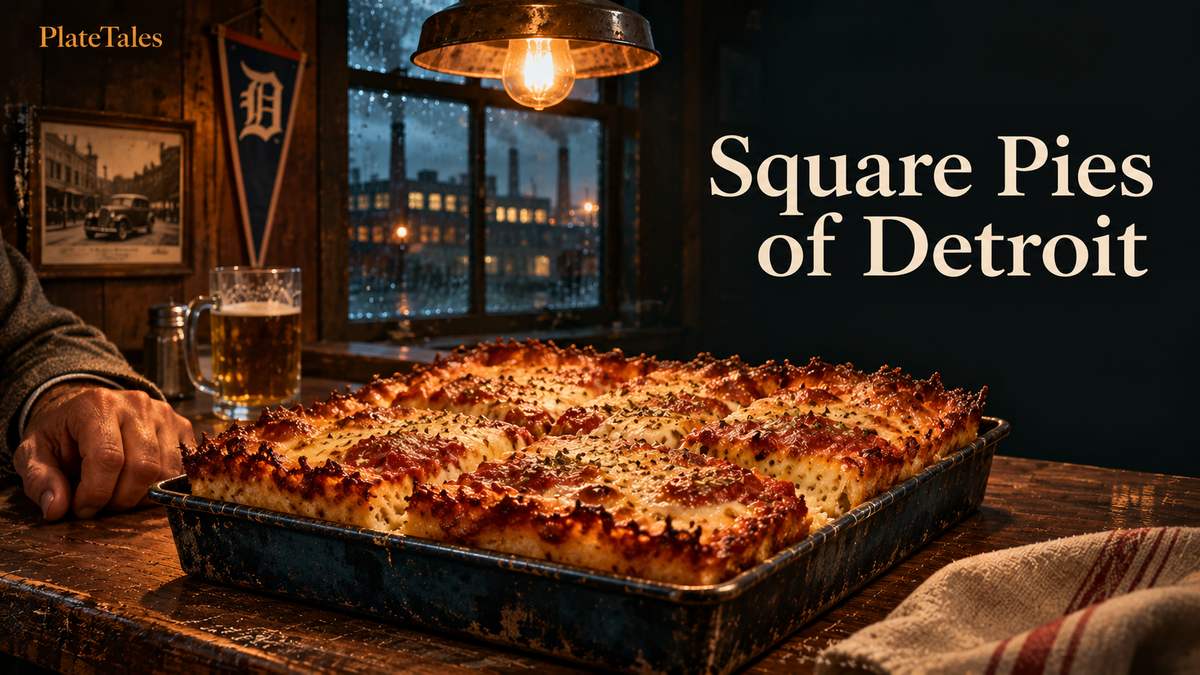
Detroit-style pizza is a thick, rectangular pie baked in a deep blue steel pan, with cheese pushed to the edges so it fries into a crisp lace and sauce spooned over the top. By the account of the Detroit Free Press, it began in 1946 at Buddy's Rendezvous, a bar at Conant Street and Six Mile Road, where owner Gus Guerra adapted a Sicilian recipe to fit a pan common in the city's auto shops.
The details of who taught whom are still argued over, but the address is not.
What is Detroit-style pizza, and where did it start?
The Free Press critic Mark Kurlyandchik, writing in 2020, put the beginning at a shot-and-beer bar that Guerra and his wife, Anna, had bought two years earlier in partnership with her two uncles. Business was slow. Guerra, who had come from the tiny Republic of San Marino, took the Sicilian Christmas pizza his mother-in-law made, known as sfincione, and baked it in a blue steel pan instead of a round pie tin.
Hour Detroit's Michael Schafer, in a 2013 feature, describes the same year and the same bar as a former blind pig, a Prohibition-era drinking spot, that had turned into a struggling tavern. He ties the idea to the postwar moment: returning soldiers wanted the pizza they had eaten in Europe, and Guerra began offering a Sicilian-style version to his regulars.
The finished pie had a particular order of operations. Pepperoni went into the dough, cheese went over it and out to the walls of the pan, and the sauce went on last. Kurlyandchik notes that the sauce on top would reduce and sweeten in the oven. The caramelized cheese at the rim is called frico, a word borrowed from Italian cooking.
The pan that came from the shop floor
The pan is the part everyone remembers, and the part with the loosest paper trail.
Michigan Public reported in 2019 that Guerra, once he decided to add a Sicilian pizza, could find nothing that would bake it properly. According to Wesley Pikula, the chief brand officer of the restaurant that grew from the original bar, customers who worked in nearby tool and die shops suggested a metal tray they used to hold nuts and bolts, or as a drip tray. Dough baked well in it, Pikula said. That is the restaurant's own telling, but it fits the neighborhood: the bar sat in a district crowded with auto suppliers.
Kurlyandchik's version is shorter. He says only that the pan was a blue steel type common to the auto shops around Detroit. Neither article names the factory, the customer or the day. Treat the picture of a tray carried in from a machine shop as a plausible local origin, not as a documented event.
Schafer's account of the pizza itself is more specific than any account of the pan. He describes the pie as wet, sticky dough, with the cheese touching the sides and corners of "the deep blue steel pan," and says that any extra toppings go on top of the cheese but under the sauce.
Who actually taught Gus Guerra?
Nobody agrees, and the rival stories tell you something about how a neighborhood remembers a recipe.
| Claim | Source |
|---|---|
| Anna Guerra made the dough from her Sicilian mother's recipe | Hour Detroit, 2013 |
| A man named Dominic taught Guerra how to make the pies | Hour Detroit, 2013 |
| A Sicilian woman, Connie Piccanato, told Guerra to press the pepperoni into the dough | Hour Detroit, 2013, citing Robert Jacobs, owner of the restaurant at the time |
| Guerra adapted his mother-in-law's sfincione for the steel pan | Detroit Free Press, 2020 |
Schafer writes that while the precise origin is "debatable," its heritage is "definitely Sicilian," and that sfinciuni, the soft rectangular bread sold by street vendors in Palermo, is the ancestor. The one fact he says everyone in metro Detroit agrees on is the location: the pizza made its debut at the original Buddy's at Six Mile and Conant.
Nothing here is a contemporary 1946 document. Every account comes from decades later, from owners and their families, which is typical for restaurant lore and worth keeping in mind. For more on how a Neapolitan flatbread turned into so many regional pies, see the origin of pizza, and for the thick-crust family that Detroit's pie belongs to, the history of pan pizza.
How the pizza left Six Mile and Conant
The pizza was an immediate success, according to the Free Press, and it carried the bar to local fame. But the partnership did not last. In 1953, Guerra's son Jack told the paper, the relationships among the original partners had deteriorated and the place was sold.
Schafer says the buyers were two patrons, "Little" Jimmy Valenti and "Big" Jimmy Bonacorse, who liked the thick pizza that was then competing with the thin-crust pies at other Italian restaurants. Sixteen years later they sold to Billy and Shirlee Jacobs, in 1970, and the business later passed to their son Robert.
Guerra used his share to buy a bar called the Cloverleaf, eight miles away in East Detroit, now Eastpointe, which the Free Press describes as a mostly Irish neighborhood. He kept the name. His children, Jack and Marie, grew up in the business, and Kurlyandchik says they still serve the original recipe there.
The cooks who carried it elsewhere
Other places got the pizza by hiring the people who made it. Schafer writes that Shield's bar, near Buddy's, watched Buddy's fill up and added pizza after hiring Loui Tourtois Sr., a Frenchman who had made pies at Buddy's. Tourtois later left, and in 1977 he opened his own place on Dequindre Road in Hazel Park. His son Loui Jr. had bused tables at the original and worked at Shield's before helping him.
That is how a recipe spread in postwar Detroit: not through a cookbook, but through one cook changing jobs. By 1977 there were four separate pizzerias, Buddy's, Cloverleaf, Shield's and Loui's, all tracing back to the same corner.
Square, not "Detroit-style"
For most of its life the pizza did not carry the Detroit label at all. Kurlyandchik notes that a growing number of people outside Michigan now call "Detroit-style" what locals "have always known as 'square.'" The geographic tag is an export label, applied by people who needed a way to tell the pie apart from every other pan pizza.
The export began slowly. Schafer's 2013 feature found a local pizzamaker, Shawn Randazzo, who had started as a delivery driver at Cloverleaf and eventually owned two of its locations. Randazzo was the 2012 World Champion Pizza Maker at the International Pizza Expo, and he told Schafer he wanted Detroit-style pizza to be as recognized as New York or Chicago style within eight to 10 years. He built a training and certification program to do it.
The Free Press wrote in 2020 that the style swept the nation some 70 years after 1946. Jack Guerra, interviewed for that story, said his father would have been proud that people were making it in Colorado, Arizona, New York and Pennsylvania. He recalled his father's own view of it: "I just happened to do the right thing at the right time."
Another pizza with a named inventor and a disputed origin is told in who invented Hawaiian pizza.
The pizza, in other words, ran on a long fuse. Seventy years elapsed between the first pie in the blue pan and a time when someone in Pennsylvania would put "Detroit-style" on a menu. Meanwhile the dish spent decades as a neighborhood habit, a recipe for people who already knew where Six Mile and Conant was, and who thought of the pizza as just pizza.
Questions people ask
Who invented Detroit-style pizza?
Gus Guerra is credited with it. In 1946 he began serving a Sicilian-style rectangular pizza at Buddy's Rendezvous, a Detroit bar at Six Mile Road and Conant Street. Sources differ on who taught him: his wife Anna's family recipe, a man named Dominic, and a woman named Connie Piccanato all appear in accounts.
Why is Detroit pizza baked in blue steel pans?
Accounts say the pans came from Detroit's auto industry. Michigan Public reported that customers from nearby tool and die shops suggested a metal tray used for nuts and bolts or as a drip tray, while the Detroit Free Press says only that the blue steel pan was common in local auto shops.
What cheese is used on Detroit-style pizza?
The Detroit Free Press says Gus Guerra substituted a blend of Wisconsin brick cheese and mozzarella for the caciocavallo used in a traditional Sicilian Christmas pizza. It is spread to the edges of the pan, where it caramelizes into a crisp rim called frico.
What happened to the first Detroit-style pizza restaurant?
Guerra and his wife Anna bought the bar in 1944. In 1953 it was sold, and Guerra bought the Cloverleaf bar in East Detroit, now Eastpointe, where his children Jack and Marie still served his recipe in 2020, according to the Detroit Free Press.
Filed under Migration Stories
Want more stories like this?
One food history story, every week. No spam, just the stories behind what the world eats.