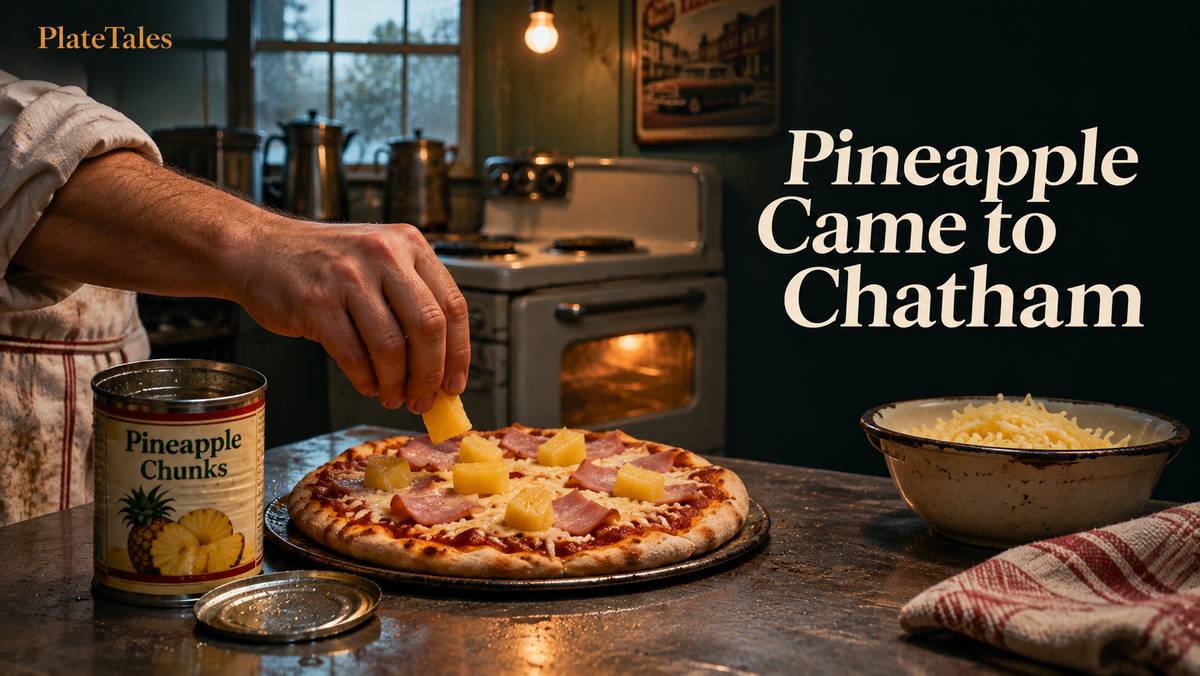
Hawaiian pizza was invented in Canada, not Hawaii. Sam Panopoulos, a Greek immigrant who ran the Satellite Restaurant in Chatham, Ontario, says he put canned pineapple on a pizza in 1962, and he is the person most often credited with it. The name came from the brand of pineapple in the can. The idea has rivals, but none of them has his paper trail.
The Greek restaurateur in Chatham, Ontario
Sotirios Panopoulos, who went by Sam, was born in 1934 in Vourvoura, Greece. He left for Canada in 1954, at about age 20. Atlas Obscura, which interviewed him by phone in 2015 when he was 81, says his boat stopped briefly in Naples and that he tasted pizza there. Other accounts say he first tried pizza in North America, on a visit to Windsor, Ontario. Either way, he knew almost nothing about pizza as a tradition.
He worked in the mines around Sudbury and Elliot Lake, then settled in Chatham, an hour or so from the Michigan border. With his brothers Elias and Nikitas he ran the Satellite Restaurant. It was a mid-century diner with no particular theme: pancakes in the morning, burgers and fries at lunch, liver and onions for dinner.
What pizza looked like in Ontario in 1962
It is hard to picture how little pizza there was. Panopoulos told Atlas Obscura that "Even Toronto didn't know anything about pizza in those days," and that the only place you could really get it was Detroit. Windsor, across the river, had started to sell it, but the menu was dough, sauce, cheese, and one of three toppings: mushroom, bacon or pepperoni.
The mushrooms came from a can. The dough was bought pre-made. The ovens were ordinary apartment-sized electric ones. A Toronto Star recipe from that same year, as Atlas Obscura describes it, offered a "Spanish pizza" of yellow rice and Vienna sausages on a base made from biscuit mix.
He had already hired a cook to make Canadian Chinese dishes. After watching how the Windsor cooks built their pies, he went home and started experimenting. He even cut circles from cardboard boxes donated by the furniture store next door, and wrapped each pizza in foil to send it out the door.
The day the can came down off the shelf
Panopoulos's explanation was about sweet and savory. "In those days, the only sweet and sour thing you would get is Chinese pork, you know, with the sweet and sour sauce," he said. "Otherwise there was no mix." The idea is also tied to his experience with Canadian Chinese cooking.
Canned pineapple was everywhere. Hawaii had become a US state only in 1959, tiki bars were fashionable, and Ontario grocers advertised tinned pineapple constantly. So in 1962 he drained a can and put the pieces on a pizza. "People said 'you are crazy to do this,'" he remembered. He liked it immediately and started advertising it.
Ham arrived almost by accident. According to Atlas Obscura, the pairing came from having only a few toppings to work with, and at first he did not market the pineapple as a ham pizza. TIME quoted him on the spirit of the thing: "We just put it on, just for the fun of it, see how it was going to taste."
A very young dish on a new continent
Pizza itself was new to most North Americans. Atlas Obscura notes that most people over about 75 can remember the first time they heard of it, and that the New York Times introduced the dish to its readers in 1944. Even in Naples, the cheese-and-tomato pizza we recognize is usually dated to 1889, when a margherita was baked to honor the visiting King Umberto and Princess Margherita, as the story goes.
That matters for the Chatham claim. With no strong rules about what belonged on a pizza, a restaurateur with a can opener and a few ingredients on hand could make up his own. Panopoulos said some of his other discoveries, such as olives and anchovies, were being found at the same time by other pizza cooks. The pineapple was the one that nobody else had tried.
Why it is called Hawaiian pizza
The name has nothing to do with the islands as a place. Panopoulos and his brothers named the pizza after the brand of canned pineapple they used, a point made by TIME. The brand was the Hawaiian Pineapple Company. Atlas Obscura says he used the name from the start.
Were there earlier pineapple pizzas?
Probably, in a loose sense. A "Hawaiian Pizza" is recorded in Portland, Oregon, in 1957 made with pineapple, papaya and chopped green pepper, with no ham or bacon. That is a different pizza, and nobody has tied it to Chatham.
Germany has a nearby cousin. Toast Hawaii, an open sandwich of ham, cheese and a pineapple ring topped with a maraschino cherry, was introduced in West Germany in 1955 by the television cook Clemens Wilmenrod. Some historians link it to a 1939 Hormel "Grilled Spamwich" recipe. It is bread, not pizza, but it shows ham and pineapple were already a fashionable pair.
The Panopoulos claim is sometimes disputed. The honest summary: his account is detailed, consistent over decades, and tied to a named restaurant and year. Nobody has produced an earlier menu or advertisement showing ham and pineapple on a pizza. It remains his word, backed by the local record.
How a Canadian pizza started an international argument
For decades the pizza simply spread. Hawaiian was Australia's most popular pizza in 1999, with about 15 percent of sales, and a 2015 review of Just Eat takeaways in the UK found it the most commonly available pie. TIME put it first in its 2014 list of the 13 most influential pizzas.
In February 2017, Iceland's president Guðni Th. Jóhannesson told a group of high school students he was fundamentally opposed to pineapple on pizza, and said that he would ban it if he could. He later clarified that he was joking and had no such power. Justin Trudeau, then Canada's prime minister, answered on Twitter: "I have a pineapple. I have a pizza. And I stand behind this delicious Southwestern Ontario creation."
Panopoulos, retired by then, was asked by reporters to defend it. He told Atlas Obscura that he regretted not finding a way to patent the combination. If you want the wider story of how the dish reached North America, start with the origin of pizza, and see how immigrants changed American food more broadly. Other dishes with disputed parents are collected in foods invented by accident.
Why people still argue about it
Atlas Obscura reported in 2015 that a reader-made BuzzFeed post had called it "the most insulting and offensive pizza in the world". The numbers show a split rather than a consensus. A 2016 Harris Poll found pineapple among the three least-favorite pizza toppings in the United States. A 2019 YouGov survey found that 12 percent of American pizza eaters ranked it among their top three favorites, while 24 percent put it among their least favorite.
Some restaurants have turned the feud into a joke. In 2025 a pizzeria in Norwich, England, charged 100 pounds for a pineapple pizza to show how it felt about the style.
He sold the Satellite in 1980 and lived out his life in London, Ontario. He died there on 8 June 2017, and in October 2025 the Chatham-Kent Cultural Hall of Fame inducted him for inventing the Hawaiian pizza.
Questions people ask
Why is it called Hawaiian pizza if it comes from Canada?
The name has nothing to do with the islands as a place. Sam Panopoulos and his brothers named the pizza after the brand of canned pineapple they used at the Satellite Restaurant in Chatham, Ontario. TIME makes this point, and the brand was the Hawaiian Pineapple Company.
Where was Hawaiian pizza first made?
Hawaiian pizza was first made at the Satellite Restaurant in Chatham, Ontario, Canada, in 1962, according to Sam Panopoulos. A Greek immigrant who ran the diner with his brothers, he drained a can of pineapple and put the pieces on a pizza. Nobody has produced an earlier menu showing ham and pineapple on a pizza.
Why did Sam Panopoulos put pineapple on pizza?
Panopoulos said he was thinking of sweet and sour. In the early 1960s the only sweet and savory mix most Ontario diners offered was Chinese pork with sweet and sour sauce. Pizza in Chatham had only a few toppings, canned pineapple was everywhere, and he tried it on a pizza for fun.
Did Iceland ban pineapple on pizza?
No. In February 2017 Iceland's president Guðni Th. Jóhannesson told high school students he was fundamentally opposed to pineapple on pizza and would ban it if he could. He later clarified that he was joking and had no such power. Canadian prime minister Justin Trudeau defended the pizza on Twitter.
Filed under Accidental Inventions
Want more stories like this?
One food history story, every week. No spam, just the stories behind what the world eats.