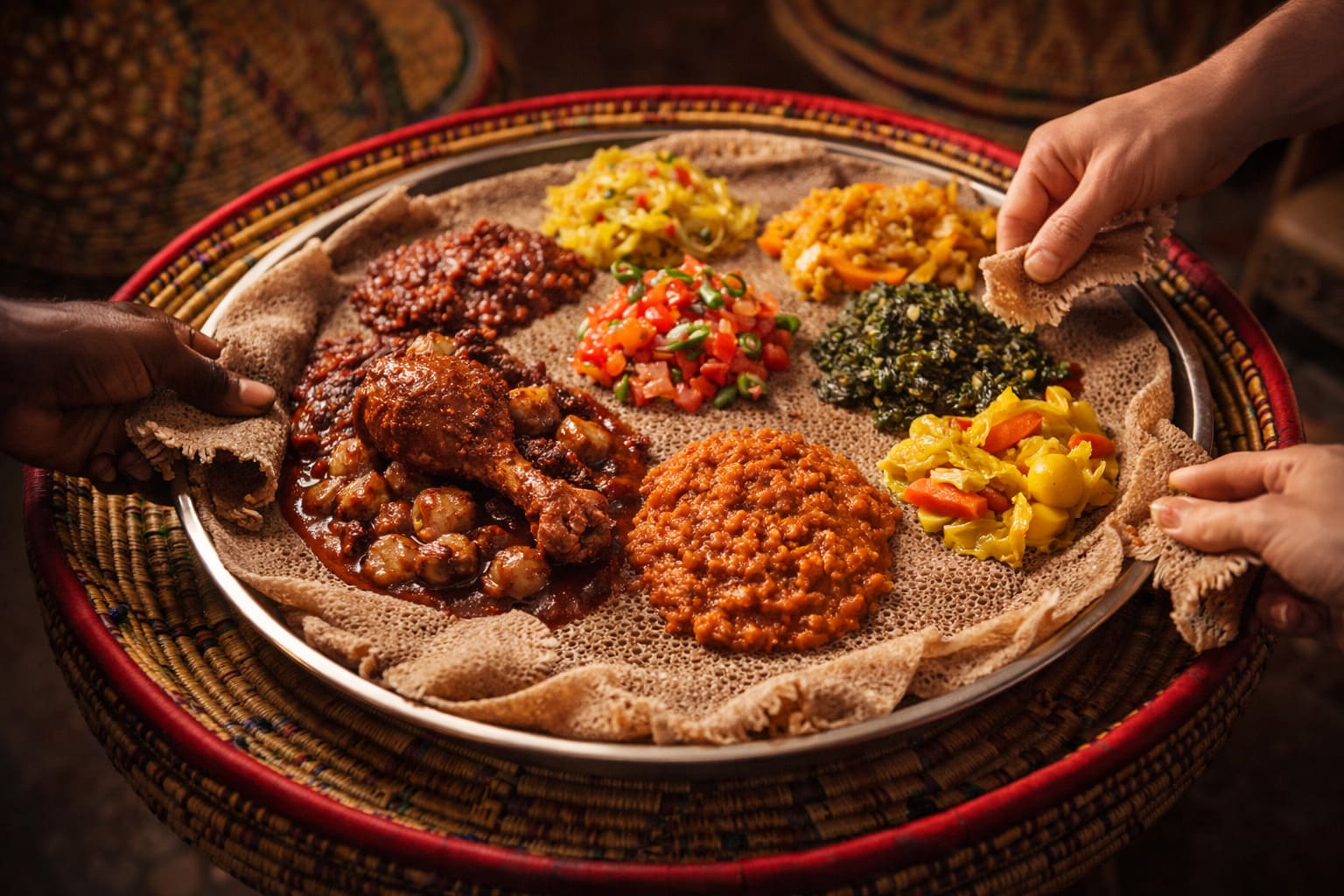
Injera is the sour, spongy flatbread of Ethiopia and Eritrea, made from a fermented batter of teff flour and cooked on one side only on a round griddle called a mitad. Nobody knows who first made it or when. What the evidence does show is that teff, its grain, was being farmed in the northern highlands by the second millennium BCE, and that the bread grew up around it.
What the date of the first injera really is
Ask for a birthday and you get a gap. Folklore puts the first injera around 100 BC, but the historical record does not confirm that, and no document or excavated loaf pins it down. Two botanists, Robert Stewart and Asnake Getachew, offered a modest guess instead: perhaps someone left a bowl of flour wet for a few days and found it had turned sour and bubbly. That is speculation, and it is labeled as such.
The grain is easier to follow than the bread. Teff (Eragrostis tef) is the smallest known grain in the world, and Britannica says it was domesticated as many as 6,000 years ago in Ethiopia and Eritrea. A 2025 genomic study is more cautious. It points to a wild grass, Eragrostis pilosa, as the ancestor and argues that teff was domesticated in the northern highlands of Ethiopia and Eritrea in the second millennium BCE, then spread south and across the Red Sea into southern Arabia.
Griddles, phytoliths and a Yemeni site
The physical evidence is thin, because seeds this small are easily lost in the soil. The same study lists the earliest finds. Phytolith and starch analysis at the Mezber site dates back to 1600 BCE, although the authors admit it cannot be settled whether that teff was wild or farmed. Teff turned up at Mai Chiot in Eritrea, dated to 300 to 400 BCE, and at Hajar bin Humeid in Yemen, a first millennium BCE site, which shows the grain crossing the sea early. Teff chaff from a cave near Lake Tana dates to around the twelfth century CE.
None of this is a loaf of bread. The archaeologist Richard Wilding suggested that griddles might signal teff and injera use, and mitads found at sites of about 600 AD are possible evidence of injera. Possible is the honest word. A griddle can cook other things.
The name of the grain has its own story. It is thought to come from an Amharic word, teffa, meaning roughly "it is lost," a reference to seeds under a millimeter across. It is a plausible derivation rather than a documented one.
A week with a bowl of batter
Whatever its age, the method is slow. Britannica describes the traditional process as taking about a week from scratch, though the first step, a starter called ersho made with wild yeast, flour and water, only has to be done once. Some starter is kept back for the next batch, so a household's ersho can run for years.
After several days the starter separates into a watery layer and a denser sponge. The water is poured off, a portion of the sponge goes into a bowl with fresh flour and water, and the bowl rests for three more days. Then a small part of the batter is cooked in a pan until it thickens and bubbles. This gelatin-like paste is called absit, and it is stirred back in to give the batter cohesion. Two more hours of resting, and the sour flavor and spongy texture are set. This kind of wild fermentation is old technology; the broader story is in the history of fermentation.
The batter is poured onto the hot mitad in a spiral from the outside inward, covered, and left to cook for a few minutes. It is never flipped. Steam rising through the batter leaves the small holes, the "eyes," on top. Ethiopian injera can reach about 50 centimeters across, while rounds made in North America tend to be smaller, about 30 to 38 centimeters, according to Britannica.
Fermentation time changes the bread. A moderate fermentation gives the smooth, thin injera most people prefer. A shorter one, 12 to 24 hours, makes a thicker, sweeter, red-bottomed bread called aflegna, and a longer one makes the very sour komtata.
Bread, plate and spoon
Injera does three jobs at the table. Stews called wot are spooned onto a large round, and diners tear off pieces of injera from the edge to pick up the food. By the end the bottom round is soaked in sauce, and finishing it counts as a sign of respect. Britannica notes that nothing is wasted: leftover pieces go into firfir, torn bread fried with tomatoes, onion, garlic and berbere.
There is also gursha, in which a person rolls a morsel of injera around some food and feeds it to someone else at the table. Britannica describes it as a way of showing love, hospitality or respect.
Between meals the rounds are stored in a tall woven straw basket, the mesob, which is common enough that a picture of one appears on the 10 birr banknote. Injera also turns up at moments that have nothing to do with dinner. At funerals, people outside the family carry mesobs full of it to the bereaved, and after services Orthodox churchgoers offer it to the priest. In Bahir Dar, some families wrap injera around a baby after baptism for good luck. For a comparison with another staple that carries this much ritual weight, see why bread matters in every culture.
When the grain became a political question
For most of the twentieth century teff stayed a mostly Ethiopian crop. Ethiopia and Eritrea remain the main producers, and in 2016 Ethiopia grew more than 90 percent of the world's teff. When production fell during the famine of 1983 to 1985, Ethiopian restaurants in the United States switched to other grains, which shows how far injera had already traveled with emigrants. Britannica adds that the flour in injera varies when shortages or export bans hit teff supply, and that injera can also be made with barley, millet or wheat.
The export question came to a head in 2006, when Ethiopia banned exports of raw teff. The government feared domestic shortages like those that followed quinoa's popularity in Europe and the United States. Processed injera could still be sent abroad, and the ban was partly lifted in 2015, with licenses going to 48 commercial farmers. North America was the largest market for injera exports.
Teff is also grown in small amounts in Idaho, California, Texas and Nevada, and a company in Caldwell, Idaho, began growing it at scale around the 1990s. The first dedicated injera bakery in the US, founded by Tedla Desta, opened in Alexandria, Virginia. How such restaurants fit into the wider story of newcomers shaping a country's table is told in how immigration changed American food.
In 2015, Ethiopia's injera exports reached about 10 million US dollars.
Questions people ask
What is injera made from?
Injera is made from teff (Eragrostis tef), the smallest known grain in the world, grown mainly in Ethiopia and Eritrea. The flour is mixed with water into a batter and fermented with a starter called ersho. Injera can also be made with barley, millet or wheat flour, especially when teff is scarce.
How long does injera take to ferment?
Traditional injera made from scratch takes about a week, according to Britannica, because the starter has to be prepared first. Once a starter exists, the batter rests for three days, then a cooked portion called absit is added and it rests two more hours before cooking.
Why does injera have holes on top?
The small holes, called eyes, form while the batter cooks on the mitad, the clay or metal griddle. The injera is covered and cooked on one side only, never flipped. Steam passing up through the fermented batter leaves the spongy, pitted surface.
What is gursha in Ethiopian dining?
Gursha is the practice of making a morsel of injera wrapped around food and feeding it to another person at the table. Britannica describes it as a way of showing love, hospitality or respect. Eating all the injera served is another sign of respect in Ethiopia.
Filed under Origin Stories, Cultural Identity
Want more stories like this?
One food history story, every week. No spam, just the stories behind what the world eats.