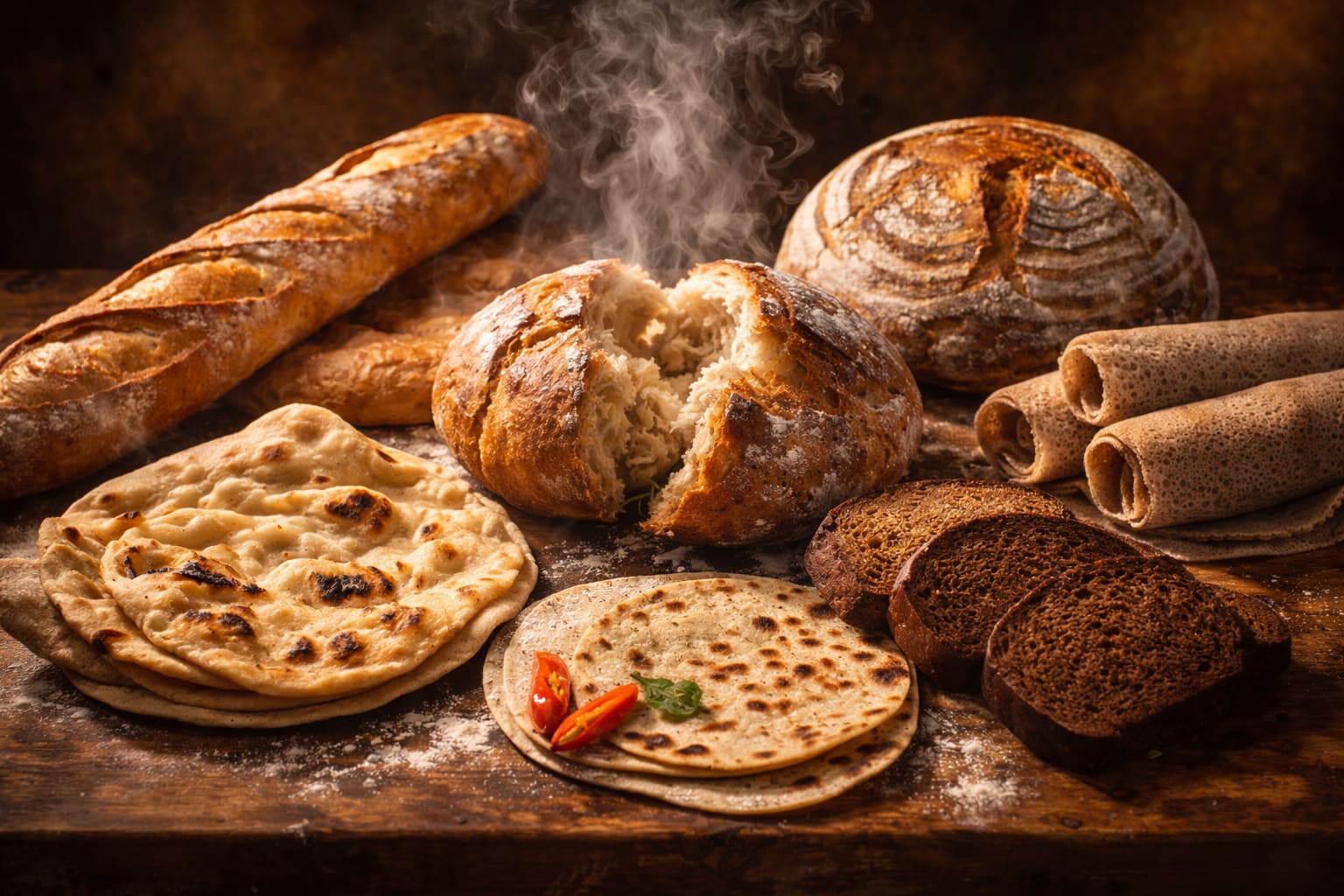
Bread is important in so many cultures because it turned grain, the most dependable food a settled community could store, into something people could carry, share and ration. The oldest bread yet found is about 14,400 years old, and religions, tax systems and street riots have all kept bread at the center ever since. The claim that every culture baked it from the start is shakier than it sounds.
The oldest bread was a fireplace leftover
In northeastern Jordan, in a stretch of basalt desert, a hunter-gatherer camp called Shubayqa 1 was dug by archaeologists from the University of Copenhagen over four seasons between 2012 and 2015. Inside a roughly one-meter ring of flat basalt stones, a fireplace used around 14,400 years ago, the team recovered more than 65,000 plant fragments. Twenty-four of them were charred scraps that Amaia Arranz-Otaegui, Tobias Richter and colleagues identified as bread-like, and 22 came from the older of two stacked hearths.
The ingredients were wild einkorn wheat and the tubers of a sedge called club-rush, ground fine and sieved. Under the microscope the pores were tiny, which points to a flat, unleavened cake. With no ovens of that period known, the authors judged it most likely that the dough went into the ashes or onto a hot stone.
The date matters. Their 2018 paper in PNAS put this bread about 4,000 years before farming began in the region. People were baking before they were planting.
Bread before it was a staple
It is tempting to say bread caused agriculture. The excavators do not. They note that wild cereals were rarely eaten in that period and that most of the diet came from small seeds, fruit, nuts and root foods. Bread at Shubayqa 1 was costly to make, with dehusking, grinding and sieving, and the authors suggest it may have been a special food, perhaps for feasts.
Only after farming took hold, about 9,000 years ago by their reckoning, do ovens and everyday bread turn up in ordinary houses. So the picture is not "grain, then civilization, because of bread." It is a rare luxury that became a daily necessity once fields could feed a village.
Reference works give a younger date. Britannica says the first bread was made in Neolithic times, nearly 12,000 years ago, probably laid on heated stones and covered with hot ashes. It also credits the Egyptians with discovering that fermenting wheat dough gives a light, risen loaf, and with building baking ovens.
Why bread matters in every culture: the sacred part
Once bread was the thing that stood between a household and hunger, religions built it into their calendars.
Christian worship centers on the Eucharist, which uses bread and wine. Jewish practice has two quite different loaves. Challah, a braided yeast bread made with eggs, is served on the Sabbath and on holy days such as Rosh Hashanah and Yom Kippur, according to Britannica. Passover calls for the opposite, matzah, flour and water mixed and baked fast. The tradition says the Israelites left Egypt in such a hurry that their dough had no time to rise, and it is also called "lechem oni," poor man's bread. Under the rules the dough is counted as starting to leaven 18 minutes after it touches water.
Both are bread, and both carry a story about the same grain. One celebrates abundance, the other hurry and hardship.
One word for flatbread, another for a loaf
Anyone looking for the universal loaf finds a spread of forms instead. Britannica calls flatbread the earliest form of bread and still common across the Middle East, Asia and Africa. Naan and roti are staples in India. Injera, the spongy sour pancake of Ethiopia and Eritrea, is made from teff, wheat or sorghum; more on that in our history of Ethiopian injera. Tortillas and arepas, made from corn, carry the same job across much of Latin America, and in Brazil small cakes are made from cassava.
Flour type decides the shape. Britannica points out that corn, barley, millet and buckwheat lack enough gluten to make raised loaves, while only wheat and rye flours can. Culture, climate and grain together explain why one region eats a tall loaf and another a thin sheet.
Our longer history of bread follows the raised loaf through Europe.
Where bread was a latecomer
The strongest argument against "every culture" is rice. Britannica notes that across much of Asia the traditional preference has been rice, and that Western bread grew popular there only in the later twentieth century. In Japan the bread-baking industry, using processes developed in the United States, expanded quickly after World War II. Baguettes are popular in Vietnam today. For a fuller picture of the grain that bread never displaced there, see the history of rice.
Bread is old and widespread, but it is not everywhere, and in places it is new.
Bread as a political fact
Governments have long known what happens when the loaf gets expensive. In his tenth Satire, around the year 100, the Roman poet Juvenal complained that the public had given up political concerns and wanted only "panem et circenses," bread and circuses. The Roman state did hand out grain to qualifying citizens, a program known as the annona, and Augustus, though uneasy about it on moral grounds, took responsibility for it as did the emperors after him.
In Britain, the Importation Act of 1815 set an 80-shilling-per-quarter threshold before foreign grain could come in, which held bread prices up for the benefit of landowners. Serious rioting followed in London. The Anti-Corn Law League, founded in 1838 with Richard Cobden as its leading voice, campaigned against the law, and Sir Robert Peel pushed repeal through during the Irish famine. The Commons voted 327 to 229 on 15 May 1846, and the act ended with royal assent on 26 June. Peel's Conservative party split over it.
In Russia in 1917 the Bolsheviks promised "peace, land, and bread."
What the old words still hold
English keeps some of this in its vocabulary. The word "lord" comes from the Old English hlafweard, bread keeper, according to the standard account. Breadwinner, breadbasket and the phrase "break bread with someone" all carry the same idea of bread as the measure of a household.
The sliced loaf has a date, too. On 7 July 1928 a bakery in Chillicothe, Missouri, began selling bread cut by the machine of Otto Frederick Rohwedder.
Questions people ask
How old is the oldest bread ever found?
The oldest bread-like remains come from Shubayqa 1, a hunter-gatherer site in northeastern Jordan, and date to about 14,400 years ago. They are charred flat cakes made from wild einkorn wheat and club-rush tubers, found in a stone fireplace, and they predate farming in the region by roughly 4,000 years.
Why do Jews eat matzah at Passover?
Tradition holds that the Israelites left Egypt so quickly that their bread dough had no time to rise, so what they baked was matzah. It is also called lechem oni, poor man's bread. Under the rules, dough counts as starting to leaven 18 minutes after it touches water.
Is bread eaten in every culture?
Not equally. Flatbreads such as roti, injera and tortillas are staples across India, Ethiopia and Latin America, but across much of Asia rice was the traditional grain. Western-style bread became popular there mostly in the later twentieth century, for example in Japan after World War II and in Vietnam, where baguettes are now common.
What does the word lord have to do with bread?
The English word lord comes from the Old English hlafweard, which means bread keeper, so the title began as a household's bread keeper. It sits alongside other bread-based English phrases, such as breadwinner, breadbasket and the expression break bread with someone, meaning to share a meal.
Filed under Cultural Identity
Want more stories like this?
One food history story, every week. No spam, just the stories behind what the world eats.