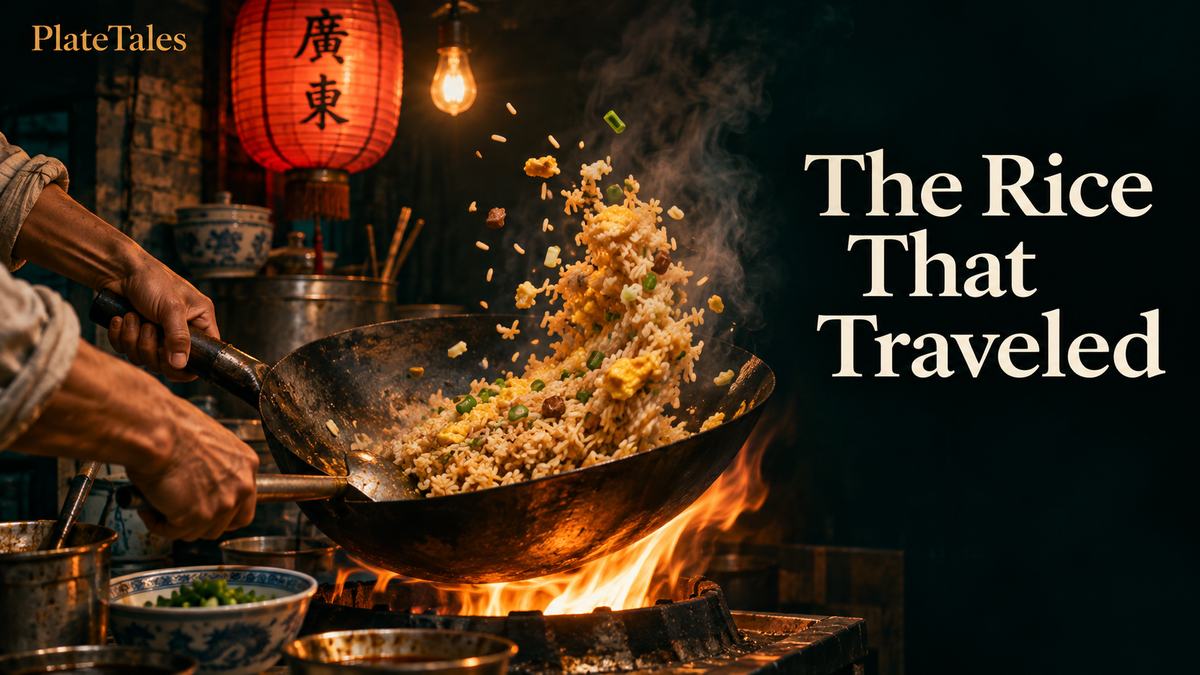
Fried rice came from southern Chinese kitchens, but no one can name the cook, the city or the year. The best-known claim, that Yangzhou fried rice goes back to the Sui dynasty emperor Yang, is a local legend, and the people who have looked hardest at it end up calling the dish's history vague. What can be dated is smaller: the arrival of Chinese cooks in California after 1848, the printed menus of Chinese-American restaurants, and the offshoots that followed Chinese migrants to Indonesia and Peru.
The emperor who supposedly loved it
Ask in Yangzhou, the Jiangsu city on the Grand Canal, and you will hear that Emperor Yang of the Sui dynasty tasted the dish on a visit and carried it back to his court. The journalist Clarissa Wei, writing for VICE about a trip to the city, reports it as a local legend and nothing more. She puts a second account next to it: that the dish arose in Guangzhou, in the Cantonese-speaking south, during the Qing dynasty. She finds that version the more plausible, because most Chinese restaurants in the United States are Cantonese. Her verdict on the whole question is that the history "remains vague."
That is a fair summary of what the record allows. None of the sources behind this article quotes a Sui recipe, a Qing menu or a cook's name. Popular accounts add that it began as a way to use up cold rice, and the idea is sensible, but it is an explanation rather than a documented first meal. The story that gets repeated most, an emperor's favorite dish, is the one with the least behind it.
Yangzhou did have a reason to attract such legends. Wei notes that it was a major trading center for salt, rice and silk until the 19th century. A rich city with a rice trade is a natural home for a dish about rice, and a natural place to pin its birth.
A city tries to own fried rice
The legend became policy in the 21st century. In 2002 the Yangzhou Cuisine Association issued a standard for the dish listing eight ingredients: sea cucumber, chicken, ham, scallops, shrimp, mushrooms, bamboo shoots and green peas.
Wei found that almost nobody follows it. A waitress at a restaurant called Shi Zi Lou told her the dish has exactly eight ingredients, though the plate Wei was served lacked ham and bamboo. A restaurant owner on Dong Quan Men Street, Mei Chen, said the standardized version "isn't even that good." A university student, Helen Ma, called the local dish "just egg fried rice." Wei concludes that "Yangzhou fried rice" is "a purely interpretive label."
In October 2015 the city tried for a Guinness record for the largest batch of fried rice, using nearly 300 chefs and about 4.6 tons of rice, according to Wei. The attempt was disqualified: most of the rice had been thrown away after sitting out for four hours and was judged unsanitary.
Fried rice in the first Chinese restaurants of America
Large-scale Chinese migration to North America began in 1848, mostly toward the California Gold Rush, according to American Heritage magazine's piece on the true history of chop suey. The article finds no contemporary mention of chop suey on the West Coast before 1900, which is a useful warning about how little of early Chinese-American cooking reached print.
The big moment came in 1896, when the Chinese statesman Li Hung Chang visited the United States and set off a craze for Chinese food. The New York Journal printed "Chow Chop Sui" in a column of "Queer Dishes." Chinatown restaurants had been drawing bohemians and tourists since the 1880s and 1890s, often on slumming outings.
Fried rice enters that record only later. By the 1920s a handful of large Theater District restaurants in New York, among them Chin Lee, House of Chan and the original Ruby Foo's, were doing business at scale. From the 1920s through the 1960s, the magazine reports, Chinese-American restaurants offered "chow mein, egg rolls, fried rice, shrimp toast, spare ribs, egg foo young and, above all, chop suey itself." Fried rice was a side player on a menu built for American customers, in the shadow of the dish that has since nearly disappeared from Manhattan's Chinatown.
The president's order
One of the most specific fried rice orders on record belongs to Dwight Eisenhower. According to the same article, his favorite takeout came from the Sun Chop Suey Restaurant in Washington: chicken chop suey, fried rice and egg foo young, with almond cookies for dessert.
The menus changed after the mid-1960s, when new immigration laws brought Chinese from Hong Kong, Taiwan and Guangdong and with them a wider range of regional dishes. For readers following that thread, the stories of kung pao chicken, orange chicken and lo mein trace what happened to a Chinese dish once it met an American dining room.
Nasi goreng: the same idea in Indonesia
Fried rice did not stay inside China's borders or inside its restaurants. Encyclopaedia Britannica's entry on gastronomy in the Pacific and Southeast Asia says that nasi goreng, one of Indonesia's nationally popular preparations, "originates in China's fried-rice concept." The Indonesian version differs in the way it is served: most of the meats, vegetables and garnishes surround the pile of rice, and the diner mixes them in at the table.
Britannica does not give a date or a first cook, and this article will not invent one. The wording itself is the finding: the standard reference work treats a Chinese method of frying cooked rice as the parent, and the Indonesian dish as a local reworking of it. The wider story of the grain is in the history of rice.
Chaufa, a Cantonese word in a Peruvian kitchen
The clearest paper trail belongs to Peru. In a 2023 Washington Post piece by Sofia Andrade, later republished by the Portland Press Herald, historian Patricia Palma of the University of Tarapacá in Chile says that between 1847 and 1874 up to a million Chinese workers arrived in South America, and about 100,000 of them went to Peru. Many lived in conditions of semi-enslavement.
Raúl Matta, a researcher at the University of Göttingen, told the paper that workers' eight-year contracts included food such as rice, vegetables and a jerky-like meat. When indenture ended, many opened small businesses, including mobile food shops and restaurants called fondas, which in the early 1900s came to be known as chifas. Matta described chaufa, and chifa food generally, as "an attempt to replicate a cuisine from China, from overseas, with ingredients that were in Peru."
The language carries the same migration. Peruvians call ginger "kion," after the Cantonese word, and soy sauce "sillao," after the Cantonese "si yau." The Washington Post article describes chaufa as a cheap, quick meal made from what was at hand, developed for immigrants working in agriculture and construction. In Lima, then, the dish was not a menu item for diners but food for people who had been brought across an ocean to work.
Questions people ask
Where did fried rice originate?
Fried rice originated in China, most likely in the Cantonese-speaking south, though no source names a first cook or date. Britannica treats nasi goreng as derived from China's fried-rice concept, and Peruvian chaufa carries the Cantonese word chaofan. Claims that it dates to the Sui dynasty are local legend.
Is Yangzhou fried rice really from Yangzhou?
Yangzhou is the name on the dish, and a local legend credits Emperor Yang of the Sui dynasty with it. Journalist Clarissa Wei, writing for VICE, reports another account placing it in Guangzhou during the Qing dynasty, and calls the history vague. She also calls the name itself "a purely interpretive label."
How did fried rice reach American restaurants?
Chinese migrants reached California from 1848 during the Gold Rush, and Chinese restaurants followed. American Heritage magazine reports that from the 1920s through the 1960s, Chinese-American menus listed fried rice alongside chow mein, egg rolls and chop suey. President Eisenhower's favorite Washington takeout order included it.
What is the difference between nasi goreng and Chinese fried rice?
Nasi goreng is Indonesia's version of fried rice, which Britannica says originates in China's fried-rice concept. The difference is in how it is served: most of the meats, vegetables and garnishes surround the pile of rice, and the diner mixes them in while eating, instead of cooking them in together.
Filed under Migration Stories
Want more stories like this?
One food history story, every week. No spam, just the stories behind what the world eats.