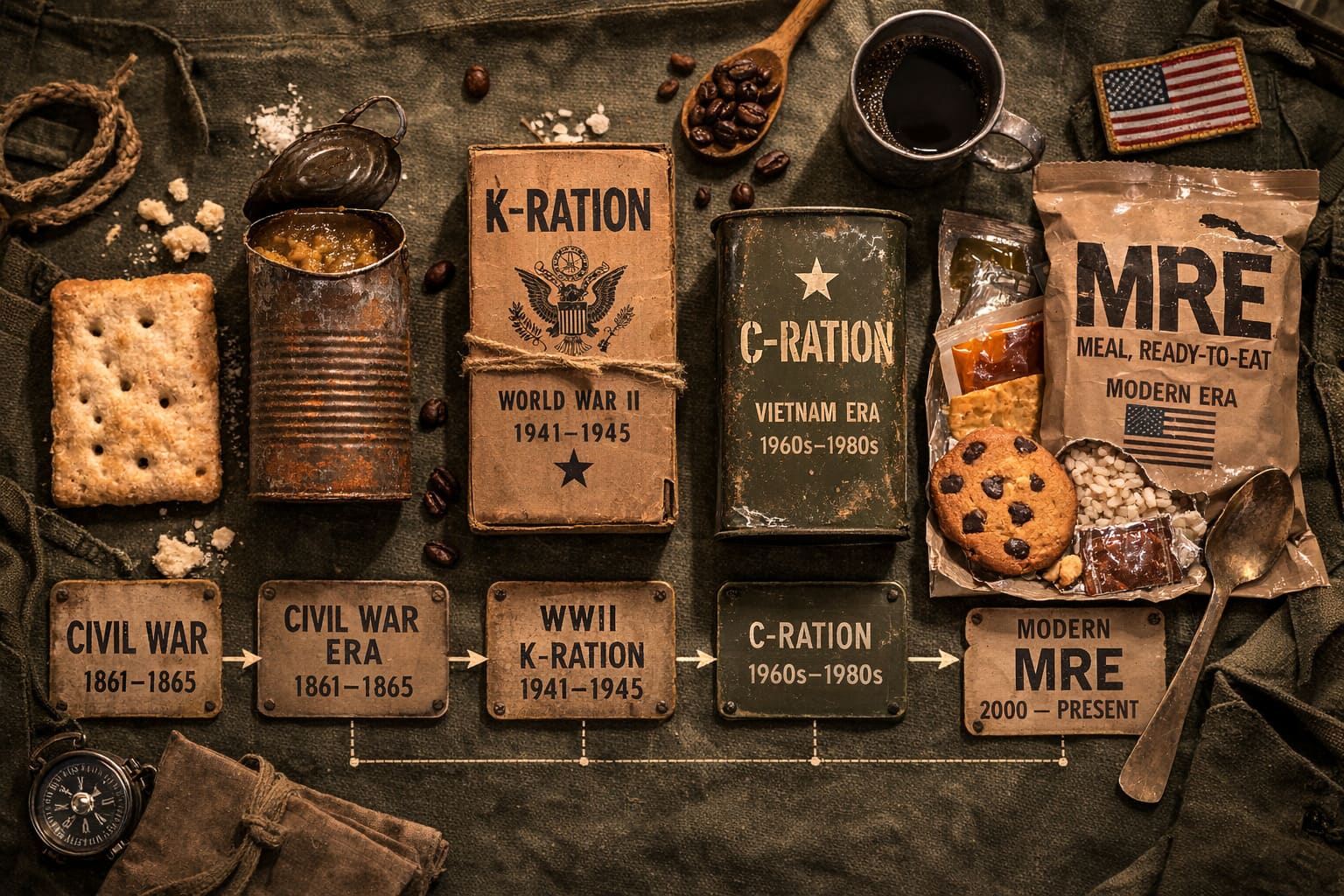
The history of military rations is a long argument between two things armies want and cannot have together: food that keeps and food a soldier will actually eat. Romans issued raw wheat and left the milling to the men. Civil War armies shipped crackers baked until they were nearly stone. Twentieth-century American planners built the C-ration, the K-ration and finally the pouched MRE, and every one of them drew complaints.
What did Roman soldiers get to eat?
The Roman army issued grain, not meals. In the second century BC a soldier received about 66 pounds of wheat a month, and it came whole, so each man had to mill it himself. Rations were handed out several times a week, which left a soldier carrying roughly three days of food. The cost, about 60 denarii a year, was deducted from his pay.
Wheat was eaten as bread or as puls, a porridge of emmer wheat. Smoked bacon traveled better than olive oil, which needed barrels or fragile clay jars, so bacon was the usual meat. Lentils, beans, soft cheese and vinegar filled out the issue. Water went stale in storage, so it was cut with vinegar to make posca, a sour drink that masked the taste.
There was no mess hall. Each contubernium, a group of eight men, cooked for itself, in a shared pot or by turns.
For marching, the army had a hard biscuit called bucellatum. It is known from Roman times, though no firm date for its introduction turned up in the sources consulted.
Hardtack: the cracker that outlived its eaters
Hardtack is flour and a little water, sometimes with salt, baked until it holds almost no moisture. Ships' biscuit meant for long voyages was baked four times instead of the usual two, and prepared about six months before sailing.
The record is long. In 1189 to 1192, during the Third Crusade, England's King Richard took a grain biscuit of barley, bean flour and rye. In 1665 Samuel Pepys regularized the Royal Navy's victualling, which included a daily pound of biscuit. A ship's biscuit from about 1852 sits in a maritime museum at Kronborg, Denmark, said to be the oldest in the world.
In the American Civil War, Union and Confederate storehouses shipped squares about three inches across. Soldiers named them "worm castles," "tooth dullers" and "sheet iron." The worms were real: weevil larvae turned up in badly stored supplies. John Billings published Hard Tack and Coffee in 1887, and in it he described how men crumbled the biscuit into coffee, skimmed the larvae off the top and drank on. By his account the grubs "left no distinctive flavor behind."
Hardtack stayed a naval staple until canned food took over. For more on the bread side of this story, see the history of bread.
A French confectioner and the sealed jar
Preserving cooked food in a sealed container began with a prize. In 1795 the French government offered a reward for a way to keep food for transport. Nicolas Appert, a chef, confectioner and distiller, spent the next 14 years experimenting. Britannica describes his method: corked glass containers reinforced with wire and sealing wax, held in boiling water for varying lengths of time. He preserved soups, fruits, vegetables and dairy products.
He received 12,000 francs in 1810, on condition that he publish, and his book appeared that year. Peter Durand patented a tin-can version the same year, and in 1812 Bryan Donkin and John Hall bought both patents. Canned meat was on the market in 1814, and the Royal Navy officially issued canned beef from 1847. Appert died in poverty in 1841.
For the other end of the problem, when no ration arrives at all, see siege food history.
The C-ration and the can that stayed on the menu
In 1938 the Quartermaster's laboratory in Chicago began work on a replacement for the Reserve Ration of the First World War. The result was the Field Ration, Type C, aimed at better taste, balanced nutrition and a longer shelf life. It had two parts. The M-unit held a canned entree, such as meat and beans or a vegetable hash. The B-unit held crackers, sugar or candy, and a drink mix such as instant coffee or bouillon.
The Quartermaster Corps said it was intended for no more than three days. It was used for far longer. Stocks of C-rations were issued in Korea, and a Marine tank commander in Vietnam in 1968 reported cans dated from the early 1950s. The ham and lima beans entree stayed on the menu through the Korean War. The Meal, Combat, Individual of 1958 was nearly the same thing and kept the old nickname.
The K-ration and the six volunteers
In 1941 the War Department asked Ancel Keys, a physiologist at the University of Minnesota, to design a non-perishable pocket meal. His first versions used shop-bought items: hard biscuits, dry sausage, hard candy and chocolate. He tested them on six soldiers, who called the meals "palatable" and "better than nothing."
The Quartermaster Corps refined the design as the Field Ration, Type K, first bought in May 1942. It was meant for paratroopers, tank crews and motorcycle couriers, for short periods. Three boxed meals (breakfast, dinner and supper) added up to 2,830 kilocalories and 79 grams of protein.
Short periods did not stay short. In Burma, Merrill's Marauders lived heavily on K-rations and reportedly lost an average of 35 pounds a man over five months. Troops threw away components they could not stand. The K-ration was declared obsolete in 1948. More wartime cases are in wartime foods history.
The MRE and the history of military rations since 1963
In 1963 the Defense Department began work on a "Meal, Ready to Eat" that would be lighter than the canned ration. A dehydrated Long Range Patrol meal in a canvas pouch arrived in 1966. At the Natick research center, Rauno Lampi refined the retort pouch so that a wet meal could be eaten straight from the package.
The MRE went into special issue in 1981 and became standard issue in 1986, with twelve entrees. Soldiers produced their own expansions of the acronym, among them "Meals Rejected by Everyone." The flameless ration heater, which warms a pouch through a chemical reaction set off by a little water, arrived in 1990 and went into every meal with MRE XIII in 1993.
Each meal provides about 1,200 kilocalories, and the minimum shelf life is three years. The Institute of Medicine estimated that service members burn about 4,200 calories a day but ate only about 2,400 in combat.
Questions people ask
What was the first military ration?
Organized armies have always issued food, but the best-documented early system is the Roman one. In the second century BC a legionary got about 66 pounds of wheat a month, issued whole and milled by the soldier. The cost, about 60 denarii a year, came out of his pay.
Why did soldiers eat hardtack?
Hardtack is flour and a little water baked until almost dry, so it lasted far longer than bread and survived rough transport. In the American Civil War, Union and Confederate armies both shipped it in squares about three inches across. Soldiers often crumbled it into coffee to soften it.
Who invented canned food for armies?
Nicolas Appert, a French chef and confectioner, began experimenting in 1795 after the French government offered a prize for a way to preserve food for transport. He sealed food in corked glass containers and boiled them. Peter Durand patented a tin-can method in 1810, and the Royal Navy officially issued canned beef from 1847.
What is the difference between a C-ration and a K-ration?
The C-ration, developed from 1938, was a set of canned items: a main course in the M-unit and crackers, candy and a drink in the B-unit. The K-ration, designed by Ancel Keys in 1941, packed three meals in boxes for paratroopers and other mobile troops. The K-ration was declared obsolete in 1948.
When did the MRE replace the C-ration?
The Meal, Ready-to-Eat went into special issue in 1981, replacing the canned Meal, Combat, Individual, the later form of the C-ration. It became standard issue in 1986 with twelve entrees. The flameless ration heater was added in 1990 and included with every meal from 1993.
Filed under War & Famine
Want more stories like this?
One food history story, every week. No spam, just the stories behind what the world eats.