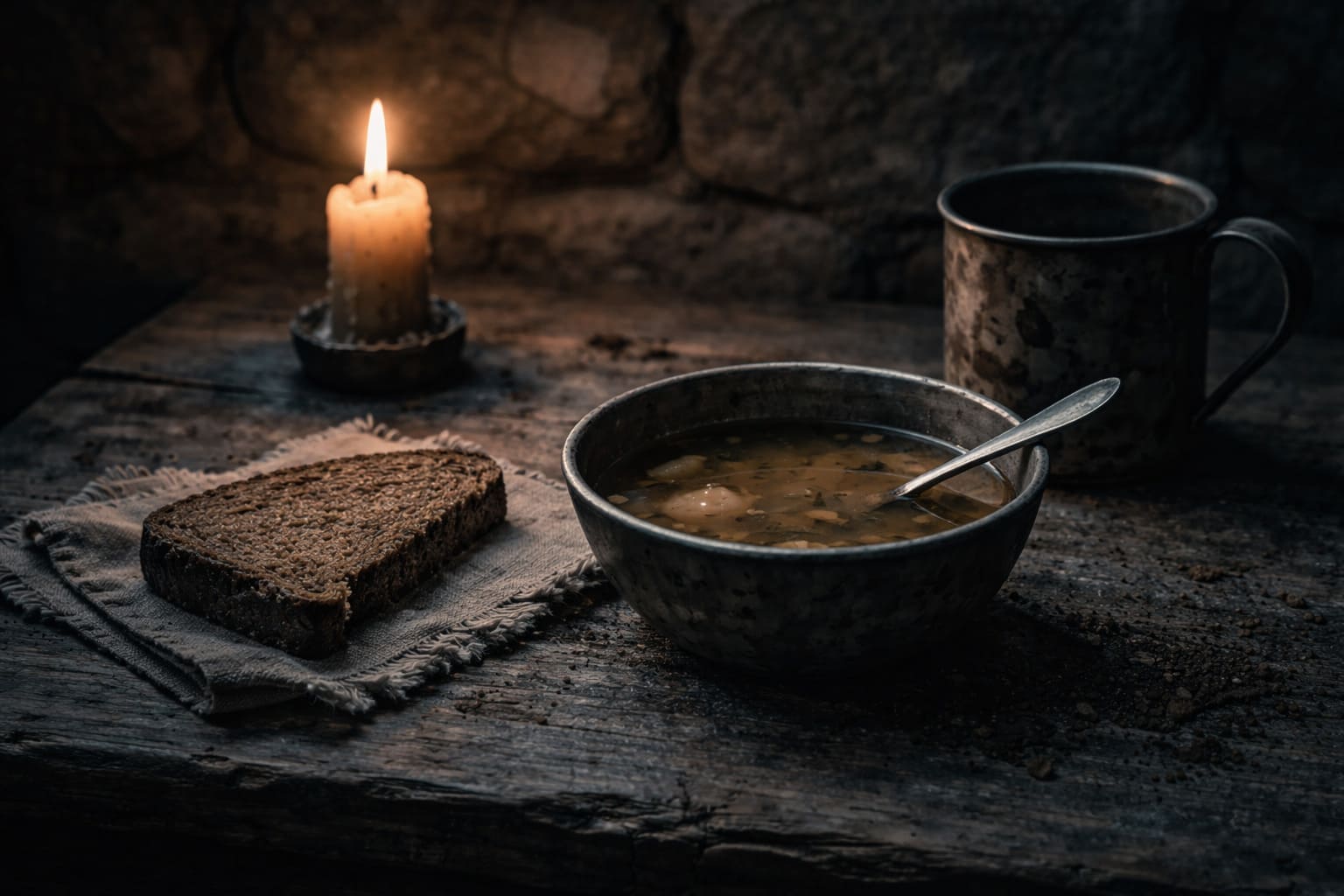
Siege food history comes down to one rule: when a city is cut off, people eat the animals first, then the stretchers, then the things that were never food. Paris in 1870 ate its horses, dogs and zoo. Leningraders in 1941 ate bread that was partly cellulose. Vicksburg in 1863 ate mule. Sarajevo, in the 1990s, ate airdropped pasta and weeds.
The details are better than the legends, and a few of the legends need trimming.
Paris, 1870: from horse to elephant
The Prussian siege of Paris ran from 19 September 1870 to 28 January 1871, a little over four months. Rationing came late. According to the standard account, nothing was rationed until mid-October, and then only meat. Bread was rationed at the very end. Price controls existed, but they were poorly enforced, and a black market flourished.
Parisians turned to horses in early October. By mid-November fresh meat had run out, and butchers were selling dog and cat. Rats were eaten too, but in smaller numbers than the legend suggests, because people feared disease and the preparation cost money.
Then came the zoo. The Jardin des Plantes slaughtered its animals, including Castor and Pollux, the only pair of elephants in Paris. A Christmas menu from the 99th day of the siege offered roast camel, kangaroo stew and wolf haunch. Another, from the Latin Quarter, listed horse consommé, dog cutlets and rat salami. Accounts of the elephant meat itself were not kind. The journalist Henry Labouchere called it "tough, coarse, and oily," and the writer Thomas Gibson Bowles, who tried camel, antelope, dog, donkey, mule and elephant, ranked elephant last.
Exotic menus were for people with money. Most Parisians had horse, then whatever the butcher still had. By January, 3,000 to 4,000 people a week were dying of cold and hunger. Food shipments from the provinces, Britain and the United States began entering the city almost as soon as it surrendered.
Vicksburg, 1863: mule, rats and a newspaper on wallpaper
Ulysses S. Grant's army besieged Vicksburg, Mississippi, from 18 May to 4 July 1863. The Confederate commander, John Pemberton, was boxed in with plenty of ammunition and little food. By the end of June half his soldiers were sick or in hospital, with scurvy, malaria and dysentery spreading. Many adults, one account says, resorted to eating shoe leather.
The American Civil War Museum notes that the Confederate army had already seized livestock, vegetables and produce, which "drained the town of supplies." Residents made a coffee substitute from sweet potatoes or other vegetables and ate frogs, mules, squirrels and rats. Newsprint ran short as well, so the Vicksburg Daily Citizen printed its news on wallpaper.
The garrison surrendered on 4 July 1863, at 10:00 in the morning.
What was Leningrad's siege bread made of?
The German encirclement of Leningrad began on 8 September 1941 and lasted 872 days, until 27 January 1944. The first blow was to the stores. Bombing in the first weeks destroyed the main food warehouses, and residents later dug up soil soaked with melted sugar to boil out what they could.
Ration cuts followed. In early September 1941 manual workers were allowed 600 grams of bread a day. By the regulation of 20 November 1941, factory workers and engineers got 250 grams and everyone else, children included, 125 grams. Those were the lowest rations of the whole siege. For readers who want the ordinary version of the loaf, the history of bread shows how far this was from it.
The bread was stretched with whatever chemists could approve. Researchers at ITMO University describe the additives as dark rye flour, knotweed seed flour, saltbush, birchbark, flour dust, plant pulp, soybean meal and hydrated cellulose. A biochemist, Mikhail Knyaginichev, ran bread research at a laboratory in the Badaev bread factory and developed a yeast culture that raised the loaf's volume and saved flour. Another team found a way to ferment cellulose with fungi to improve the bread. The additives were not desperate improvisation by hungry cooks. They were a managed scientific effort.
Individual households went further. Residents boiled old leather, and it is recorded that they scraped potato-starch paste off the walls to cook into a soup. Reports of cannibalism began in the winter of 1941-42, though historians describe them as comparatively few given the scale of starvation.
Death tolls are disputed. The Soviet government's postwar figure was about 670,000 registered deaths, while independent studies suggest 700,000 to 1.5 million, with civilian losses around 1.1 to 1.3 million. Deaths peaked at about 100,000 a month in January and February 1942. Supplies crossed Lake Ladoga by boat in summer and over the ice in winter, with the ice road working from 20 November 1941.
Sarajevo, 1992-1996: nettles and airdropped pasta
The siege of Sarajevo lasted from 5 April 1992 to 29 February 1996, about 1,425 days. Bosnian Serb forces set up a total blockade in May 1992, cutting supplies of food and medicine, and also water, electricity and heating. At some points residents went up to six months without gas, electricity or water.
Food came by air and by tunnel. UN forces ran a humanitarian airlift from mid-1992 to early 1995, with more than 13,000 flights. Defenders later dug a tunnel beneath the airport runway, which became the city's only land link to the outside world. Before it existed, several hundred people died running across the airstrip.
Aid alone did not fill plates. People ate what they could make from airdropped pasta and powdered milk, and gardens were turned over to vegetable patches. The researcher S. Redzic recorded the wild plants eaten during the siege: nettles, dandelions, coltsfoot, chicory and common mallow were the ones most often named, with young leaves and stems the usual parts.
Where wartime food and siege food overlap
A siege differs from ordinary wartime shortage in one respect: there is no way out, so the cost of every bite is counted in days. Wartime food rationing in Britain or America worked with ships and farms behind it. Military rations were designed to move. A besieged city has neither, only a stockpile and a date nobody knows. That is why the pattern keeps repeating: slaughter the draught animals, requisition the grain, then stretch the bread. Bread has been central in every culture, and every siege here ends up reworking it first.
On 28 January 1871 the guns around Paris stopped, and food trains were already on the way.
Questions people ask
What did people eat during the siege of Paris in 1870?
Parisians ate horses from early October 1870, then dogs and cats once fresh meat ran out in mid-November. Rats were eaten in smaller numbers. Zoo animals from the Jardin des Plantes, including the elephants Castor and Pollux, were also slaughtered. Christmas menus listed roast camel, kangaroo stew and wolf haunch.
What was the bread ration in besieged Leningrad?
From 20 November 1941, Leningrad factory workers and engineers received 250 grams of bread a day, and all other residents, children included, received 125 grams. These were the lowest rations of the 872-day siege. The bread was stretched with additives such as knotweed seed flour, birchbark, soybean meal and hydrated cellulose.
Did people at Vicksburg really eat mules and rats?
Yes. The American Civil War Museum lists frogs, mules, squirrels and rats among the meat substitutes eaten in Vicksburg in 1863, after the Confederate army had seized the town's livestock, vegetables and produce. The siege ran from 18 May to 4 July 1863, and half the garrison was sick by late June.
How did Sarajevo residents find food during the siege?
Sarajevans relied on a UN airlift of more than 13,000 flights, a tunnel under the airport runway, and their own gardens. They also gathered wild plants. Researcher S. Redzic recorded nettles, dandelions, coltsfoot, chicory and common mallow among the most commonly eaten during the 1,425-day siege.
Filed under War & Famine
Want more stories like this?
One food history story, every week. No spam, just the stories behind what the world eats.