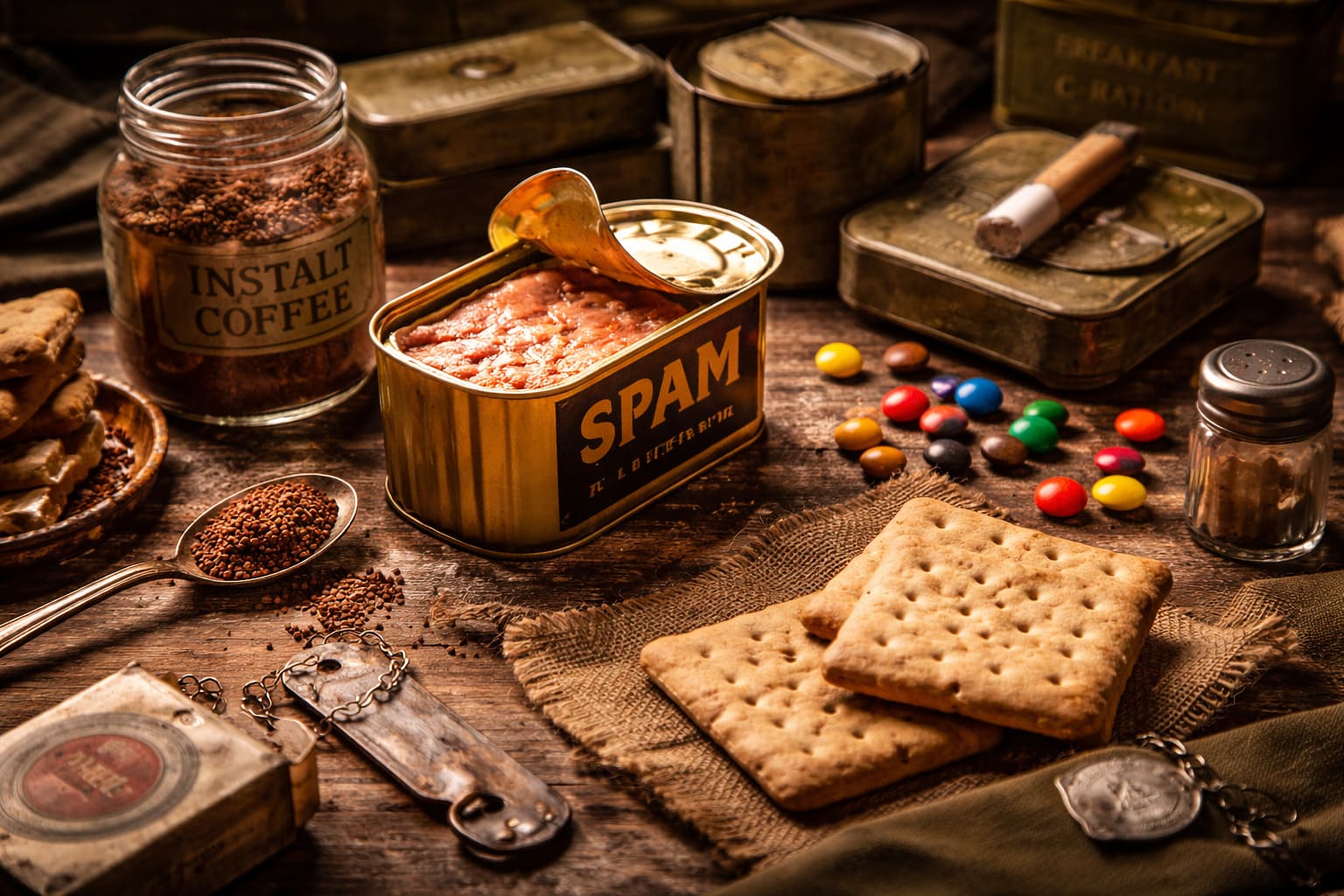
Only a few well-known foods were truly invented in wartime, and the best example is canning: the French government wanted a way to feed its armies, and a Parisian confectioner named Nicolas Appert answered in 1809. Spam, instant coffee and M&Ms came from peacetime inventors. What war did was make them famous, by buying them in enormous quantities.
The French prize that led to the can
Britannica's account is short. Appert invented canning in France in 1809, "in response to a call by his government" for a way to preserve food for army and navy use. His method was to seal food tightly in a bottle or jar, heat it to a set temperature for a set time, and keep it sealed until it was eaten.
The prize story is messier than the popular version. One account says the French government had offered 12,000 francs, before the Napoleonic wars, for a cheap way to preserve food for the Grande Armee, and that Appert collected it in 1810. Another, more careful, account says the 1795 offer came from the army, that Appert got nothing when he showed bottled goods at a national industrial exhibition in 1806, and that in 1810 the Ministry of the Interior paid him 12,000 francs as a favor, on condition that he publish his process. That same year he did: a treatise, with 6,000 copies printed.
Nobody could say why it worked. Britannica notes that it took about 50 years before Louis Pasteur explained that the heat killed the microorganisms and the seal kept others out. Appert had a working method and no theory.
Tin replaces glass
Glass jars travel badly. In 1810 an Englishman, Peter Durand, patented the use of tin-coated iron cans instead of bottles. One account says the process was allegedly developed by the Frenchman Philippe de Girard, with Durand acting as his agent in Britain. Durand sold the patent in 1811 to Bryan Donkin and John Hall, and Donkin's workshop made the early cans by hand. They could take up to six hours to cook.
The market was the navy. Britannica says that by 1820 Durand was supplying canned food to the Royal Navy in large quantities. Canned meat also went north with Arctic explorers: Parry in 1824, Ross in 1829, Franklin in 1845. The can opener, by one account, did not arrive for roughly another thirty years, so for a long time you opened the tin with whatever tool was at hand. The big nineteenth-century wars, the American Civil War among them, then pushed canned food into more households, and put it in front of working-class men who had never bought it.
The story of how armies feed themselves has more chapters, and we tell them in the history of military rations.
What Spam was made for
Spam was not a war product. The George A. Hormel Company of Austin, Minnesota, introduced it in 1937, according to the Minnesota Historical Society, "to use up an excess of pork shoulder" in its inventory. A man named Kenneth Daigneau won $100 for suggesting the name. What he meant by it is unclear. It is usually taken to be short for spiced ham, but Hormel says only a few former executives ever knew.
War found it a few years later. Hormel shipped canned Spam abroad to feed Allied troops and civilians through the 1940s, and the product suited mass feeding because it needed no refrigeration and kept for a long time. Totals quoted for the war years differ a lot from source to source, so treat any single number with caution. The Minnesota entry says Spam was available so often in military meals, sometimes two or three times a day, that many veterans would not eat it at home. It also records that in 1966 Dwight D. Eisenhower wrote to Hormel's president that millions of soldiers had eaten Spam, and that he forgave the company for sending so much of it. Khrushchev, in his memoirs, is quoted as saying: "Without Spam, we wouldn't have been able to feed our army."
The occupation left lasting habits. Hawaiians have eaten Spam since the war and buy more than seven million cans a year, and South Korea ranks second to the United States in Spam sales. The Korean dish budae jjigae, army stew, grew from the Korean War, when Americans brought Spam with them.
Was instant coffee a wartime invention?
No, and the usual credit is wrong in two places. For years the invention was attributed to Satori Kato, a Japanese scientist in Chicago who showed a powder at the 1901 Pan-American Exposition in Buffalo. More recent writing treats that as outdated: David Strang of Invercargill, New Zealand, filed for a patent in January 1889 and received it in 1890, and sold "Strang's Soluble Coffee Powder." George Washington (the chemist, not the president) put his own version on sale in 1910.
The version in your pantry came later. Nestle began developing it in 1932, at the urging of a bank that was holding surplus South American coffee after prices fell. Chemist Max Morgenthaler led the work, and the product went on sale as Nescafe in Switzerland on April 1, 1938. It was about half coffee solids and half maltodextrin, which made spray drying workable.
Then came the war. Nescafe, in one account's words, became known worldwide during the Second World War through its inclusion in the rations of the US Army, and American troops introduced instant coffee to Britain. The war did not invent the product, but it gave a Swiss novelty a few million regular customers. For the older story of the drink itself, see the history of coffee.
The candy that did not melt
M&M's belong to the same pattern. Forrest Mars received a US patent for his sugar-coating process on March 3, 1941. The business was called M&M Limited, and the two Ms were the surnames of Mars and Bruce Murrie, whose father, William Murrie, ran the Hershey Chocolate Company. Production began in Newark, New Jersey in 1941.
During the war, the candies went exclusively to the military, because the hard sugar shell let chocolate survive hot climates. The story that Mars got the idea from British Smarties while in Spain during the Spanish Civil War is repeated everywhere, but the supporting sources are thin. It is likely, not proven.
If you want chocolate's longer path before the shell, read the history of chocolate.
Which foods were invented in wartime, and which were not?
The popular list is longer than the documented one. Some claims in circulation, such as Cheetos coming from surplus military extruders, Tang coming from the space program, or margarine rising out of the First World War, were not confirmed in the sources used here, so we leave them out.
| Food | Invented | Wartime role |
|---|---|---|
| Canning | 1809, France | Made for the army and navy |
| Tin can | 1810, Britain | Supplied to the Royal Navy by 1820 |
| Spam | 1937, Minnesota | Shipped to Allied troops in the 1940s |
| Nescafe | 1938, Switzerland | Issued in US Army rations |
| M&M's | Patent 1941, US | Sold to the military only |
Siege and famine produced a different kind of invention, improvised substitutes rather than products, which is the subject of our piece on siege food. For one-off accidents in the kitchen, see foods invented by accident.
Appert, for his part, was paid in 1810 and went on to receive silver and gold medals in 1816 and 1820 from the Societe d'encouragement pour l'industrie nationale. The 2,000 francs attached to them were not paid until 1824.
Questions people ask
Who invented canning?
Nicolas Appert, a Parisian confectioner, invented canning in France in 1809 after the government asked for a way to preserve food for its army and navy. He sealed food in glass jars and heated them. In 1810 Peter Durand patented tin-coated iron cans in England.
Was Spam invented for World War II?
No. Hormel introduced Spam in Austin, Minnesota in 1937 to use up surplus pork shoulder. The war came later and made it famous, because the canned meat needed no refrigeration and Hormel shipped it to Allied troops and civilians through the 1940s.
When was instant coffee invented?
Instant coffee dates to the 1890s at least. David Strang of Invercargill, New Zealand, patented a soluble coffee powder in 1890. The Nescafe brand launched in Switzerland on April 1, 1938, and became widely known through US Army rations in World War II.
Why were M&M's made with a hard shell?
The sugar shell let chocolate survive hot climates. Forrest Mars patented his sugar-coating process on March 3, 1941, and during World War II the candies were sold exclusively to the military. The idea may have come from British Smarties, but that link is not firmly documented.
Filed under War & Famine
Want more stories like this?
One food history story, every week. No spam, just the stories behind what the world eats.