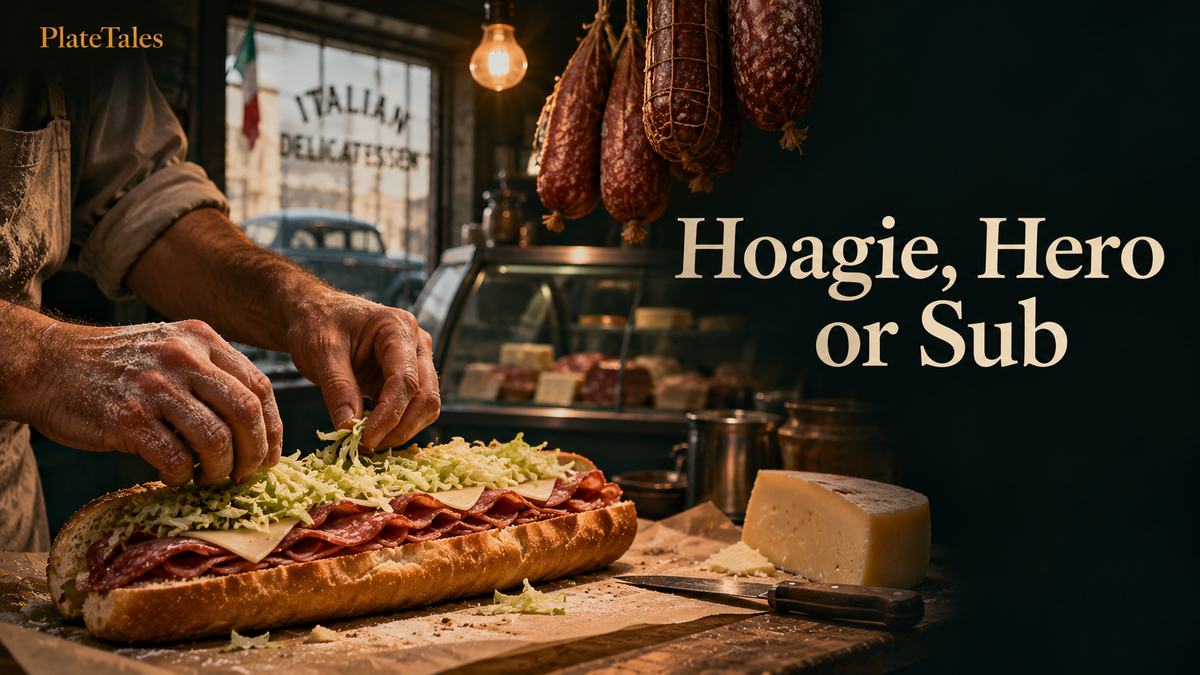
The submarine sandwich is a long Italian-style roll split and filled with cold cuts, cheese and vegetables, and it grew up in the Italian-American neighborhoods of the northeastern United States in the first decades of the twentieth century. Nobody can name a single inventor. What the record does show is a sandwich that picked up a different name in almost every city it reached.
Why is it called a submarine sandwich?
The tidy answer is a naval one: a base at New London, Connecticut, sailors on leave, a sandwich shaped like a hull. A July 1955 trade magazine, Restaurant Management, said flatly that the name "came from New London, Conn.," as Barry Popik's research file records, but it gave no evidence. The printed record points elsewhere.
Popik's earliest dated hit is in Paterson, New Jersey: the Paterson Evening News of November 28, 1930 mentions a bet paid in "submarine" sandwiches, and the same paper called a submarine sandwich a favorite dish on August 1, 1931. Wilmington, Delaware, ads follow, among them a December 4, 1936 notice for an "Italian Submarine Sandwich" and a January 1940 telephone directory listing.
Paterson also has the best-known naming story. Dominic Conti, an Italian immigrant born in 1874 who ran a grocery on Mill Street, is said to have named the sandwich after he saw an early submarine on display in a local museum. His April 5, 1954 obituary in the Evening News does say police on the "Dublin" beat remembered the "submarine" sandwiches he made. The submarine story itself has no document behind it, and accounts disagree on which boat it was (CooksInfo says the Holland 1 in 1927, Popik's page says the Fenian Ram in 1928), so treat it as a claim.
The word that won is the odd one out. In a 1967 American Speech article, "The Submarine Sandwich: Lexical Variations in a Cultural Context," Edwin Eames and Howard Robboy found that "sub" was the only name not tied to a particular region.
Hoagie: the Hog Island story and its rivals
Philadelphia says hoagie, and Philadelphia has several explanations.
The best known runs through Hog Island, the shipyard on the Delaware River that built ships for the First World War. Italian workers there, the story goes, brought long sandwiches for lunch and were called "hoggies." The Philadelphia Encyclopedia calls this unlikely because the name does not appear in print until much later. The Word Origins site notes that the yard ran from 1917 to 1920 and closed in 1925, while the sandwich name is not attested until 1941.
The explanation the Philadelphia Encyclopedia calls the most widely accepted belongs to Al DePalma, a former musician. He opened a sandwich shop in 1936 and called his sandwiches "hoggies," and customers said "hoagies." He told people he had thought, back in 1928, that you would have to be a hog to finish one, and styled himself the "King of the Hoggies."
The printed trail is Popik's. He found "hoogie" in January 1941, "hogie" in September 1943 and "hoggie" in October 1944, all in Philadelphia directories or advertising. A 1945 directory that Eames and Robboy cited lists "hoagie" and "hoggy."
Other theories do not fare better. The food historian William Woys Weaver ties the word to H.M.S. Pinafore, which reached Philadelphia in the 1880s, long thin "pinafore" rolls, and the hokey-pokey men who sold sandwiches on them. A 1953 Philadelphia Evening Bulletin piece suggested hoboes "on the hoke," and Word Origins finds no other trace of the phrase.
One more story concerns the sandwich and not its name. In 1925 the DiCostanza family's grocery in Chester, Pennsylvania, is said to have served a customer a meat-and-cheese sandwich with fried peppers. Philadelphia Magazine, which tells it, notes that this explains the sandwich but not the word.
Hero, grinder, and the map of names
The word "hero" is a New York word, and its paper trail is better than most. Barry Popik's research for his Big Apple site turns up the phrase in the Albany Evening News on June 6, 1934, in an Associated Press item noting that a prominent woman served "hero sandwiches" to her guests. The Brooklyn Times Union had a "husky man-sized sandwich" on August 23, 1936. A Works Progress Administration lexicon of trade jargon defined hero as "a big sandwich" in 1937. In June 1939 Walter Winchell described the "Hero Sandwich" in his column as a loaf of Italian bread with ham and cheese.
Some credit the food writer Clementine Paddleford with the name, citing a line attributed to her, "You'd have to be a hero to finish one." Her piece on Manganaro's heroes ran in the New York Herald Tribune on August 9, 1947, thirteen years after the Albany item, so she cannot have coined it.
"Grinder" belongs to New England. Popik's file gives its earliest dated print use as a December 14, 1935 ad for the Elm Tavern in Wethersfield, Connecticut, and records two explanations: shipyard workers who ground welds at the Electric Boat yard in Groton, and bread so chewy it made you grind your teeth. The term, he notes, usually means a baked or toasted sandwich.
The list gets stranger from there.
| Name | Where | What the sources say |
|---|---|---|
| Hero | New York City | Printed in 1934, defined in a 1937 jargon lexicon |
| Hoagie | Philadelphia, South Jersey | "Hoogie" in a January 1941 directory; DePalma's shop opened in 1936 |
| Grinder | New England | First dated ad 1935; shipyard workers or tough crust |
| Spukie | Boston | Used in Dorchester, South Boston and Roxbury for a roll pointed at the ends |
The New Orleans cousin
The po' boy is a relative, not a branch. Benny and Clovis Martin moved from Raceland, Louisiana, worked as New Orleans streetcar conductors in the mid-1910s, and opened a restaurant in 1922. When the streetcar men struck on July 1, 1929, the Martins wrote in a letter of support, "Our meal is free to any members of Division 194." They worked with the bread supplier John Gendusa to make a longer, uniform loaf, originally forty inches long, for big sandwiches.
According to 64 Parishes, the term "poor boy" was first applied during the 1929 strike and began appearing in newspapers and on menus in the early 1930s. The same entry is wary of the tidier legends that have grown up around it, and notes that no documentary evidence supports the theory that the name came from "pour bourre," for tips.
How the sandwich left the delis
The sandwich moved with its makers. Italian immigrants ran grocery counters and bakeries in Connecticut, Pennsylvania, New York and New Jersey, and the filled loaf was a cheap, portable lunch for dock and shipyard workers. The story of the Italian-American food that followed those workers is mostly a story of small shops. Later, pizzerias across the same states added subs to their menus, and that is how many towns outside the old neighborhoods first met one. The pizza side of that trade is told in the history of pizza.
The hot cousin is a separate case. The Philly cheesesteak went into a similar roll in the same city that argues about hoagies, and the broader question of who first put filling between bread is covered in who invented the sandwich.
Howard Robboy told a Washington Post reporter in 1977, according to Popik's file, about his American Speech work on sandwich names. The paper trail for "submarine" and "hero" is far thicker than any single inventor's claim.
Questions people ask
Is a hoagie the same as a sub?
Mostly yes. Both are long Italian-style rolls filled with cold cuts and cheese. Hoagie is the Philadelphia and South Jersey word, while Eames and Robboy found in 1967 that "sub" was the only name of the sandwich not tied to a region. In New England, a grinder usually means a baked or toasted sub.
Where did the word hoagie come from?
The most repeated story is that Italian workers at the Hog Island shipyard near Philadelphia were called "hoggies" in the First World War. The Philadelphia Encyclopedia calls that unlikely because the name is not in print until much later. The most widely accepted account credits Al DePalma, who opened a sandwich shop in 1936 and called his sandwiches "hoggies."
Why is a hero sandwich called a hero?
Nobody knows. The phrase appears in print in the Albany Evening News on June 6, 1934, and a 1937 Works Progress Administration lexicon of trade jargon defines hero as "a big sandwich." Clementine Paddleford is sometimes credited, but her first piece on heroes ran in 1947, years after the first print use.
Who invented the submarine sandwich?
No one person has been proven. Dominic Conti of Paterson, New Jersey, is said to have named it after seeing a submarine, a story with no document behind it. The earliest dated print use found so far is a November 28, 1930 item in the Paterson Evening News, and Wilmington, Delaware, ads follow from 1936.
Filed under Migration Stories
Want more stories like this?
One food history story, every week. No spam, just the stories behind what the world eats.