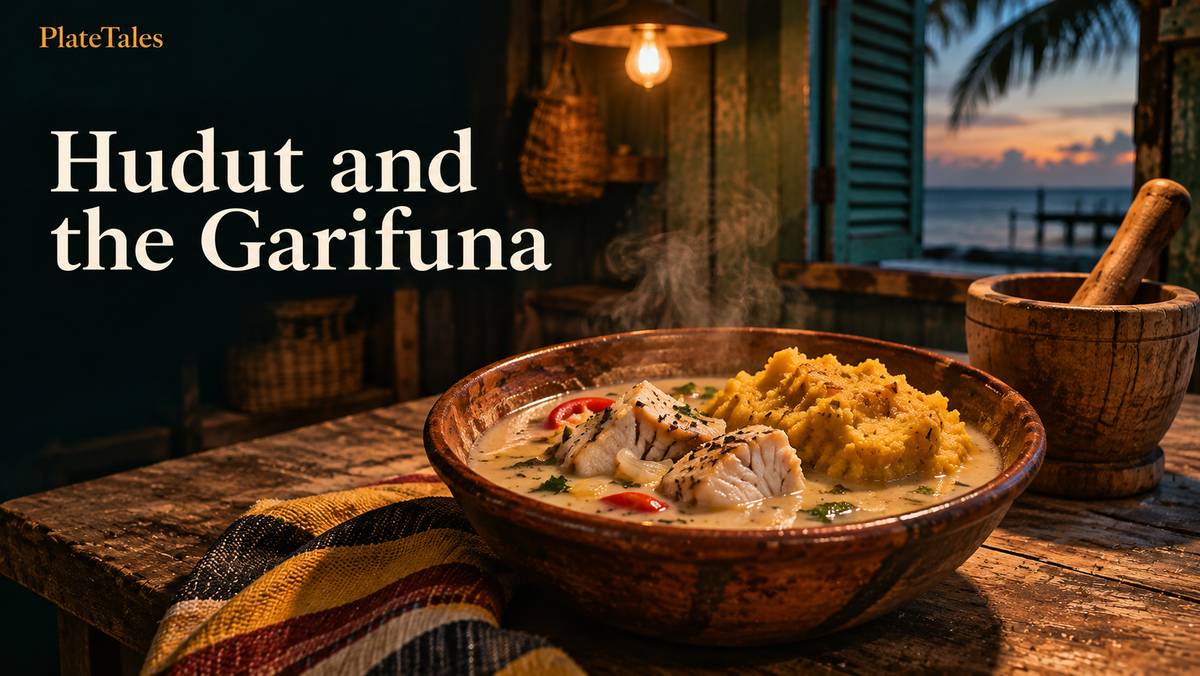
Hudut is the fish-in-coconut-milk stew of the Garifuna, served over mashed plantain, and its history is the history of a people moved around the Caribbean by force. The dish comes from communities on the Central American coast, Belize among them, whose ancestors were deported from St Vincent by the British in 1797. Every year on 19 November, Belize marks Garifuna Settlement Day, and hudut is on a great many tables.
What is hudut, exactly?
Two things in one bowl. The first is a stew of fish cooked in coconut milk. The second is plantain, boiled and then pounded into a heavy mash that sits in the bottom of the bowl or alongside it. The Smithsonian Folklife Festival, in a 2022 piece by foodways intern Katie Reuther, describes it simply as a coconut milk-based fish stew served with mashed plantains, and calls it a traditional Garifuna dish.
The Smithsonian piece opens at the house of Veronica Tun, a fisherwoman in Belize, where "Saturdays are for hudut." Her family knows it is coming when they hear her pounding plantains. She usually makes it with snapper or grouper. At the 2022 Festival in Washington she made it with lionfish, an invasive species that fishing groups in the Caribbean are trying to turn into a catch worth selling.
A Belizean guide to Garifuna dishes on the site Belize Living sorts the family of coconut dishes this way: hudut is a coconut milk fish soup over mashed plantains, bundiga is seasoned fish in a gravy of grated banana and coconut milk, and "serre" is fish cooked in coconut milk. The Belize Living guide also lists darasa, a Garifuna version of a tamale made from green bananas and filled with fish or chicken, and notes that cassava bread takes two days to make and appears at most meals.
Who are the Garifuna?
The name Garifuna comes from Karifuna, the word the Kalinago (Island Carib) people used for themselves. The Garifuna are an Afro-Indigenous people who formed on the island of St Vincent, which they called Yurumein, from Kalinago and Arawak people and Africans who arrived by shipwreck or by escaping slavery on nearby islands. Scholars disagree about the details. The Smithsonian article gives a seventeenth-century shipwreck off St Vincent as the beginning of the story.
European writers called them "Black Caribs" from the seventeenth century on. In 1795 William Young published an Account of the Black Charaibs that described the Afro-Indigenous majority as interlopers from Africa. Modern historians criticize that framing, which served British interest in taking the island's land.
Hudut and Garifuna history: from St Vincent to Roatan
Britain fought two wars on St Vincent for the land. The First Carib War began in 1769 under the chief Joseph Chatoyer, and a peace was signed in 1773. The Second Carib War began in 1795. By 1796 forces under Ralph Abercromby had defeated the resistance.
In 1797 the British deported the Caribs with more African features, first to Jamaica and then to Roatan, off Honduras. Those with more Amerindian features were allowed to stay. More than 5,000 people were deported, and only about 2,500 survived the voyage. They landed on Roatan on 12 April 1797.
From Honduras the Garifuna spread along the Caribbean coast, north to Belize and Guatemala and south to Nicaragua. A 1981 count puts about 65,000 Garifuna in fifty-four fishing villages across those three countries. Fishing and coconut palms are close at hand in villages like these, which is the plain reason a fish stew built on coconut milk is at home on that coast.
What does the 19 November holiday actually mark?
Garifuna Settlement Day marks the arrival of the Garifuna in Belize. The date most often given for the landing is 1832. Accounts differ on the details. The town of Dangriga, the centre of the celebrations, was "settled before 1832" by Garifuna from Honduras, and was declared a town on 15 February 1895. No single landing in 1832 is documented, so the neat story of one boat on one morning is one the evidence does not carry.
What is documented is the holiday itself. The Belizean civil rights activist Thomas Vincent Ramos created it in 1941. It was recognized as a public holiday in the southern districts in 1943 and declared a national holiday in 1977. If 19 November falls on a Sunday, the following Monday is observed.
The main events are in Dangriga: a week-long lead-up with a torchlit parade, a wreath-laying at the T.V. Ramos monument, the selection of Miss Garifuna and a bike race, along with street music and dancing. Punta rock, the dance music, began in the town.
Why this stew became the dish people point to
The Garifuna closely identify with their food, and the Belize Living author names fish, chicken, cassava, bananas, plantains, coconut milk and rice as its base. Hudut gathers several of these at once, which may help explain why it is the dish visitors are steered toward. Hopkins, Dangriga and Seine Bight are the Garifuna villages the same author recommends for eating it.
The pounding of plantain is also the part that ties the dish to other places. Starchy mashes eaten with a sauce are common across West Africa, and hudut is often compared to them. No documented source traces hudut itself to a particular African dish, so that link is an observation by cooks and writers, not a documented line of descent. Plantains and coconuts are also not native to St Vincent, so the ingredients have their own travel stories. Our pieces on rice and soul food follow similar paths of crops and cooks moved across oceans, and the story of bread covers the cassava and flatbreads that sit beside many such stews.
Hudut is also a dish of the present. In Washington in 2022, a Belizean fisherwoman cooked it from lionfish for a crowd that had never seen Dangriga. In villages along the coast it is still a Saturday meal. And every year Dangriga's streets fill with drummers on 19 November.
Questions people ask
What is Garifuna Settlement Day?
Garifuna Settlement Day is a public holiday in Belize held every 19 November. It marks the settlement of the Garifuna people in Belize. Civil rights activist Thomas Vincent Ramos created it in 1941, southern districts recognized it in 1943, and Belize made it a national holiday in 1977. The main celebrations are in Dangriga.
What is Garifuna food made of?
Garifuna food is built on fish, chicken, cassava, bananas, plantains, coconut milk and rice, according to one Belizean guide. Dishes include hudut, a coconut milk fish soup over mashed plantains, bundiga, which is fish in a grated banana and coconut milk gravy, and darasa, a green banana tamale filled with fish or chicken.
When were the Garifuna deported from St Vincent?
The British deported the Garifuna from St Vincent in 1797, after the Second Carib War that began in 1795. They were taken first to Jamaica and then to Roatan, Honduras, where they landed on 12 April 1797. More than 5,000 were deported, and only about 2,500 survived the crossing.
Who makes hudut in Belize today?
Hudut is cooked in Garifuna communities such as Dangriga, Hopkins and Seine Bight, and by others on the Belizean coast. The Smithsonian Folklife Festival profiled Veronica Tun, a fisherwoman in Belize who makes hudut with snapper or grouper every Saturday. Her family knows it is coming when they hear her pounding plantains.
Filed under Migration Stories, Cultural Identity
Want more stories like this?
One food history story, every week. No spam, just the stories behind what the world eats.