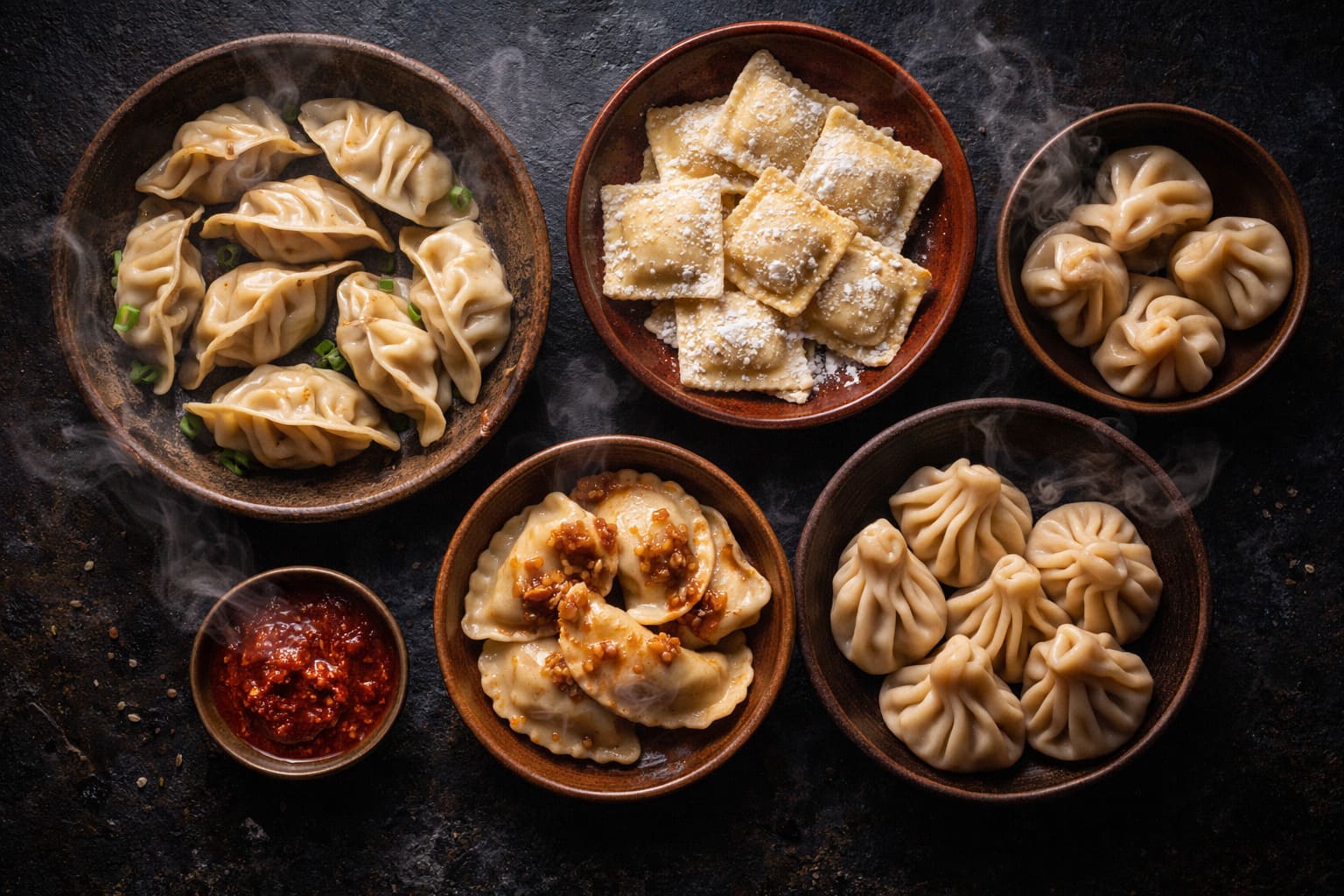
The history of dumplings has no single starting point, but the oldest dumplings anyone has actually held were found in a tomb at Astana, near Turpan in Xinjiang, and date to roughly 499 to 640 AD. Written records of Chinese jiaozi go back a little earlier. After that the trail splits into Central Asian manti, Italian ravioli, Polish pierogi and Siberian pelmeni, each with its own paper trail and its own tangle of legend.
Two dumplings from a tomb in Turpan
Between 1959 and 1975, archaeologists from the Xinjiang Uyghur Autonomous Region Museum and other institutions excavated more than 500 tombs in the Astana cemeteries, the burial ground of the old Gaochang kingdom. Turpan is hot and very dry, so bodies, textiles and food survived there that would rot almost anywhere else. In tomb 73TAM514 the diggers found two dumplings.
A 2012 study in PLoS One, led by Tao Chen, analysed starch grains, phytoliths and bran from them. The dough was a mix of wheat and foxtail millet flour. The tomb is dated by its structure and contents to 499 to 640 AD, and the authors describe the dumplings as having a thin skin and a filling, so close to modern ones that they are surprisingly hard to tell apart. They call the Astana cemeteries the site of the earliest physical evidence of dumplings. They also note that written records show dumplings becoming popular in the Southern and Northern dynasties (420 to 589 AD), and that because dumplings are soft and perishable, no other physical example has been reported.
Two cautions. The tombs mostly held people of high status, so these dumplings tell us what a wealthy family could afford to bury, not what everyone ate. And "earliest surviving" is not "first made": the authors themselves say more dumplings from the site should be sampled.
Did a doctor invent jiaozi to cure frostbitten ears?
The best-known origin story gives jiaozi to Zhang Zhongjing, a physician of the Eastern Han dynasty (25 to 220 AD). In the tale he saw poor people with frostbitten ears in winter, boiled lamb and pepper, wrapped it in dough shaped like ears and handed it out. The early name is given as "tender ears," jiao'er.
It is a charming story, and it is folk tradition. The sources that repeat it are popular news and magazine pieces, not excavation reports or contemporary documents, and the dumplings from Turpan are about three centuries too late to prove it. Treat Zhang Zhongjing as the dumpling's patron figure, not its documented inventor.
What the record does support is a changing word. The character for jiaozi was first written with 角, "horn," probably for the shape, and later replaced by 餃, which carries a food radical. In the Tang dynasty (618 to 907) the dish also went by bianshi. A sixth-century writer, Yan Zhitui, described the crescent-shaped kind as a common food.
What is in a name: mantou, manti and mandu
Much of the dumpling family is held together by one possible word. The Chinese term mantou appears in early Jin dynasty records (266 to 420 AD), in a passage tied to Shu Xi's poem on cakes. Early mantou was meat-filled; in Mandarin the word now means a plain steamed bun. Turkic manti, Korean mandu and Japanese manju are commonly linked to it, though the Chinese root is a suggestion, and some researchers argue the dish began in the Middle East and travelled east instead.
Dated evidence for the Turkic side is later. The earliest known mention of a manti-style dumpling is in the Yinshan Zhengyao, a 1330 manuscript by Hu Sihui, a court therapist to the Yuan emperor Buyantu Khan. The first Ottoman recipe survives in a fifteenth-century cookbook by Muhammed bin Mahmud Shirvani: steamed dumplings of minced lamb and crushed chickpeas, spiced with cinnamon, soured with vinegar, topped with sumac and served with garlic yogurt. The usual account is that Turkic and Mongol peoples carried the idea along the Silk Road, and Korean mandu is said to have arrived with the Mongols in the fourteenth century. For the wider road, see the foods of the Silk Road.
Ravioli in a merchant's letters
Italy's paper trail starts in the fourteenth century. Ravioli appear in letters of Francesco Datini, the merchant of Prato, according to Alan Davidson's Oxford Companion to Food. A Venetian manuscript of about the same century, the Libro per cuoco, describes ravioli of blanched chopped greens, beaten egg and fresh cheese, simmered in broth and seasoned with sweet and strong spices, a version of the dish that sounds more like a soup than a pasta course. English cooks had a cousin too: The Forme of Cury lists "rauioles."
By 1549 the dish was familiar enough in Rome that the cook Bartolomeo Scappi served ravioli with boiled chicken at the papal conclave of 1549 to 1550, as John Dickie recounts in Delizia!
A cookbook known as Apicius is also cited with a recipe for roasted pheasant dumplings, dated to the fifth century. Whether that counts depends on how strictly you define a dumpling, and the definition really is disputed.
Pierogi: 1682, a saint and a Marco Polo story
Polish pierogi are older than their paperwork. The earliest cookbook mention usually cited is Compendium ferculorum, albo Zebranie potraw, published in 1682, but that marks the first surviving recipe, not the first pierogi. The word comes from Proto-Slavic pirъ, "feast," the same root behind Russian pirog, which usually means a pie.
Two popular origin tales have thin support. One says Saint Hyacinth brought pierogi from Asia in the thirteenth century; another says Marco Polo carried them home from China. Both appear in print as theories, and the exact origin of pierogi is, in one summary, "unknown and unverifiable." The Polish exclamation "Swiety Jacek z pierogami" ("Saint Hyacinth with his pierogi") has no known source either. Compare the other filled-dough tradition of the Slavic lands: Ukrainian varenyky takes its name from var, boiling liquid.
Pelmeni, the dumpling named for an ear
Russian pelmeni have a name that echoes the Chinese legend. It likely comes from Komi and Udmurt words glossed as "ear bread" or "dough ears." Theories about the dish divide three ways: a version of jiaozi carried by the Mongols (supported by traditional fillings that use black pepper, which is not native to Russia); an Urals invention; or a food made by hunters who needed something light to carry.
The best dated clue is a 1679 census book from Kungur, in the Urals, which records surnames derived from the dish, such as Pelmenev. That suggests pelmeni existed there for some time before. They spread east into Siberia along Russian transport routes and entered national Russian cooking in the nineteenth century, often as "Siberian pelmeni." In Siberia cooks froze them outdoors in winter, and hunters and travellers carried sacks of them into the taiga because they kept well and cooked fast.
So did everyone invent the dumpling?
The popular line is that every culture invented dumplings independently. The record does not settle that. Filled dough is a simple idea that several cooks could have reached alone, and the Turkic, Chinese and Slavic names tangle in ways that point to borrowing. For Korea, see how Korean food went global; for the wheat that makes most of these wrappers possible, see the history of bread.
What can be said is that thin dough around a small amount of filling was being made in Turpan by the sixth or seventh century, that Turkic and Italian cooks were writing it down by the fourteenth, and that the first Polish recipe on paper dates to 1682. In 1959 the Astana excavations began turning up wheat-and-millet dumplings that had waited more than a thousand years in the dry ground.
Questions people ask
What is the oldest dumpling ever found?
The oldest known dumplings come from the Astana cemeteries near Turpan in Xinjiang, China. Two dumplings from tomb 73TAM514 are dated to about 499 to 640 AD and were made from wheat and foxtail millet flour. A 2012 study calls Astana the site of the earliest physical evidence of dumplings.
Did Zhang Zhongjing invent jiaozi?
There is no firm evidence that he did. The story says the Eastern Han physician Zhang Zhongjing made lamb-filled dough ears to treat frostbitten ears in winter. It appears in popular accounts, not in excavation reports, and the earliest surviving dumplings from Turpan date to about three centuries after his era.
Are manti and mantou related?
They are commonly linked, but the connection is a suggestion and not settled. The Chinese word mantou appears in early Jin dynasty records, and early mantou were meat-filled. Manti, Korean mandu and Japanese manju share a name root, though some researchers argue manti began in the Middle East instead.
When were pierogi first written down?
The earliest cookbook mention usually cited for Polish pierogi is the 1682 Compendium ferculorum, albo Zebranie potraw. That is the first surviving recipe, not necessarily the first pierogi. Stories linking them to Saint Hyacinth or Marco Polo are theories, and the true origin of pierogi is unknown.
Filed under Origin Stories, Street Food
Want more stories like this?
One food history story, every week. No spam, just the stories behind what the world eats.