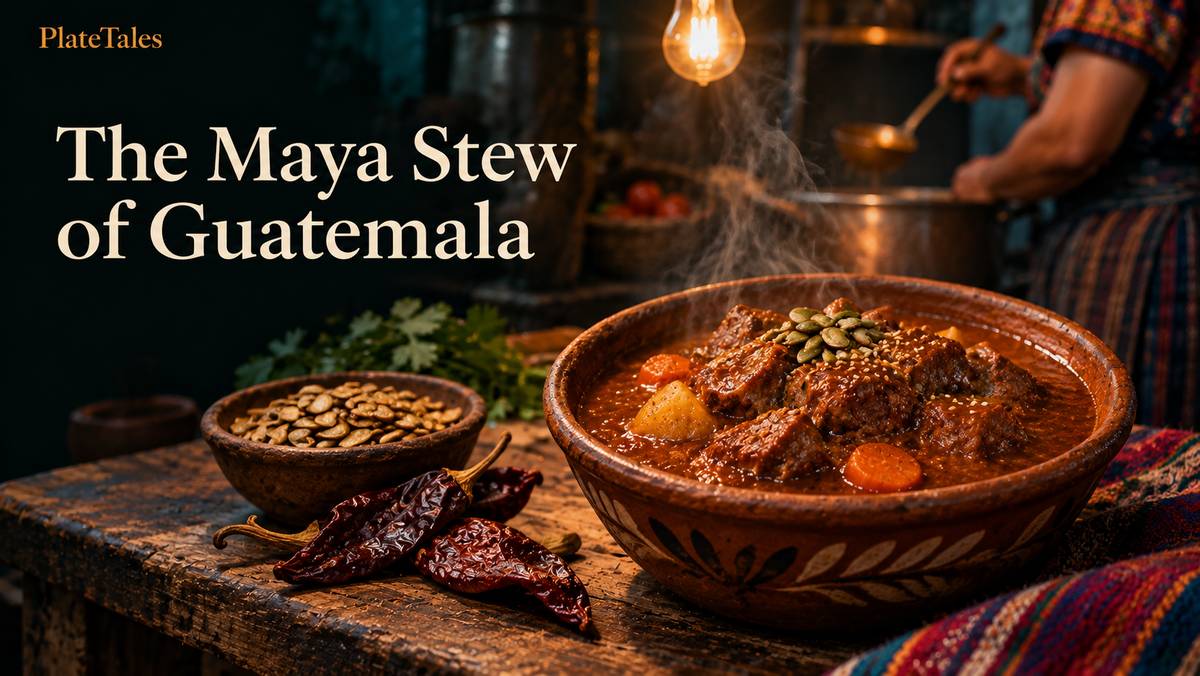
Pepian is a thick Guatemalan stew of meat and vegetables in a roasted sauce of squash seeds, sesame, tomatoes and chiles, and its history runs back to the Maya-Kaqchikel people of the western highlands. Historians quoted by Agence France-Presse place its origin in Chimaltenango, before Europeans arrived. The dish as it is cooked now is a blend: a Maya base with ingredients the Spanish brought. Guatemala declared it national cultural heritage in 2007.
What is pepian, exactly?
Start with the sauce, because the sauce is the dish. Pepian is a thick meat stew thickened with gourd seeds, made with beef or chicken, with beef more common in the cities. It is also called a recado, one of the roasted-and-ground seasoning pastes that anchor Guatemalan cooking. Its base is roasted tomato, sesame, miltomate (a small green husk tomato), pepitoria and several kinds of chile.
Pepitoria is the word to remember. It is the Guatemalan name for roasted, ground squash seeds, and it is the key ingredient. The meat, the carrots and the potatoes are what you chew. The pepitoria is what makes it pepian.
AFP described the finished stew in 2015 as a thick, deep-red sauce of tomatoes, garlic and chiles, dotted with meat, carrots and potatoes, "spicy but not tongue-numbing," usually served over rice. It comes with small tamales wrapped in milpa leaves, in a clay bowl.
Pepian Guatemala history: ceremonial before the Spanish
The origin claim is specific and fairly consistent. AFP's 2015 feature says historians hold that pepian started among the Maya-Kaqchikel in Chimaltenango, in the western highlands, before Europeans reached the Americas. Ericka Sagastume, who studies Guatemalan cuisine at the Center for Folkloric Studies at the University of San Carlos, told the agency that in the pre-Hispanic world pepian was served at major religious and political ceremonies and rituals.
Her account of the original dish is short: pepitoria, chiles and tomatoes. No onion, no cinnamon, no sesame, no beef. That list is worth holding on to, because every later layer sits on top of it.
A caution on the evidence. These are historians and a folklorist speaking to a news agency, not a recipe or a menu from 1400. Nobody has produced a dated pre-Conquest document describing the stew, and the claim rests on oral and scholarly tradition. It is plausible, since squash, tomatoes and chiles are all native to the Americas, but it is a tradition reported by experts, not a dish caught on paper.
How the conquest changed the pot
Over time, Sagastume said, the recipe shifted to take in ingredients from Europe. AFP lists onion, sesame, cinnamon and coriander as arrivals with the Spanish, and the dish draws on both Guatemala's colonial past and its indigenous cooking. The condiments of Maya ritual meals were combined first with pre-Columbian ingredients and then with ingredients of Hispano-Arab origin in household kitchens.
Some histories date the fusion to the second half of the 16th century and give the religious brotherhoods, the cofradias, a central role, with members keeping pepian as a ceremonial food. That dating is thinly referenced, so treat it as a claim, not a settled fact.
What is not in doubt is the pattern. Spanish animals and spices entered a Maya sauce, and the sauce survived. The resulting stew records two food systems meeting in one pot, much as chocolate did after it crossed the Atlantic, a story told in the history of chocolate.
The one ingredient that did not move
AFP made a sharp point about pepitoria. Pepian absorbed Old World ingredients, but pepitoria stayed the key component. The agency called that "a rare cultural victory" for Guatemala's indigenous peoples, who have endured five centuries of Spanish conquest, colonial subjugation and marginalization, and who were the main victims of the 1960 to 1996 civil war, which killed some 200,000 people.
The same piece notes that indigenous Guatemalans make up about 40 percent of the population by census figures, with the other 60 percent identifying as ladino, the term for people of European or mixed descent who have dominated politics and economy since colonial times. A stew built on a Maya seed is therefore eaten across that line, "by Guatemalans of all walks of life," in AFP's phrase. For how a single dish can carry a national identity, see how food shaped cultural identity.
Red, black and the question of the name
There is more than one pepian. A red version is tied to Chimaltenango and Sacatepequez, with more tomato and lightly toasted guaque chile, served at patron saint celebrations. A darker version, called black or brown, belongs to the central highlands and uses burnt plantain peel, deeply roasted pasa chile and darker pepitoria. It is linked to cofradia rituals.
The name is less clear. No firm etymology is settled; the most that can be said is that "pepian" seems to refer to pepitoria. The similar Mexican dish pipian is a close cousin, and in Mexican Spanish pipian is the word for pumpkin seeds in mole dishes. Whether the two names share a root is not settled in any source read for this article, so it stays open here.
The 2007 declaration
The date is firm and comes from a government source. On 26 November 2007, Guatemala's Ministry of Culture and Sports declared pepian an Intangible Cultural Heritage of the Nation through Acuerdo Ministerial 801-2007, and the ministry's own technical file for the declaration is the source for that. AFP confirmed in 2015 that the government had declared the dish part of the national heritage in 2007.
Guatemala considers pepian a national dish, and Guatemalan restaurants abroad usually present it as Maya in origin. It is also a street food in the country's cities. At the Rosita diner, in a basement inside the market in the historic center of Guatemala City, the chef Elsa Morales, then 62, told AFP that people who come once always come back. She had served several presidents.
Questions people ask
Is pepian the national dish of Guatemala?
Guatemala considers pepian its national dish. The government formalized its standing on 26 November 2007, when the Ministry of Culture and Sports declared it an Intangible Cultural Heritage of the Nation under Acuerdo Ministerial 801-2007. There is no single law naming one national dish.
What is pepian made of?
Pepian is a Guatemalan stew of meat and vegetables in a roasted sauce. The base is tomato, sesame, miltomate, chiles and pepitoria, the roasted ground seeds of a native squash. Beef, chicken or pork are common, and potatoes and carrots usually go in. It is often served with rice.
Where does pepian come from?
Historians quoted by Agence France-Presse say pepian began among the Maya-Kaqchikel people in the Chimaltenango region of western Guatemala, before Europeans reached the Americas. It was a ceremonial dish. The Spanish later added onion, sesame, cinnamon and coriander, but pepitoria stayed the central ingredient of the Guatemalan stew.
What is the difference between pepian and Mexican pipian?
Both are seed-thickened sauces, but they are separate dishes from different countries. Mexican pipian is a similar dish, and Guatemalan pepian is a thick meat stew thickened with gourd seeds. Whether the two names share a root is not established in the sources read for this article.
Filed under Cultural Identity
Want more stories like this?
One food history story, every week. No spam, just the stories behind what the world eats.