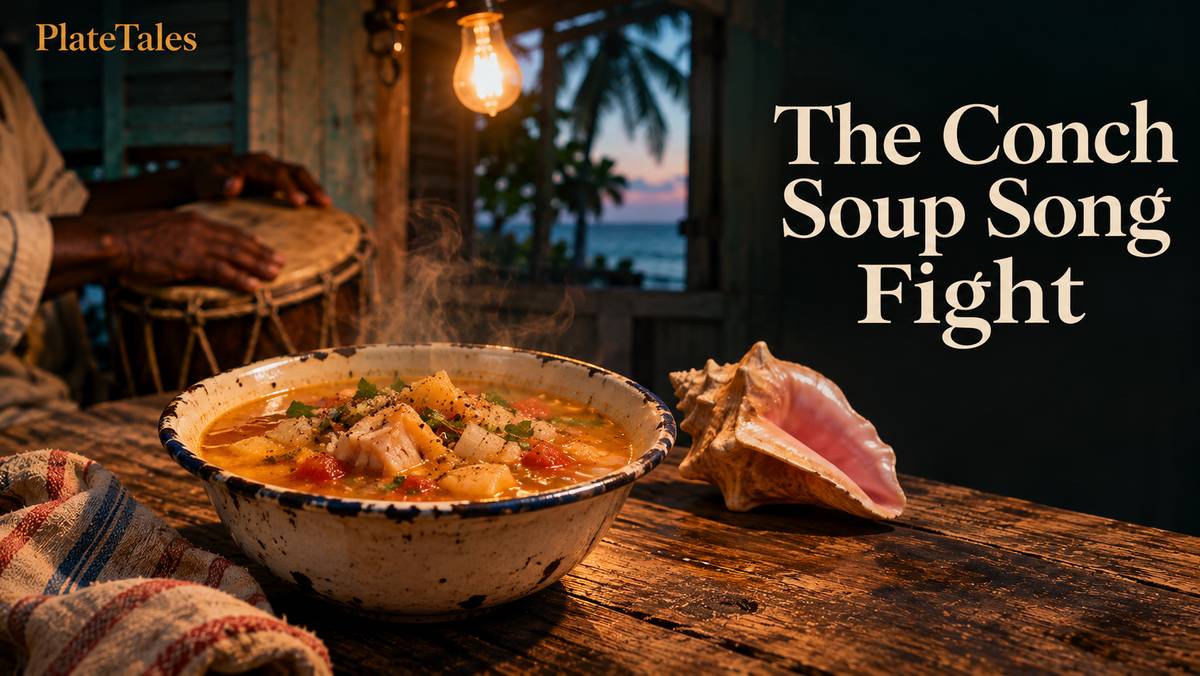
The sopa de caracol story is mostly a song story: "Sopa de Caracol" is a punta rock hit that the Honduran band Banda Blanca took to number one on Billboard's Top Latin Songs chart in March 1991, built on a song the Belizean Garifuna musician Chico Ramos had written and recorded as "Conch Soup." The soup in the title is conch soup, a coastal staple. The history here belongs to the music, and to a court fight over who made it.
Sopa de Caracol history: what the song is, and what it is not
"Sopa de Caracol" translates as "conch soup," though the title is also given as "Snail Soup," which is how caracol is often rendered in Spanish. It is a dance track in the punta rock style, running 4:48, with lyrics that mix Garifuna and Spanish. It was recorded in 1990 and released in 1991 by Sonotone Music.
It is not a recipe or a food document. None of the sources read for this article describes how the soup is cooked, and none says when conch soup first appeared on a Caribbean coast. What they do show is a dish used as a hook for a dance tune, and a tune that traveled much further than the dish ever did.
Punta rock before Banda Blanca
Punta rock began in Belize. Pen Cayetano is credited with creating it, and from the 1970s he, Andy Palacio and the group Fuerza Garifuna reworked traditional punta, a Garifuna dance music, into an electrified version for younger listeners. It adds guitars and electronic instruments to traditional drumming and singing, at a faster tempo. Belize's version drew on Trinidadian calypso and soca and on Jamaican reggae.
The Garifuna are an Afro-Indigenous people of Central America and Saint Vincent. UNESCO recognized Garifuna music, dance and language as a Masterpiece of the Oral and Intangible Heritage of Humanity in 2001, and its listing names Belize, Guatemala, Honduras and Nicaragua. Punta rock was a Garifuna sound before it was a Latin pop one. Honduran punta rock, by contrast, took on influences from salsa and cumbia and is mostly sung in Spanish.
The Belizean who wrote "Conch Soup"
Chico Ramos was born Herman Ramos on 20 February 1963 in Dangriga, in Belize's Stann Creek District. According to a profile in the San Pedro Sun in March 2007, he spent childhood time with a musician grandfather and a songwriter grandfather. At 14 he was filling in on drums for a band called Supa J's in Mango Creek. Money was short, and he left school after elementary.
By 1988 Ramos had moved to the United States. The same profile says that by 1989 he had recorded his first compact disc, Stop Scratch up mi back, and that it held "Sopa de Caracol (Conch Soup)," a punta number that "played through the airwaves around the world." The profile also says the song later sold 1.5 million copies in the United States alone.
Note the number. A 2021 article in La Nacion attaches the same 1.5 million figure to Banda Blanca's version. The sources do not agree on whose sales that figure counts, and neither one is a certified sales audit that this article could check. It is safest to say the song sold well, in whichever hands.
How a San Pedro Sula band got it
Banda Blanca formed in San Pedro Sula, Honduras, in 1971, starting as a rock band before adding merengue and punta. By the early 1990s it was making punta rock for a Spanish-speaking audience.
The San Pedro Sun profile gives the Belizean version of the next step: the band changed the song's original Garifuna language to Spanish, and the Spanish version soon played across South and Central America. Another listing of the song's writers differs, naming Hernan "Chico" Ramos and Juan Pompilio Tejeda, the band's keyboard player. So credit was shared on paper, at least in that listing. How the credit was arranged at the time is not something the pages read for this article explain.
Number one on the Latin chart
The numbers on the American side are clear, because Billboard kept them. The Banda Blanca version entered the Top Latin Songs chart at number 15 in the week of 19 January 1991 and reached the top ten the following week. It hit number one on 16 March 1991, displacing Myriam Hernandez's "Te Pareces Tanto a El." Franco De Vita's "No Basta" took the top spot two weeks later. For the full year, it ranked as the fifth-best-performing Latin single in the United States.
Honors followed. It won the Silver Seagull at the Viña del Mar International Song Festival. It was nominated for a Lo Nuestro Award for Tropical/Salsa Song of the Year and lost to Juan Luis Guerra's "Burbujas de Amor." The video, directed by Chad Domenencis, earned two Billboard Music Video Award nominations. The band also won the Lo Nuestro for Tropical New Artist of the Year in 1991, and its album Baile Punta topped Billboard's Tropical Albums chart.
Cashbox called it the biggest crossover fad since "Lambada" in 1991, and President Rafael Callejas named the band "ambassadors of Honduran music." The band is credited with carrying punta, a Garifuna style, beyond Central America, even though the San Pedro Sun's account has the song starting with a Belizean Garifuna musician.
The lawsuit, and what is known about it
The San Pedro Sun puts it in one sentence: the song "became a fight in court, when Chico sued Banda Blanca and copyrighted Sopa de Caracol; the matter was eventually settled out of court." A thesis posted by UCLA's eScholarship repository, seen in a search result but not opened for this article, describes Ramos as suing the band for copyright infringement over "Conch Soup." That snippet is a lead, not a source here.
Beyond that single sentence, the terms are not public in anything read. The year of the filing, the date of the settlement and the amount are not given. Other write-ups repeat a 1994 filing and a five-year wait, but no page opened for this article confirms either, so they stay out. Ramos was named Godfather of Punta Rock and given a Lifetime Achievement Award by the Punta Rock Music Association on 23 February 2007, in Dangriga, where a weekend of events marked his 30 years in music.
A second Belizean version
Banda Blanca was not the only act accused of taking the song. In July 2025, 7 News Belize ran a segment on what it called the Conch Soup controversy, "almost 40 years later." It said the Belizean band Dell and the Sensations, best known for a cover of "Tears on My Pillow," had recorded the most controversial of its covers, Ramos's "Conch Soup," and was accused of trying to steal writing credits. The segment mentioned a book by someone named Smart that devotes a portion to the dispute. The report gives no detail on how that matter ended.
The song after 1991
Others covered it afterward. Los Fabulosos Cadillacs, Banda Maguey, Los Flamers, Wilkins and Tony Camargo are among them. On 30 July 2013, Elvis Crespo released "Sopa de Caracol - Yupi" with Pitbull on his album One Flag. It reached number 41 on Hot Latin Songs and number one on Tropical Airplay.
The song has also been used to promote Honduras's Ladino region, while its Garifuna roots sit with Dangriga. For more on how a dish ends up standing for a people, see how food shapes cultural identity, or read about soul food, another cuisine carried by people of African descent. More stories like this are in the cultural identity collection.
Chico Ramos returned to Dangriga in 2000 after living in the United States, where he had released nine albums.
Questions people ask
Who wrote Sopa de Caracol?
Accounts differ. One listing names Hernan "Chico" Ramos, a Belizean Garifuna musician from Dangriga, and Juan Pompilio Tejeda of the Honduran band Banda Blanca as the writers of "Sopa de Caracol." A 2007 San Pedro Sun profile says Ramos first recorded it as "Conch Soup" around 1989, and that Banda Blanca later made the Spanish version.
Did Sopa de Caracol reach number one?
Yes. Banda Blanca's "Sopa de Caracol" reached number one on Billboard's Top Latin Songs chart on 16 March 1991, after debuting at number 15 in the week of 19 January 1991. Franco De Vita's "No Basta" replaced it two weeks later, and it finished 1991 as the fifth-best Latin single in the United States.
What does Sopa de Caracol mean?
"Sopa de caracol" is Spanish for conch soup, and the title is also given as "Snail Soup." Ramos's original Garifuna-language song was called "Conch Soup" in English. The sources read for this article do not describe the soup itself as a cooked dish.
Did Chico Ramos sue Banda Blanca?
According to a March 2007 San Pedro Sun profile, Chico Ramos sued Banda Blanca over "Sopa de Caracol," and the matter was eventually settled out of court. The sources read do not give the year the case was filed, the date of the settlement or the terms.
Filed under Cultural Identity
Want more stories like this?
One food history story, every week. No spam, just the stories behind what the world eats.