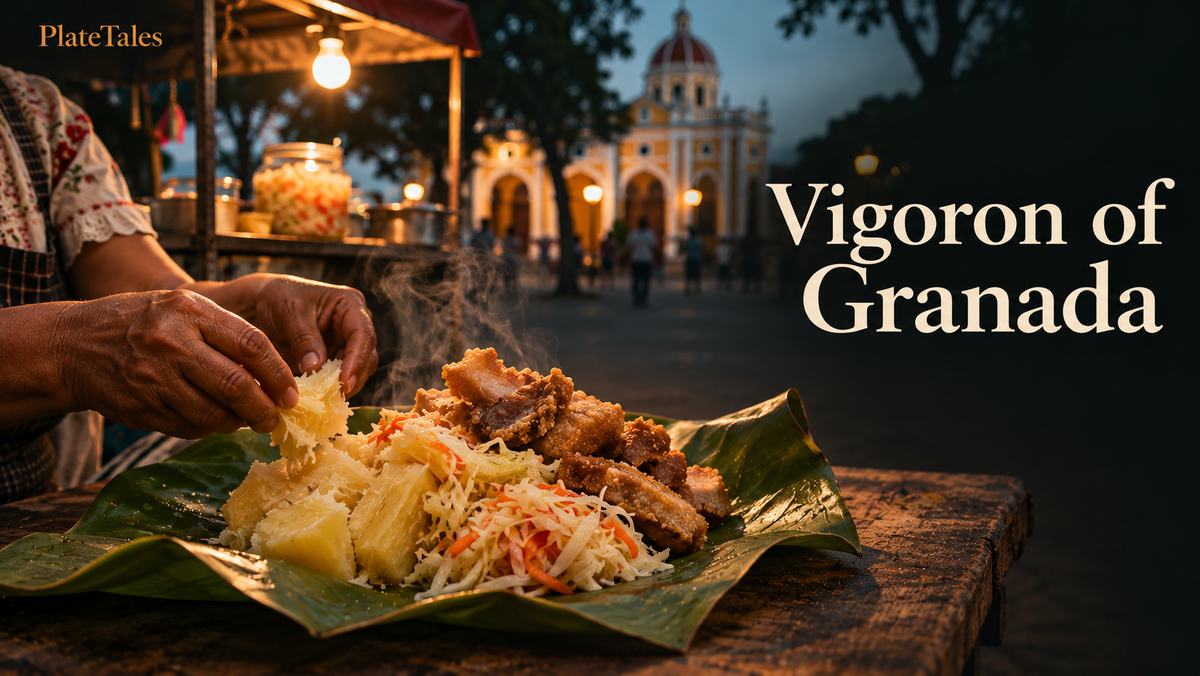
Vigoron is a Nicaraguan street dish of boiled yuca, crisp fried pork and a sharp cabbage salad, served on a banana leaf, and its history points to Granada in 1914. The credit usually goes to a woman named Maria Luisa Cisneros Lacayo, nicknamed "La Loca", who is said to have named it after the poster for a medicinal tonic. That is the whole documented story, and it rests on one book.
What is vigoron, exactly?
Three things on a leaf. The base is yuca (cassava), boiled until soft. On top goes a cabbage salad, the kind Nicaraguans call curtido: chopped cabbage with tomato, onion and chili, marinated in vinegar and salt. Then chicharrones, fried pork belly or pork rinds, broken over the pile for crunch and salt.
TasteAtlas adds a detail that starts arguments. Some Nicaraguans, it says, claim there is no true vigoron without mimbro, a tangy fruit from the cucumber tree. So even the ingredient list has a purist camp.
The banana leaf matters as much as the food. According to TasteAtlas, the combination comes served in banana leaves when street vendors sell it, and the dish is often eaten without utensils. The leaf is the plate, the napkin and the container, which is why the dish works on a park bench.
It is also a dish for surprise visitors. Both sources say it is quick and easy to prepare, which is why it turns up when guests arrive unannounced. A pot of yuca and a bowl of pickled cabbage can sit ready for hours, and the pork needs only a hot pan.
The 1914 claim and the woman behind it
The earliest account that anyone points to is Dr. Alejandro Barberena Perez's 1971 book Granada. The book states that Maria Luisa Cisneros Lacayo, known as "La Loca", developed the recipe in 1914 in Granada. TasteAtlas repeats the same attribution, phrased as "it is believed" that she invented it there in that year.
Notice how thin that is. Two websites carry the story, and both trace it to Barberena. Neither the book nor the trademark record could be checked here (a USPTO serial number is cited for the name story, but the link returned an error). So the 1914 date and the inventor's name are best read as local tradition set down in print in 1971, fifty-seven years after the event it describes.
That does not make it false. A town history written by a local doctor is a normal way for a vendor's name to survive. But no 1914 menu, newspaper or receipt has turned up in anything read for this article, and a dish that sells for pocket change rarely leaves paperwork.
A published photo caption for the dish reads "Vigoron de dona Luisa Cisneros Lacayo", which suggests her name stayed attached to the plate rather than just to a book passage. A caption is not proof of anything, though.
Why a tonic poster gave the dish its name
The name is the best part of the story. According to Barberena, as relayed by TasteAtlas, she named the dish after seeing an advertisement for a medicinal tonic of the same name. The other account says the same: a poster for a tonic called vigoron.
The word fits. Vigor is Spanish for strength or vitality, and a tonic sold as a pick-me-up would reasonably borrow it. A plate of starch and fried pork sold on a street corner could just as reasonably borrow a name that promised energy.
No source read here identifies the tonic itself: its maker, its label, or a printed advertisement. Without that, the poster is part of the legend. It is a plausible, specific detail, and specific details are what good local stories are made of, but it stays attributed to Barberena and no one else.
Granada, the place that claims it
Spanish conquistador Francisco Hernandez de Cordoba founded Granada on 21 April 1524, on the shore of Lake Nicaragua (Lake Cocibolca), and named it for the Spanish city. English, French and Dutch pirates attacked it by sailing up the San Juan River, although they never took control. Its cathedral, Our Lady of the Assumption, dates to 1751. William Walker's commander Charles Frederick Henningsen set the city on fire, destroying much of its colonial architecture.
So by 1914 Granada was a town with four centuries behind it, a lake at its edge, and a central park, the sort of place where people gather and vendors set up. That is the setting the tradition gives: a woman selling a cheap, filling plate to a crowd. Nothing read here says exactly where in town she stood, and the claims that she sold near the baseball fields came only from search snippets, so they stay out of this article.
The ingredients are older than the dish
Every part of vigoron except the pork is older than the Spanish arrival, or arrived with it.
Yuca is the oldest. Cassava was likely first domesticated in west-central Brazil no more than about 10,000 years ago, and by 1492 it was a staple for peoples of northern South America, southern Mesoamerica and the Caribbean. The Spanish word yuca most likely comes from the Taino. Boiling is the commonest way to eat it, and for smaller-rooted sweet varieties cooking alone removes the cyanide, which is carried off in the cooking water.
Pork and the vinegar-pickled salad are the colonial half. Nicaraguan cooking is a mixture of Amerindian, Spanish and Creole traditions, and cabbage shredded in vinegar is served as a side dish called ensalada, sometimes with carrots and beets. Put an Indigenous root together with a European-style pickle and a fried pork topping and you have a plate that is mestizo in a literal sense.
If you like stories about root crops reshaping what people eat, how potatoes changed Europe follows a different tuber on a similar road. For other plates built to be eaten standing up, see street food across Southeast Asia, and for dishes that survive mostly by word of mouth, lost recipes of grandmothers. More are collected under street food stories.
Vigoron against its neighbors
Vigoron is not vaho, though the two are often mentioned together. Vaho is a Nicaraguan dish that is pressure-cooked, typically with brisket, and includes green and ripe plantains. Vigoron has no such cooking step.
Versions of vigoron exist in neighboring countries, especially Costa Rica, and families differ mainly in the curtido. That variation is what you would expect from a dish with no fixed recipe and no founding document.
The surviving record is small: a 1914 date, a nickname, a tonic poster and a book from 1971. The book was written by Dr. Alejandro Barberena Perez, who put Maria Luisa Cisneros Lacayo's name in print.
Questions people ask
Where does vigoron come from?
Vigoron comes from Granada, Nicaragua. Both TasteAtlas and the book it draws on say it was developed there in 1914 by Maria Luisa Cisneros Lacayo, known as "La Loca". Both trace this to Dr. Alejandro Barberena Perez's 1971 book Granada, so the date rests on local tradition rather than a surviving 1914 document.
What is vigoron made of?
Vigoron is made of boiled yuca, a cabbage salad called curtido (cabbage, tomato, onion and chili marinated in vinegar and salt), and chicharrones, which are fried pork belly or pork rinds. Street vendors in Nicaragua serve it on a banana leaf, and some cooks insist it needs mimbro, a tangy fruit from the cucumber tree.
Why is vigoron called vigoron?
According to Dr. Alejandro Barberena Perez, quoted by TasteAtlas, Maria Luisa Cisneros Lacayo named the dish after a poster for a medicinal tonic called vigoron. The tonic itself, its maker and its advertisement were not found in the sources read, so the naming story remains a tradition.
Is vigoron the same as vaho?
No. Vaho is a different Nicaraguan dish that is pressure-cooked, typically with brisket, and includes green and ripe plantains. Vigoron is boiled yuca topped with cabbage salad and fried pork, with no pressure cooking and no plantains. Both come from Nicaraguan cooking, but they are separate plates.
Filed under Street Food
Want more stories like this?
One food history story, every week. No spam, just the stories behind what the world eats.