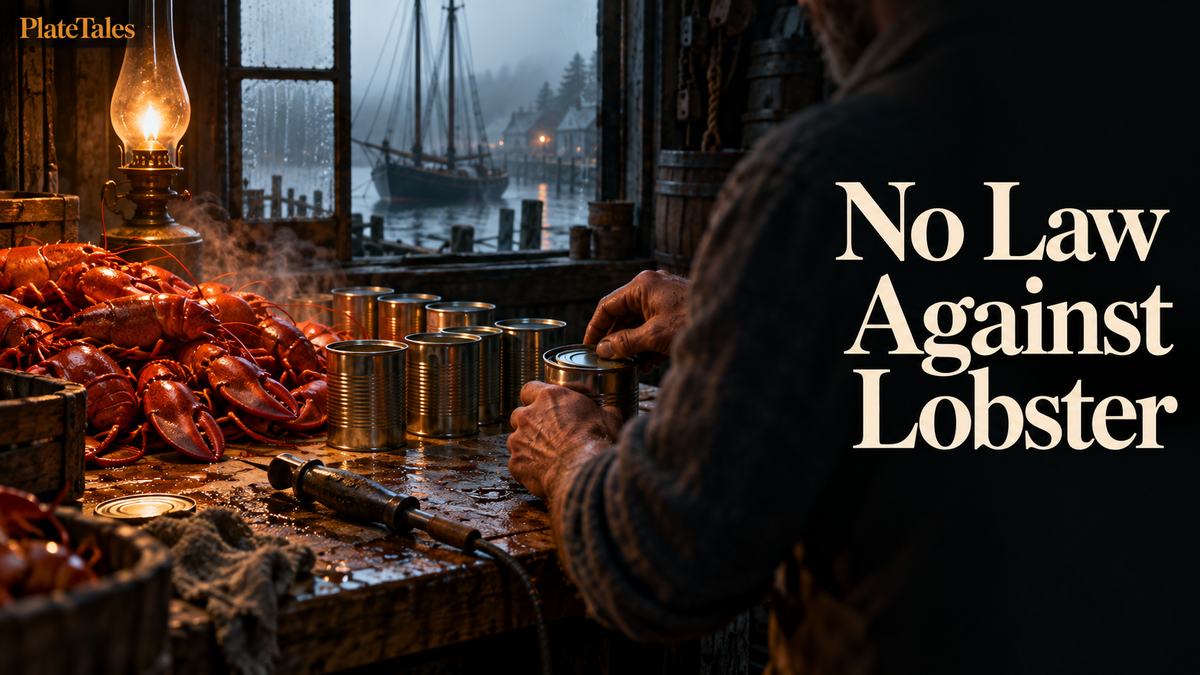
Lobster was cheap in early New England, but there is no record that it was prison food, and no law, court ruling or servant's contract ever limited how often anyone had to eat it. When the Massachusetts historian J. L. Bell went looking in 2010, every version of the claim he found in Google Books dated from the previous quarter-century, and none cited a document.
The real record is stranger than the legend. It runs through a secret canning experiment in Eastport, Maine, lobsters sold for a penny in Halifax, and an older story about salmon that changed species sometime in the 1900s.
Eastport, 1843: the year lobster went into a can
The best account of how lobster got cheap comes from a federal survey. For the 1887 report The Fisheries and Fishery Industries of the United States, the naturalist Richard Rathbun pieced together how lobster canning began, while admitting the early accounts conflicted. A Maine smoked-salmon man named U. S. Treat, with partners named Noble and Holliday, moved to Eastport in 1842 to put lobster, salmon and haddock into sealed tins.
The cans often burst in the boiling bath, and the partners worked in secret, letting no outsiders into the bathing room. In 1843 they hired Charles Mitchell, a Scottish canner then working in Halifax, who had learned the trade from John Moir & Son of Aberdeen. After he arrived the lobsters kept.
Then nobody bought them. Canned food was almost unknown in American shops, so Treat carried samples from city to city and mostly had to ship on consignment.
Canneries set the price on the Maine coast. Rathbun reports that the first lobsters canned at Eastport weighed about 3 to 10 pounds. Within three or four years the average was down to about 2 pounds, and by 1880 the factories were taking "cullings," small lobsters of around a pound that the fresh markets did not want. A hundred pounds of live lobster made about 22 pounds of canned meat.
His price tables read like a joke now. In 1880 Eastport dealers got about 3 cents a pound for lobsters packed in barrels for Boston. Portland and Boston dealers sold them at about 7 cents apiece.
The fertilizer story, and the part that is true
John J. Rowan saw the same trade in Nova Scotia and wrote it up in The Emigrant and Sportsman in Canada (1876). Fresh lobsters in the Halifax market cost a penny each. The canneries used only tails and big claws, and "the bodies, legs, &c., are thrown aside for manure or washed away by the tide."
After a gale in New Brunswick threw tons of lobsters on a beach, he saw "several acres of potato ground manured with them." Some country people boiled lobsters for their pigs, he added, "but are ashamed to be seen eating lobsters themselves. Lobster shells about a house are looked upon as signs of poverty and degradation."
The Maine food historian Sandy Oliver tells the American side more carefully. Canneries were glad to give their stinking refuse to farmers as manure. City visitors who saw it assumed the farmers were plowing whole lobsters into their fields.
Why was lobster considered poor food?
Mostly because it was everywhere and cost nothing. The English knew lobster from home and ate it from the start. In 1623, when the ship Anne brought over families of the first Plymouth settlers, William Bradford wrote that "the best dish they could presente their freinds with was a lobster, or a peece of fish, without bread or any thing els but a cupp of fair spring water."
Bradford was describing hunger. Lobster was what they had. The real story of Plymouth's food is mostly about that kind of scarcity.
Francis Hobart Herrick, in his 1911 Natural History of the American Lobster, passes on the Salem minister Francis Higginson's report of lobsters weighing 25 pounds and his claim that "the least boy in the plantation may catch and eat what he will of them." Herrick also quotes a 1740 account of the Boston market selling large lobsters "at 3 half-pence each."
Oliver's rule for all of this is short: "No market, no sale. Eat it yourself." Where there were buyers, lobster had value. By the early 1700s Long Island Sound lobsters went live to New York, and Boston vendors sold them boiled in the street.
Rathbun dates lobstering as a separate trade to about 1800. In the early 1800s Cape Cod supplied nearly all the lobsters eaten in New York, caught mostly by Connecticut men in sailing smacks. Until about 1840 the fishery stayed on a few stretches of coast. By the middle of the century, Oliver writes, Boston vessels were buying on the Maine coast.
Was lobster poor man's food in Europe too?
Not in the same way. Ken Albala, in Food in Early Modern Europe, notes the "common perception that lobster was considered a poor man's food" and says it may fit colonial New England but not Europe. In April 1663 Samuel Pepys gave his yearly dinner marking the operation that removed his bladder stone. On the table, next to a lamprey pie, was "a dish of four lobsters." The Metropolitan Museum of Art owns a Dutch still life by Abraham van Beyeren, probably painted in the early 1650s, with a red lobster laid among silver, glass and fruit.
Did servants have contracts limiting lobster?
No such contract has ever turned up. The story began as a fish tale from across the Atlantic. Bell traced one early form to the Irish novelist Charles Robert Maturin's Gothic novel Melmoth the Wanderer, published in Edinburgh in 1820.
Maturin describes a table with "lobsters and fried turbot enough to justify what the author of the tale asserts": that when his great-grandfather, the Dean of Killala, hired servants, "they stipulated that they should not be required to eat turbot or lobster more than twice a-week." It is family lore, told at second hand, inside a ghost story.
The version that traveled was about salmon. Jerome V. Smith's Natural History of the Fishes of Massachusetts (1833) repeated that British farm servants "stipulated to have them only twice a week as food." George Wingate Chase's History of Haverhill, Massachusetts (1861) raised the stakes: "It is well authenticated, that at one time it was nowise uncommon to stipulate in the indentures of apprentices, that they should not be obliged to eat salmon oftener than six times a week!"
In 1893 John P. Farrow's History of Islesborough, Maine moved it to the poorhouse: "Tradition informs us that the salmon were so plenty that the first town poor protested against being served with salmon more than twice a week."
Chase gives the game away in his next sentence, which blames dams, mills and bridges for choking the Merrimack and cutting its salmon run. Oliver has collected the story from about a dozen places, from Lowell mill boarding houses to Northwest lumber camps. In her reading it crops up when a once-plentiful food is in decline and the writer wants to recall a richer past. None of the versions cite a paper. The line is always "tradition has it" or "it is often said."
British writers started asking for proof in the late 1800s. The editor of the Worcester Herald offered a reward for an old indenture with a salmon clause, and by the end of the century the tale was being filed as folklore. Oliver suspects the seed may be a rule by an English fishmongers' guild about how often apprentices could be fed fish, though she gives no source for it.
When did lobster become expensive?
Slowly, from the 1880s, as the inshore supply fell and shipping lobsters live got easier. Herrick's figures show the turn. In 1892 the United States landed 23,724,525 pounds of lobster worth $1,062,392, about 4.5 cents a pound. In 1905 the catch had fallen to 11,898,136 pounds, worth $1,364,721.
Half the lobster brought in more money. By 1911 Herrick was quoting retail prices of 30 to 35 cents a pound.
According to a 2006 Mother Jones report by April Dembosky, the historian Colin Woodard found in The Lobster Coast that average prices quadrupled between 1889 and 1898. The same piece describes the oceanographer Glenn Jones reading old restaurant menus: lobster first appeared in the 1850s and 1860s as a bargain salad, at half the price of chicken salad.
Well-off city people began spending summers in Maine and found that 1- to 2-pound lobsters fit a dinner plate. Packed in ice, live lobsters went as far as Chicago and St. Louis. Prices first peaked in the 1920s. The Depression sank the luxury market, and lobster went back into cans as cheap protein for American troops, a turn that fits the wartime pantry of tins and the history of military rations.
Cape Cod showed where this led. By 1880 its fishery was worked out. Herrick, summarizing the federal survey, says "only eight decrepit men" were still in it, earning about $60 apiece.
How lobster became prison food in print
The lobster version, by Oliver's count, did not appear until the 1900s, once lobster was a luxury and the story could flatter it. The forms she hears name prisoners at the Maine State Penitentiary and apprentices in Boston.
Bell's printed examples are all recent. George Wuerthner's Maine Coast (1989) cited "an old Maine law" barring prisoners from being fed lobster more than twice a week. Maine had no laws of its own until it split from Massachusetts in 1820, which narrows the search, and the book gives no source. Greg O'Brien's 1990 guide to Cape Cod moved the story to Virginia, with a quotation Bell could find in no other book. Richard Adams Carey's Against the Tide (1999) made it an 18th-century petition on behalf of Massachusetts apprentices.
David Foster Wallace repeated it in his essay "Consider the Lobster," writing that "some colonies had laws against feeding lobsters to inmates more than once a week because it was thought to be cruel and unusual, like making people eat rats." Mother Jones in 2006 had servants in one Massachusetts town winning a court ruling that capped lobster at three times a week. The number kept changing, which is what happens when nobody has an original to copy.
What the Massachusetts archives show
Bell ended his 2010 posts with an open offer. If anyone found "an apprenticeship contract, or a law in Maine, or a petition in the Massachusetts archives that limits the number of lobster meals," he would quote it on his blog, Boston 1775.
In 2021 Marina Santos, writing for MIT Sea Grant, reported no evidence in the Massachusetts state archives of any petition, act or bill protecting inmates from too much lobster, and no indenture with such a clause. The colony's first jail, the Boston Gaol, opened in 1635 and usually held fewer than 50 people awaiting trial. Prisoners paid for their own food, and those who could not got bread and water.
Oliver notes that rationed diets of the 1700s and 1800s, ashore and at sea, ran on salt pork, salt beef, bread, potatoes and, in some places once a week, salt cod. The food historian Kathleen Curtin, quoted in Elisabeth Townsend's Lobster: A Global History, was blunter: "It never happened."
Questions people ask
Where did the story about lobster limits for servants come from?
It began as a fish tale. Charles Robert Maturin's 1820 novel Melmoth the Wanderer told of servants who would not eat turbot or lobster more than twice a week. The version that traveled in New England books was about salmon, and the lobster form did not appear in print until the 1900s, once lobster had become a luxury.
Why did people in New England once feel ashamed to eat lobster?
In the 1870s, John J. Rowan wrote that some Nova Scotia and New Brunswick country people boiled lobsters for their pigs but were ashamed to be seen eating them, because lobster shells about a house were taken as signs of poverty. Lobsters were plentiful and cheap, and canneries threw away much of each one as manure.
When did lobster become a luxury food in America?
Slowly, from the 1880s onward. As the inshore supply fell, the United States catch dropped from about 23.7 million pounds in 1892 to about 11.9 million in 1905, yet it earned more money. Live lobsters packed in ice reached Chicago and St. Louis, and retail prices reached 30 to 35 cents a pound by 1911.
Is there any record of a law that limited lobster for prisoners?
No. In 2021 MIT Sea Grant reported that the Massachusetts state archives hold no petition, act or bill protecting inmates from too much lobster, and no indenture with such a clause. J. L. Bell asked in 2010 for any such document and none has turned up. Prisoners in the Boston Gaol paid for their own food or got bread and water.
Filed under Cultural Identity
Want more stories like this?
One food history story, every week. No spam, just the stories behind what the world eats.