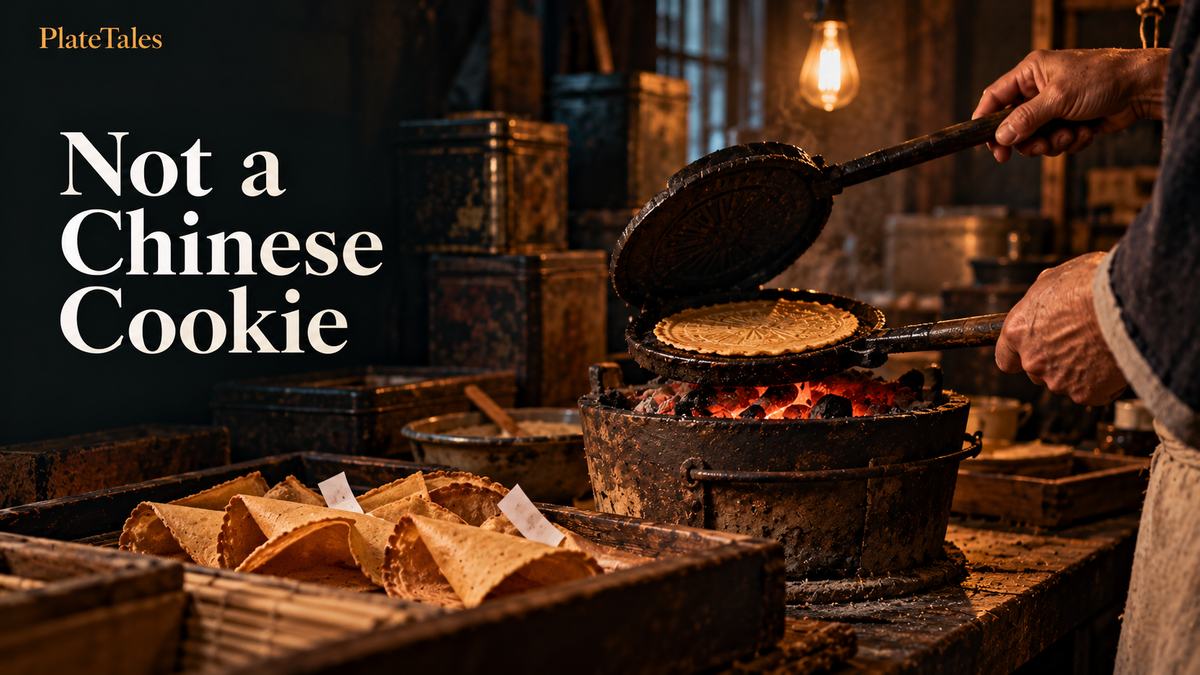
Fortune cookies come from Japan, by way of California. They descend from tsujiura senbei, a folded cracker with a paper fortune that Japanese bakers were making by the mid-1800s. Japanese immigrant confectioners in San Francisco and Los Angeles turned it into the sweet American cookie in the early 1900s. Chinese restaurants took it over only after 1942.
That last step happened because of the Second World War, when the people who baked the cookies were sent to camps.
Are fortune cookies Chinese or Japanese?
The cracker is Japanese. The sweet, vanilla-flavored version was made in California. Chinese American bakers took over its production in the 1940s. Few people who have studied the record still argue for China.
When the Japanese American National Museum in Los Angeles held a public program on the question in September 2008, its press release carried the subtitle "Everyone Agrees It Is Not Chinese." It said most interested parties accept that the cracker is Japanese senbei.
What people still argue about is narrower: which Japanese American baker, in which California city, sold the first one, and in what year. Los Angeles and San Francisco both claim it. The paper trail is thin, and most of it is family memory written down decades later.
Where did fortune cookies come from before California?
The archive work was done by Yasuko Nakamachi, a researcher from Kanagawa, Japan. In the late 1980s she ate her first fortune cookie after a meal in a Chinatown restaurant in New York. In about 1998 she read about tsujiura in a Japanese article on sweets and saw the connection. She went on to write her graduate thesis at Kanagawa University on the cracker's history.
The name explains the thing. Tsujiura are fortune slips, and senbei are crackers. In the late 1990s Nakamachi found a family bakery near a Shinto shrine outside Kyoto that still made them by hand over a flame.
Gary Ono summarized her findings in 2007 for Discover Nikkei, the Japanese American National Museum's online journal. He reports that she traced the earliest mention of tsujiura to Haru no Wakakusa (Spring Grass), a book by the novelist Tamenaga Shunsui from 1830 to 1844. The folded cracker with a message inside is documented back to 1847.
Her best exhibit is a picture. From the National Diet Library in Tokyo, Japan's national library, she reproduced a woodblock print from a Meiji-era book, Moshiogusa Kinsei Kidan. It shows a character named Kinnosuke working in a tsujiura shop, baking the crackers in hand-held iron molds called kata over a charcoal grill. The book is dated 1878, about thirty years before the California claims begin.
The Japanese cracker is not quite the one that comes with the bill. It is a little larger and made of darker dough, flavored with sesame and miso instead of vanilla and butter. The fortune is not sealed inside. It is tucked into the bend on the outside, where nobody swallows it by mistake.
Who invented the fortune cookie in America?
Nobody can prove it, and at least four businesses have tried.
| Claimant | City | The claim | What supports it |
|---|---|---|---|
| Makoto Hagiwara, Japanese Tea Garden | San Francisco | Served the cookies in Golden Gate Park between 1910 and 1914 | A 1983 letter from his grandson; iron molds marked "M.H." |
| Benkyodo (Suyeichi Okamura) | San Francisco | Baked them for the Tea Garden | Family testimony; the same molds |
| Fugetsu-do (Seiichi Kito) | Los Angeles | Invented them in Little Tokyo | A 2003 letter citing a 1927 article |
| Hong Kong Noodle Company (David Jung) | Los Angeles | Invented them in 1918 or 1924, depending on the account | Jung's own claim |
The Golden Gate Park claim
San Francisco has the best evidence, which still falls short of proof. Makoto Hagiwara was the Japanese immigrant who looked after the Japanese Tea Garden in Golden Gate Park from the 1890s. In 1983 his grandson George Hagiwara put the family account in writing: "My grandfather, Makoto Hagiwara introduced the fortune cookie at the Japanese Tea Garden between 1910 and 1914."
The letter says the family first made the crackers by hand in iron molds over charcoal. Makoto tried to build a machine to do it and failed. "Around 1918, my grandfather contracted with the Okamura family," the letter goes on, meaning the owners of the Benkyodo confectionery. It also claims, "We were the first to put in fortunes written in English."
Suyeichi Okamura had opened Benkyodo in San Francisco's Japantown in 1906. He helped adapt the flavor for American customers, making it sweet instead of savory, and helped develop a machine to make the cookies in quantity. Gary Ono is his grandson. In a storeroom in his late mother's house he found about two dozen kata. Some were engraved "M.H.", which he and a Hagiwara great-granddaughter read as Makoto Hagiwara's initials. Others carried the words "Japan Tea" under an outline of Mount Fuji.
The Los Angeles claims
Fugetsu-do has made sweets in Little Tokyo since 1903, the year Seiichi Kito arrived from Gifu in central Japan. The shop's history page says Kito was "verified as the inventor of the fortune cookie" by a letter dated 16 July 2003 from a member of the Chinese Historical Society of New England. That letter cites a 1927 California magazine article naming a Japanese American in Los Angeles as the inventor. Another Japanese American bakery, Umeya, supplied fortune cookies to well over 100 chop suey restaurants in southern and central California before the war.
David Jung, founder of the Hong Kong Noodle Company, is the one Chinese candidate. Ono's account has him handing out cookies with uplifting messages to the homeless in 1924; other accounts say 1918. Nothing dated has surfaced to back either year, and both come after the Hagiwara family's dates.
The 1983 mock trial
San Francisco tried to settle it in 1983 at the Court of Historical Review, a mock court that rules on local history disputes. Judge Daniel M. Hanlon, a real federal judge, heard both cities. One exhibit was a cookie whose slip read "S.F. Judge who rules for L.A. Not Very Smart Cookie."
Hanlon found the cookie's ethnic origin impossible to pin down. "Matters of the East, we should leave to the East," he said, and then ruled for San Francisco. Los Angeles condemned the decision.
The most useful witness that year may have been S.I. Hayakawa, then a U.S. senator from California. He wrote to the San Francisco Examiner that he had visited Japan with his mother in 1911, and that it was the first time he saw senbei with the fortune inside.
How internment made fortune cookies Chinese
The cookie was in chop suey houses well before the war. In the 1920s and 1930s many of those restaurants in California were owned by Japanese immigrants, serving Americanized Chinese food. Japanese bakeries supplied Japanese-run and Chinese-run restaurants alike. It is one of the odder chapters in how immigrants built American restaurant food.
On 19 February 1942, ten weeks after Pearl Harbor, Franklin Roosevelt signed Executive Order 9066. People of Japanese ancestry on the West Coast, citizens or not, were forced from their homes and held in camps. The Hagiwaras were evicted from their house in the Tea Garden, which the family had run for decades, and interned. They were never allowed back. The Kito family of Fugetsu-do went to Heart Mountain, Wyoming. Benkyodo, Fugetsu-do and the Japanese-owned chop suey restaurants closed for the duration.
The restaurants that stayed open still wanted cookies, so Chinese American bakers began making them. Ono puts it in one line:
The cookies at this point quietly became Chinese by default.
Most Japanese confectioners who came back from the camps returned to their other sweets and left the cookie alone. Meanwhile, servicemen heading to and from the Pacific ate at Chinese restaurants on the West Coast and took the cookie for authentic Chinese food. Back home in the Midwest and the East, they asked for it. The same war changed a good deal of the American pantry (see what it did to Spam and instant coffee), and this was one more small change.
Do they have fortune cookies in China?
Not as a custom. Jennifer 8. Lee, the former New York Times reporter who brought Nakamachi's work to American readers in 2008 and wrote The Fortune Cookie Chronicles the same year, put it plainly: there is one place where fortune cookies are "conspicuously absent: China."
Lee has said that a 1992 Times story first made her suspect the cookie was not Chinese. It began: "Thanks to the Brooklyn-based Wonton Food company, China will soon have fortune cookies." By most accounts the company dropped the plan after the cookies were judged too American.
Wonton Food is now the largest maker in the United States, turning out more than 4 million cookies a day. An estimated 3 billion are made every year.
Ono records a line he heard from a Chinese American acquaintance: "The Japanese invented it, the Chinese marketed it and the Americans eat it." When he wrote in 2007, the Japanese Tea Garden in Golden Gate Park still served fortune cookies with its tea. The concession was leased to Chinese operators, and the cookies came from Simon Chow's Mee Mee Bakery in Chinatown.
Questions people ask
Why do Chinese restaurants serve fortune cookies?
Chinese American bakers began making fortune cookies after 1942, when Japanese American bakeries in California closed because their owners were interned. Restaurants that stayed open still wanted the cookies. Servicemen who ate at West Coast Chinese restaurants then took the cookie for authentic Chinese food and asked for it back home.
What was the Japanese ancestor of the fortune cookie called?
It was called tsujiura senbei, a folded cracker with a paper fortune tucked into the bend on the outside. Tsujiura are fortune slips and senbei are crackers. Japanese bakers were making it by the mid-1800s, and a woodblock print in an 1878 book shows a tsujiura shop baking the crackers in iron molds.
How is a fortune cookie different from Japanese tsujiura senbei?
The Japanese cracker is a little larger and made of darker dough, flavored with sesame and miso. The American fortune cookie is sweet, flavored with vanilla and butter, and has its fortune sealed inside. Japanese bakers in California made the sweeter version in the early 1900s.
Did a court ever decide who invented the fortune cookie?
In 1983 San Francisco's Court of Historical Review, a mock court, heard the dispute between San Francisco and Los Angeles. Judge Daniel M. Hanlon ruled for San Francisco, saying the cookie's ethnic origin could not be pinned down. Los Angeles condemned the decision, and the question is still unsettled.
Are fortune cookies eaten in China?
Not as a custom. Jennifer 8. Lee, who wrote The Fortune Cookie Chronicles in 2008, called China the one place where fortune cookies are conspicuously absent. A 1992 New York Times story said the Brooklyn company Wonton Food planned to bring them there, but by most accounts the plan was dropped.
Filed under Origin Stories, Migration Stories
Want more stories like this?
One food history story, every week. No spam, just the stories behind what the world eats.