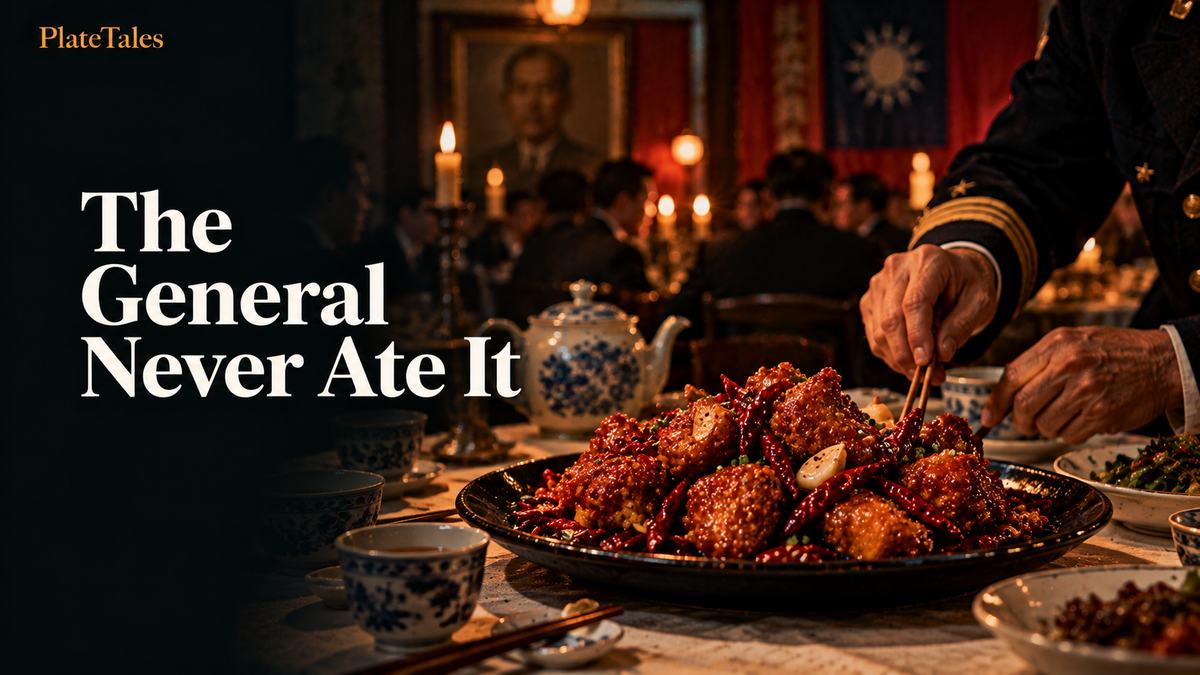
General Tso's chicken was invented by Peng Chang-kuei, a Hunanese banquet chef who fled to Taiwan in 1949. By his own account he first served it in Taipei in the 1950s, at a navy banquet for a visiting American admiral. The crisp, sweet version most Americans order took shape later, in a rival's kitchen in New York.
The general himself, Zuo Zongtang, had been dead for almost seventy years before anyone fried a chicken in his name.
A Hunan chef near the United Nations, 1973
The best-documented part of this story happened in Manhattan. In 1973 Peng moved to New York and opened Uncle Peng's Hunan Yuan on East 44th Street, between Second and Third Avenues, a short walk from United Nations headquarters.
Henry Kissinger became a regular. In 1977 he held a banquet there, which still puzzled Peng's son decades later: "He should have held the event at a higher-end establishment, not a small Chinese restaurant." That same year Mimi Sheraton reviewed the place for The New York Times, and her line is the one later accounts quote:
"General Tso's chicken was a stir-fried masterpiece, sizzling hot both in flavor and temperature."
Peng went on to open restaurants in Atlanta, Houston, Los Angeles and San Francisco. Patrick Swayze and the architect I. M. Pei ate at them. By the end of the decade the dish had a name Americans knew and a chef who could claim it. It did not have one fixed recipe, though, and that is where the argument starts.
Who was General Tso?
Zuo Zongtang was born on 10 November 1812 in Xiangyin County, Hunan. From 1851 he fought the Taiping rebels in the long civil war that nearly toppled the Qing dynasty. He then oversaw the building of the Foochow Arsenal, a shipyard and naval academy in Fuzhou. In the 1870s he put down the Dungan revolt in the northwest and took Xinjiang back for the Qing. He died in Fuzhou on 5 September 1885.
Nothing in his record mentions chicken. He never ate the dish, and no one in his lifetime cooked anything by that name. The link is geography. Peng was Hunanese, Zuo was the most famous general Hunan ever produced, and a banquet dish for foreign guests needed a name with some weight to it.
Why not call it Peng's chicken? His son Chuck told Time in 2016: "We are commoners, so to use the family name would have been highfalutin." A Qing general was safer. It is a little like the Earl of Sandwich, except that the earl at least had bread in his hands.
Peng Chang-kuei, from Changsha to Taipei
Peng was born on September 26, 1919, to a farming family in Changsha County, Hunan. In 1933, at about thirteen, he was apprenticed to Cao Jinchen, who had been a personal chef to the late Nationalist politician Tan Yankai. That was training in formal banquet cooking, the food served to officials.
During the war against Japan he followed Cao to Hengyang and then went to Chongqing, the wartime capital, where he was offered a post as personal chef to an official. Before the Communists took Hunan in 1949, he followed Chiang Kai-shek's Kuomintang to Taiwan. He left his mother, his wife and his children behind.
In Taipei he founded a restaurant called Yuloudong in 1952, which burned down a few years later. He then opened Peng Yuan, the name his family's restaurants still carry. He married again in Taiwan and, by one count, had seven children with three mothers.
Where General Tso's chicken started: a navy banquet in Taiwan
Peng told the story of the first plate on camera in Ian Cheney's 2014 documentary The Search for General Tso. The Republic of China Navy asked him to run a three-day state banquet for Admiral Arthur W. Radford, then the top American commander in the Pacific. On the third day he served a new dish of fried chicken with dried chilies, and when the guests asked what it was, he named it on the spot after General Tso.
Peng put that banquet in 1952. The date is shaky. A State Department dispatch from Taipei, printed in Foreign Relations of the United States, records a Radford visit to Formosa from June 2 to June 6, 1953. The Washington Post's obituary of Peng, citing Fuchsia Dunlop, put Radford's dinner in 1955, when he was chairman of the Joint Chiefs of Staff. Radford went to Taiwan more than once, so the safest statement is the one Peng and the record agree on: the mid-1950s, for Radford.
There are other origin stories, and they are weaker:
| Claim | Who made it | How well supported |
|---|---|---|
| Created for Admiral Radford's visit | Peng himself, on film | Radford's visits to Taiwan are on record; the year is disputed |
| Created for General Douglas MacArthur during the Korean War | Time obituary, 2016 | No other source found; contradicts Peng's own account |
| Improvised when Chiang Ching-kuo turned up late and the kitchen was short of ingredients | Taiwanese food writer Zhu Zhenfan, 2009 | A later anecdote, not from Peng |
| Invented in New York by T. T. Wang in 1972 | Wang's restaurant group, Shun Lee, quoted in The Washington Post in 2002 | Fits the sweet version, not the name |
The first version, before the sugar
The Taipei dish was a different animal from the takeout box. Peng used chunks of chicken thigh with the skin on, seasoned with soy sauce, garlic, vinegar and dried chilies. There was no broccoli. Time described his version as having less batter and being less sweet and crunchy than American ones, "but more oily, salty, tart and spicy."
Some retellings say the original had no sugar at all. The sources disagree on that point, so the fair summary is that it was savory and sour first, with sweetness a minor note at most.
How General Tso's chicken got sweet in New York
The dish reached Manhattan before Peng did. In 1971 two New York restaurateurs, David Keh and T. T. Wang, went to Taiwan separately, without telling each other, to look for ideas and recruit chefs. Both ended up at Peng's restaurant. Back home they opened Hunan restaurants within weeks of each other, and both won rare four-star reviews from The New York Times.
The timing was good. Interest in China was running high around Nixon's 1972 visit. According to Ed Schoenfeld, who worked for Keh and later became his business partner, New York went from five Sichuanese restaurants to more than 130 in the early 1970s. Restaurants took out ads in the Times promising dishes never before served in the country, and rivals answered with ads promising more.
Schoenfeld told Francis Lam of Salon in 2010 that the dish was remade at Wang's restaurant, Hunam. Wang "added a crispier batter to the chicken, and made the sauce sweet." Americans liked it far better that way, and the crisp, sweet version is the one that spread.
So when Peng arrived about a year later, he found his own cooking already on New York menus, sweetened. He felt ripped off, and some New Yorkers treated him as the copier. Schoenfeld's verdict on him was diplomatic: "he was a great chef, but not necessarily a better cook than the chefs who were popularizing his cuisine here."
Put plainly, Peng created the dish and the name in Taiwan, and Wang at Hunam made the version most Americans eat.
Is General Tso chicken actually Chinese?
It was invented by a Chinese chef, cooking Hunan-style food, but outside mainland China, for foreign guests, and then rebuilt by the next cook for New Yorkers. It belongs with the other dishes that changed country along with their cooks, told in how immigration built American food culture.
In Hunan itself it barely registered. The food writer Fuchsia Dunlop, who spent months in the province, told The Washington Post that the dish is "all but unknown in Hunan itself," and that mentioning it there drew blank looks. Jennifer 8. Lee, author of The Fortune Cookie Chronicles, put the difference this way: in America, General Tso, "like Colonel Sanders, is known for chicken, not war."
Peng left New York in 1983 and went back to Taipei, where he built Peng Yuan into a chain. He later opened a branch in Changsha, which brought General Tso's chicken to General Tso's province. Local diners did not take to his style, and the branch closed soon after.
What happened to Peng Chang-kuei
Peng kept cooking into his nineties. His son said he would watch the younger cooks for a while and then take over: "You don't know how to do it. I'll do it myself." In 2016 Chuck Peng told Time, with a smile, "If we patented General Tso's chicken, we'd be extremely rich."
He was still cooking in the family's Taipei kitchen a few months before he died. Peng Chang-kuei died of pneumonia in Taipei on November 30, 2016. He was 97, though most obituaries gave his age as 98.
Questions people ask
Did General Tso ever eat General Tso's chicken?
No. Zuo Zongtang, the Hunanese general the dish is named after, died in Fuzhou in 1885, almost seventy years before Peng Chang-kuei served it in Taipei. Nothing in his record mentions chicken. Peng, a fellow Hunanese, chose the name because a banquet dish for foreign guests needed one with some weight.
Is General Tso's chicken eaten in China?
Barely. Peng Chang-kuei created it in Taipei, Taiwan, and it was reworked in New York, not in Hunan. The food writer Fuchsia Dunlop told The Washington Post it is "all but unknown in Hunan itself." Peng's Changsha branch served it in Hunan, but local diners did not take to his style and it closed soon after.
What did the original General Tso's chicken taste like?
Peng's 1950s Taipei version used skin-on chicken thigh chunks seasoned with soy sauce, garlic, vinegar and dried chilies, with no broccoli. Time described it as less battered, less sweet and less crunchy than American versions, but more oily, salty, tart and spicy. Sources disagree on whether it had any sugar.
Why is General Tso's chicken sweet in America?
The sweetness came from New York. In the early 1970s, according to Ed Schoenfeld, T. T. Wang's restaurant Hunam added a crispier batter and made the sauce sweet. American diners liked that version far better, and it spread. Peng arrived in New York about a year later and found his dish already sweetened on local menus.
Filed under Origin Stories, Migration Stories
Want more stories like this?
One food history story, every week. No spam, just the stories behind what the world eats.