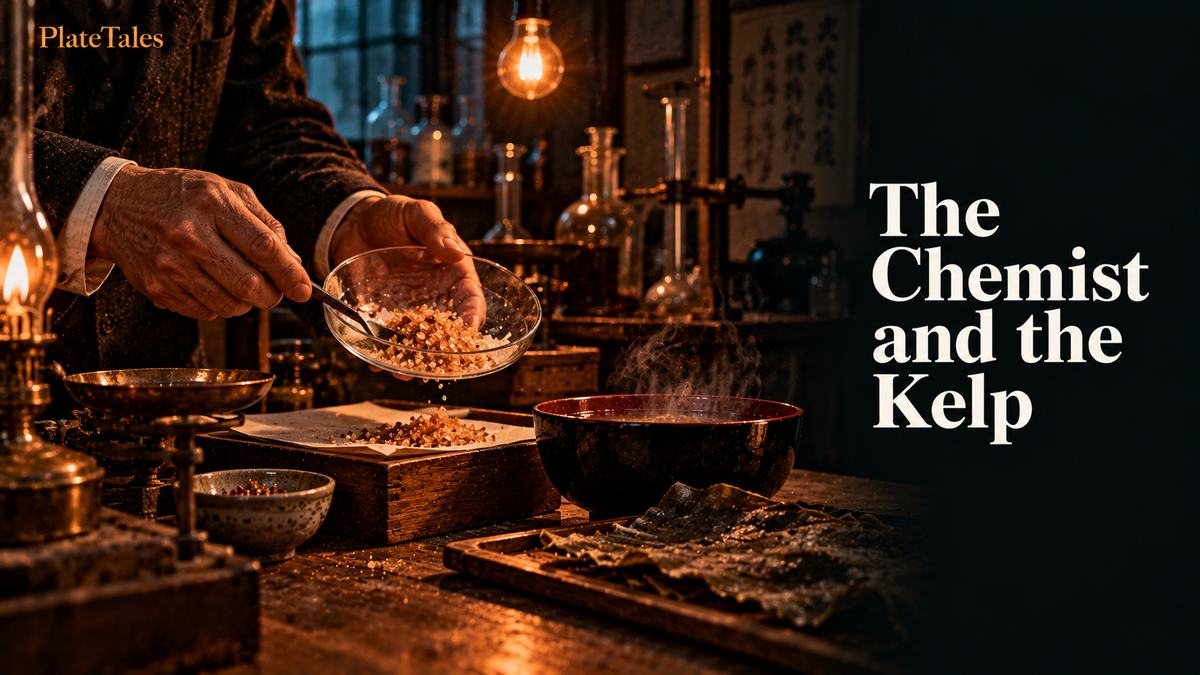
Kikunae Ikeda, a chemistry professor at Tokyo Imperial University, invented MSG. In 1908 he isolated glutamate from kombu, the kelp that gives Japanese dashi its depth, named its taste umami, and patented a way to make a seasoning from it. A businessman, Saburosuke Suzuki II, began selling the result as Ajinomoto in 1909.
That much is solid. The edges are softer. Ikeda did not discover glutamic acid, which a German chemist had identified about forty years earlier, and he did not invent the flavor, which Japanese cooks had been drawing out of seaweed for centuries. What he invented was the white powder: a pure, stable salt of that acid that anyone could shake into a pot. And the other famous name attached to MSG, the doctor who supposedly gave it a bad reputation in 1968, comes with an authorship fight of its own.
Karl Ritthausen and the wheat gluten of 1866
The molecule came first, and it came from flour. In 1866 the German chemist Karl Heinrich Ritthausen treated wheat gluten with sulfuric acid and identified a new amino acid in what was left. He named it after its source: glutamic acid, from gluten.
Ritthausen was cataloguing proteins, and nobody built a seasoning on his work. If inventing MSG means finding the chemical, the credit is his. Almost nobody uses the word that way, so his name mostly turns up as a trivia correction.
Kikunae Ikeda and the kelp in the pot, 1907 to 1908
Ikeda was born in Kyoto in 1864 and graduated in chemistry from Tokyo Imperial University in 1889. From 1899 he spent two years in Wilhelm Ostwald's laboratory in Leipzig.
According to Sam Kean, writing for the Science History Institute, he came from a samurai family that had fallen on hard times and once sold his bed to pay for college. Ajinomoto's company history says the stay in Germany left him wanting to improve Japanese nutrition, which is the kind of motive a company history likes to record, and may well be true.
The usual story puts the question at the dinner table in 1907, when a family dashi tasted unusually good and he traced the difference to the kombu. That scene comes from later retellings rather than from anything of Ikeda's we have, so treat it as plausible rather than proven.
The lab work is better documented. By Kean's account, starting in 1907, Ikeda boiled down about 90 pounds of kelp into a tarry resin, then spent months stripping out salts and other compounds until he had roughly an ounce of brown crystals. They were glutamic acid, Ritthausen's molecule, now pulled out of seaweed.
He then tested which salt of the acid made a usable seasoning, trying calcium, potassium, ammonium and magnesium glutamate. The sodium salt, monosodium glutamate, dissolved most easily, tasted best and was the easiest to crystallize, so that is the one he patented in 1908. It was a deliberate piece of chemistry, the opposite of the happy kitchen mishaps in foods that were invented by accident.
What is umami, and who discovered it?
Ikeda also named the taste, and that half of his work took far longer to be accepted than the powder did. In his paper "New Seasonings," published in Japanese and translated into English for the journal Chemical Senses in 2002, he wrote that the taste "is most characteristic of broth prepared from dried bonito and seaweed." Then: "I propose to call this taste 'UMAMI' for convenience."
For convenience. The mild phrasing carried a large claim, that a fifth basic taste sat alongside sweet, sour, salty and bitter. Western scientists were slow to accept it.
The strongest evidence came in 2000, when researchers at the University of Miami reported receptors on the tongue that respond to glutamate. Ajinomoto's own scientists reported similar receptors in the stomach six years later.
So the answer to who discovered umami has two layers. Cooks knew the effect long before anyone named it, which is why dashi is built on kombu and bonito flakes, and why kitchens elsewhere lean on aged cheese, fish sauce and fermented soy, all glutamate-heavy products of the long history of fermentation. Ikeda was the one who gave the taste a name and tied it to a molecule.
Saburosuke Suzuki II and the first jars of Ajinomoto
A chemist with a patent is a long way from a product on a shelf. That part belongs to Saburosuke Suzuki II, whose family business began selling the powder in 1909 under the name Aji-no-moto, usually translated as "essence of taste" or "origin of flavor." Some popular accounts, including a Science History Institute article, say Ikeda founded the Ajinomoto company. Ajinomoto's own history credits Suzuki with launching the business, and that version is better supported: Ikeda supplied the patent, Suzuki the factory and the selling.
Where does MSG come from?
Not from seaweed, after the first experiments. Kelp was far too costly a raw material for an industry.
From 1909 to 1962 the powder was made by breaking down vegetable protein with hydrochloric acid, and the first source was wheat gluten, which closes a neat loop back to Ritthausen's bench. For about a decade from 1962, chemical synthesis from acrylonitrile, a byproduct of Japan's synthetic fiber industry, took over.
Today almost all MSG is made by fermentation. Bacteria of the genus Corynebacterium are fed starch, sugar beet, sugar cane or molasses and release glutamate into the broth, an industrial process developed by the Japanese firm Kyowa Hakko. The FDA compares it to making yogurt, vinegar or wine.
By the late 1940s, according to the Science History Institute, American manufacturers were quietly adding MSG to canned soups, and Americans went on eating it for decades without complaint. It was also in the kitchens of Chinese American restaurants, part of the larger story of how immigration built American food, and that is where the trouble started.
Chinese restaurant syndrome: the origin of the scare
On April 4, 1968, the New England Journal of Medicine printed a short letter under the title "Chinese-Restaurant Syndrome," signed by Robert Ho Man Kwok, a researcher in Maryland. After meals at restaurants serving northern Chinese food, he wrote, he felt "numbness at the back of the neck, gradually radiating to both arms and the back," along with weakness and a racing heart. He offered three suspects: the cooking wine, the salt, or perhaps the MSG.
The readers took it from there. A month later the journal printed ten replies from other doctors. One blamed duck sauce, another frozen vegetables, and one the strain of Westerners struggling with chopsticks.
The editors ran the batch with a smirking note, and some of the early replies read as if their authors were in on a joke. The joke did not survive reprinting. In February 1969 a team led by Herbert Schaumburg reported in Science that 55 of 56 people given pure MSG had at least one of three symptoms (burning, facial pressure or chest pain), in a part of the study that was not blinded. In May of the same year a Washington University psychiatrist named Olney reported brain lesions in mouse pups injected with large doses. Those two papers turned a letters column into a national worry.
Did Kwok write the letter, or did Howard Steel?
Half a century later, the radio program This American Life aired a claim from Howard Steel, a retired orthopedic surgeon and Colgate University trustee. He said he had written the letter himself to win a $10 bet with a friend, the internist Bill Hanson, and signed it with a made-up name meant as a crude pun.
Steel had left a voicemail for Jennifer LeMesurier, a scholar who had published a 2017 paper on the letter: "I am the author of Ho Man Kwok."
The reporting that followed went against him. Robert Ho Man Kwok was a real researcher who had worked at the National Biomedical Research Foundation, an institution Steel said he had made up. Kwok died in 2014. His children said he wrote the letter and was proud of it, and a colleague from the foundation agreed.
Details in the letter, such as the writer's move to the United States and the focus on northern Chinese cooking, fit Kwok, not Steel. Asked whether the evidence pointed to the Kwok family's version, Steel's daughter Anna said, "It seems to point in that direction, doesn't it?" She also noted that Hanson never paid up on the bet.
Colgate Magazine later concluded that Steel was likely lying. He was 96 when he was interviewed and died a few months later, at 97.
Is MSG bad for you? How the question was tested
This is a history site, so here is the paper trail and nothing more.
After years of complaints the FDA asked the Federation of American Societies for Experimental Biology to review the evidence. Its 1995 report concluded that MSG was safe at customary levels, while noting short-lived symptoms such as headache or flushing in some people who took 3 grams or more without food. The FDA says a typical serving of food with added MSG holds less than half a gram, and it classes MSG as "generally recognized as safe."
A multicenter double-blind study published in 2000 by Geha and colleagues tested 130 people who said they were sensitive to MSG; only two reacted every time, and the authors concluded the response could not be reproduced. In 2020 Ajinomoto and others launched a campaign against the phrase itself, and Merriam-Webster kept the definition but renamed the entry "MSG symptom complex."
So who invented MSG?
| Claimant | Year | What the record shows |
|---|---|---|
| Karl Heinrich Ritthausen | 1866 | Identified glutamic acid in wheat gluten |
| Kikunae Ikeda | 1908 | Isolated glutamate from kombu, chose the sodium salt, patented it, named umami |
| Saburosuke Suzuki II | 1909 | Put Ajinomoto on sale |
| Robert Ho Man Kwok | 1968 | Wrote the letter that coined Chinese restaurant syndrome |
| Howard Steel | about 50 years later | Claimed the letter; the evidence points to Kwok |
The thing in the shaker, monosodium glutamate made on purpose as a seasoning, starts with Ikeda's crystals and his 1908 patent. He died in Tokyo on 3 May 1936, aged 71, and on 18 April 1985 the Japan Patent Office named him one of its Ten Japanese Great Inventors.
Questions people ask
Is MSG made from seaweed?
Not anymore. Kikunae Ikeda first isolated glutamate from kombu kelp in Tokyo in 1908, but kelp was too costly for industry. MSG was later made by breaking down wheat gluten with acid, then by chemical synthesis, and today almost all of it is made by fermenting starch, sugar beet, sugar cane or molasses with Corynebacterium bacteria.
Who wrote the Chinese Restaurant Syndrome letter?
The letter appeared in the New England Journal of Medicine on April 4, 1968, signed by Robert Ho Man Kwok, a researcher in Maryland. Howard Steel later claimed he wrote it for a $10 bet, but Kwok was a real researcher, and his children and a former colleague said Kwok wrote it.
Is MSG safe to eat?
The FDA classes MSG as generally recognized as safe. A 1995 review for the agency found it safe at customary levels, with short-lived headache or flushing in some people who took 3 grams or more without food. A typical serving with added MSG holds less than half a gram.
What does Ajinomoto mean?
Ajinomoto is the Japanese company name and brand under which Saburosuke Suzuki II's family business began selling Ikeda's MSG powder in 1909. Aji-no-moto is usually translated as "essence of taste" or "origin of flavor." Ikeda supplied the patent, and Suzuki supplied the factory and the selling.
Filed under Origin Stories, Accidental Inventions
Want more stories like this?
One food history story, every week. No spam, just the stories behind what the world eats.