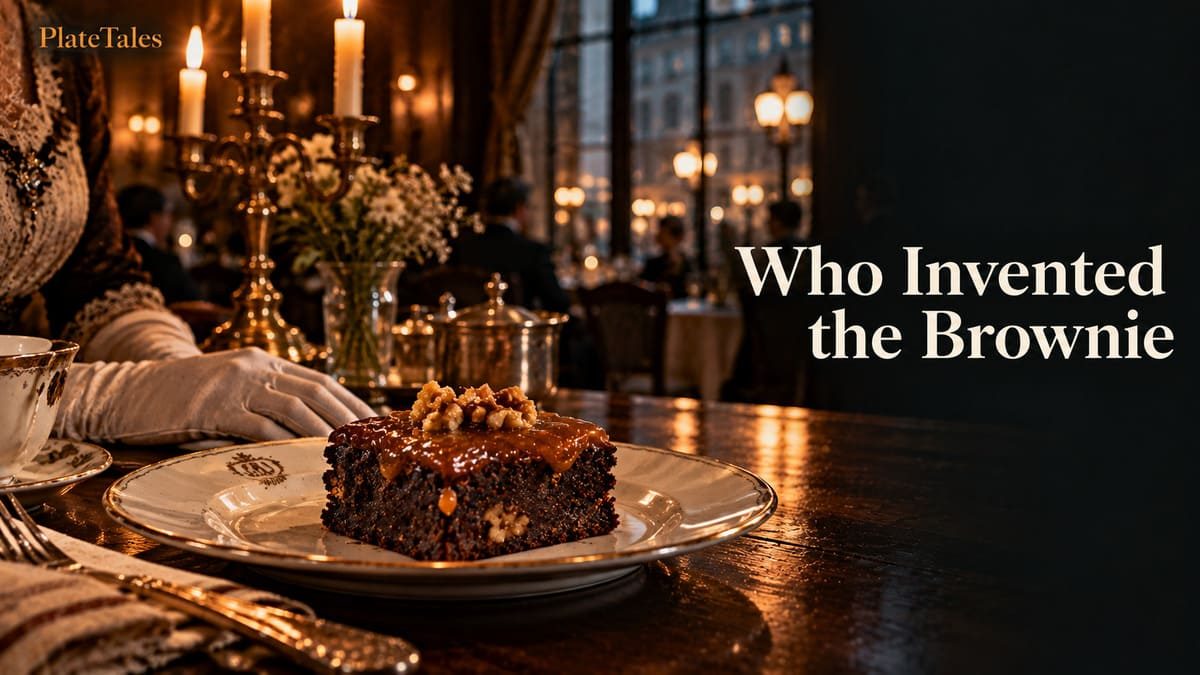
Nobody can name the person who invented the brownie. The Palmer House Hotel in Chicago says its pastry kitchen made the first one in 1893 for Bertha Palmer, and the hotel still serves a walnut brownie with an apricot glaze. The printed record tells a messier story: the word "brownie" meant other things in the 1890s, and the first chocolate recipes with the modern proportions turn up in newspapers and cookbooks around 1904.
The Palmer House story: a box lunch for the fair
The popular version goes like this. In 1893 Chicago hosted the World's Columbian Exposition, a huge fair marking the arrival of Columbus in the New World. Bertha Palmer, wife of Potter Palmer, who owned the Palmer House Hotel, headed the fair's Board of Lady Managers. She had held that post since 1891, and it was officially honorary but meant a great deal of work.
According to the legend, Palmer asked the hotel's pastry chef for a dessert the women attending the fair could eat from a boxed lunch. It had to be smaller than a slice of cake and easy to hold. What came back was a chocolate square with walnuts and an apricot glaze. The Palmer House still sells a brownie made to that description.
It is a tidy story, and the details are plausible. A woman who spent two years arguing over murals, architects and a commemorative coin could well have had opinions about lunch. But every telling of it, including the ones on encyclopedia pages, presents it as a legend. No fair-era document that we could read shows the order being placed or the dessert being named.
The name arrived later
Here is the first problem. Even the people who repeat the Palmer House story concede that the name "brownie" came some time after 1893, and that cookbooks and journals of the period did not use it for this dessert. So the hotel may have made a chocolate square in 1893. What it did not do, on the evidence we have, is call it a brownie.
Hotel dessert kitchens in the 1890s were full of small cakes and bars. A walnut chocolate square would not have been strange. What makes the Palmer House version special is only the claim, and the claim is a story told afterward. A hotel can have been first without anyone writing it down.
Brown dinners and Palmer Cox's sprites
The word itself has a separate history. In the 1880s, brown-themed dinner parties were fashionable. Hosts served brown dishes, and sauteed mushrooms were colloquially called "brownies." That is the odd part: the first brownies on a plate may have been fungus.
The name also borrowed from a comic cast. Palmer Cox, a Canadian illustrator born in Granby, Quebec, had been drawing mischievous, kind-hearted sprites called the Brownies since 1879. By February 1881 they had their final form in Wide Awake magazine. The Brownies, Their Book came out in 1887, and The Brownies at Home in 1893, the year of the fair. A composer in Detroit, Effie Kamman, wrote a popular "Dance of the Brownies" the same year, and a stage musical followed in 1894. The Eastman Kodak Brownie camera took its name from the same characters.
By the 1890s, hosts were holding "Brownie Banquets," decorated with figurines of Cox's characters. The word was everywhere, and cooks attached it to whatever small brown thing they were serving.
1896: Fannie Farmer's molasses brownie
The first brownie recipe in a major American cookbook is not chocolate at all. Fannie Farmer's Boston Cooking-School Cook Book of 1896 included, by most accounts, a molasses brownie with a nut at its center. We could not open an 1896 copy, but the 1910 printing on Project Gutenberg, which still lists 1896 first among its copyright years, has a molasses brownie in its cake chapter: butter, powdered sugar, Porto Rico molasses, an egg, bread flour and pecans, baked in small fancy tins with half a pecan on top of each. By then "brownie" had come to mean a molasses cake, which fits the brown-dinner habit of naming things by color.
So if the question is "what is the first brownie recipe," the answer depends on what you accept. A molasses cake with a nut is a brownie in name only. The Palmer House square is a brownie in shape only, and it has no 1893 paper behind it.
1899 to 1907: chocolate takes over
The food writer Stella Parks, found an 1899 Chicago cookbook with a "Brownie cake," an unleavened chocolate cake. She calls it a "proto-brownie," the earliest evidence she found. Chicago, again, which keeps the Palmer House story alive without proving it.
By 1904, recipes with the ratios we would recognize appeared in newspapers in Chicago and the Northeast. Parks suggests they shared a common source. Two years later, in 1906, Farmer is said to have added chocolate to her own recipe. Why she did so is not settled. The 1910 printing does carry a chocolate version in its candy-and-small-cakes pages: a cup of sugar, a quarter cup of melted butter, one egg, two squares of Baker's chocolate, vanilla, half a cup of flour and half a cup of walnuts, baked in a paper-lined seven-inch pan and cut into strips.
In 1907 Maria Willett Howard's Lowney's Cook Book adapted the Boston recipe as a "Bangor Brownie," with an extra egg and an extra square of chocolate, which made it fudgier. That is close to what most people mean by the word now.
The Bangor housewife
A second legend says a housewife in Bangor, Maine, invented the recipe. Mildred Brown Schrumpf promoted that idea. Reference works disagree about it, and no source we could read shows that a particular woman stood behind the name.
Where the evidence leaves the brownie
Put the dates in a row and the picture is of a recipe assembled over about fifteen years rather than invented in one afternoon. A chocolate square may have come out of the Palmer House in 1893. A molasses cake took the name in 1896. A chocolate cake carried it in 1899. The modern proportions show up around 1904, and the fudgy Bangor version was printed in 1907. For more cases of this kind, see foods invented by accident and the accidental inventions shelf. The chocolate itself has an older story, told in the history of chocolate.
A walnut brownie with an apricot glaze is still on the menu at the Palmer House, which reopened on June 17, 2021, after closing in March 2020.
Questions people ask
Did Bertha Palmer really invent the brownie?
No source we could read shows that she did. The story says Bertha Palmer asked the Palmer House Hotel pastry kitchen in Chicago for a small dessert for women at the 1893 World's Columbian Exposition. It is presented as a legend, and the name "brownie" was not used for it in 1893.
What was the first brownie recipe?
It depends on the definition. Fannie Farmer's Boston Cooking-School Cook Book printed a molasses brownie with a nut on top and no chocolate; the 1910 printing also has a separate chocolate-and-walnut brownie. A Chicago cookbook of 1899 had a chocolate "Brownie cake," and recipes with modern proportions appeared in newspapers around 1904.
Why are brownies called brownies?
The name probably came from the 1880s and 1890s fashion for brown-themed dinners and from Palmer Cox's cartoon sprites, the Brownies, who were hugely popular by 1893. Hosts held Brownie Banquets decorated with figurines of the characters, and the word attached itself to a molasses cake and later to the chocolate square.
What is a Bangor brownie?
A Bangor brownie is the fudgier version printed in Maria Willett Howard's 1907 Lowney's Cook Book, adapted from the Boston recipe with an extra egg and an extra square of chocolate. The name comes from Bangor, Maine, though the story of a local housewife inventing it is disputed.
Filed under Origin Stories, Accidental Inventions
Want more stories like this?
One food history story, every week. No spam, just the stories behind what the world eats.