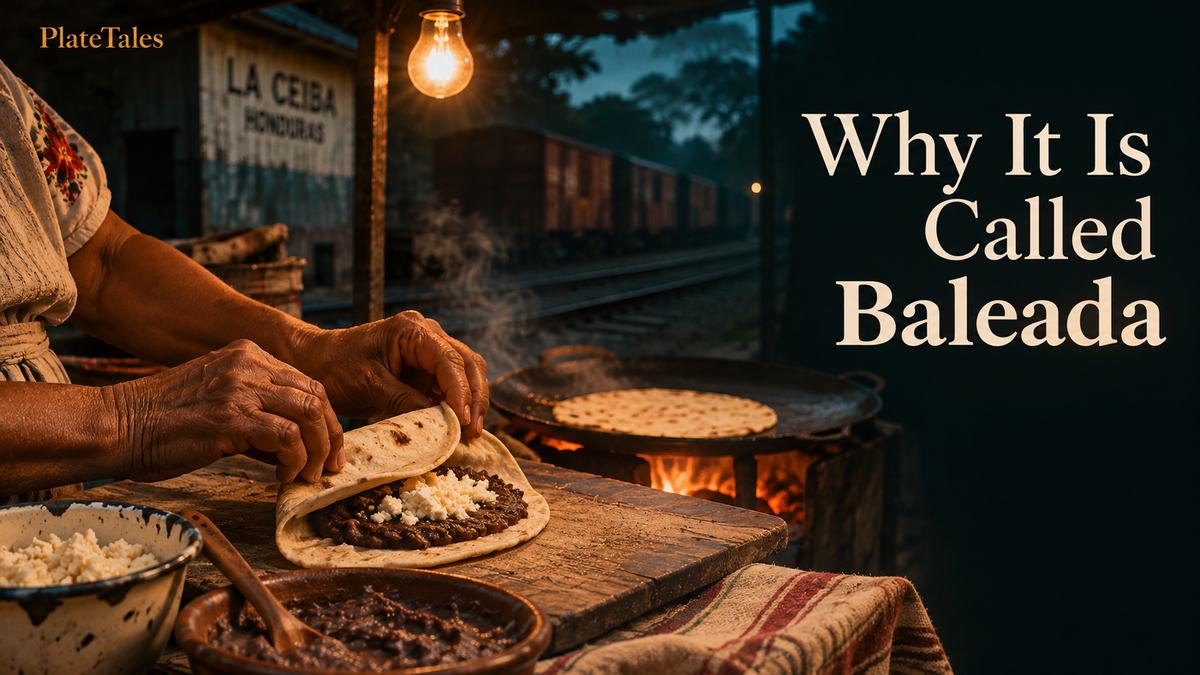
A baleada is called a baleada because the Spanish word means "shot" or "hit by a bullet," and Hondurans have been arguing for decades about which bullet. The most common explanation is plain: the beans inside the folded flour tortilla look like bullets, balas. The more colorful one says the name belonged first to a woman who survived being shot. Neither has a document behind it.
What the word actually says
Baleada is the feminine form of a past participle. It comes from bala, a bullet, and it describes something that has been shot, in the way la baleada would be "the shot woman." That grammar matters, because it is why the legends are about a person and not an object. A dish with a masculine name might have been "the shot one." This one is a woman.
The dish itself is simple. A wheat flour tortilla is folded around mashed refried red beans, crumbled hard cheese and a spoonful of crema. Add eggs, avocado, meat or fried plantain and the name changes: a plain one is a baleada sencilla, and the fuller versions are called mixta, preparada or super preparada, according to a 2022 piece for Mayorga Coffee.
The beans-as-bullets explanation
Sources agree that the name has to do with the beans. When you bit into one, the filling could shoot out of the open end. In the old way of serving them, the beans were piled on standing up, parados, or en bala, and the beans themselves were sometimes called balas.
One version puts the joke in a customer's mouth. The beans were like bullets, the tortilla the cartridge and the cheese the gunpowder. The line is given in Spanish and the customer is not named. Other web accounts give the same speech to the vendor herself, which is a sign of a story that has been retold until the speaker changed.
Daniel Galeano, a Honduran entrepreneur who helped set up the National Day of the Baleada, told Mayorga Coffee that one of the most widely accepted explanations is the resemblance between a bean and a bullet. That is a fair summary of the state of knowledge. It is a plausible joke, widely repeated, with no first speaker you can point to.
The shot woman of the legend
The folk tale has a woman who sold food, was shot, lived, and kept her stall. Customers then began to say they were going to see the baleada. After a while the name moved from the woman to the food.
Even the setting changes with the teller. One version puts the shootout in Tegucigalpa, the capital, and no historical evidence supports it. The Mayorga Coffee version puts the stall somewhere in the north of the country. A story with a different city every time is usually a story that nobody was in.
Galeano adds a reading that does not depend on the facts. In his telling, the legend carries a different truth: women run most baleada stalls. He calls the typical baleadera a mother who gets up early to knead dough, carry it to the stall and light the griddle. The Honduran women who cook the dish are real even if the shot woman is not.
Baleada history on the record: La Ceiba, 1964
The firmest date comes with a name and a street. The first recorded sale of baleadas was in 1964 at a stand on Avenida República in La Ceiba, beside the railway of the Standard Fruit Company. The woman running it was Teresa de Jesus Montino, then 20 years old. The stand still operates as Baleadas Dona Tere.
That is the "Dona Tere" of the second popular account, and it is the one with a verifiable person attached. What it does not do is prove she coined the word. 1964 is the first recorded sale, not the first baleada ever made. Tela, about 100 kilometers away, is named as a likely place of invention because tortilla makers lived there, and San Pedro Sula, El Progreso and La Lima also appear as candidates. The exact origin is unknown.
Galeano is firmer about the city. He told Mayorga Coffee that the dish was "definitely born in La Ceiba," a port and banana-growing region, and that it became popular there in the 1950s before spreading across Honduras. He also points to photographs from the 1950s, posted by the account Historia de Honduras, that show plantation workers eating tortillas with beans.
So the record offers two things: photographs of workers with beans and tortillas in the fifties, and a named vendor selling them in 1964. Neither says what anyone called the food.
Where the wheat tortilla came from
The tortilla is the odd part. Most Central American staples are corn, with centuries of history behind them. Galeano points out that wheat is not native to the continent, so the baleada has no indigenous or colonial past. It belongs to the banana boom of the twentieth century. If you want the corn side of that family, our story on the history of tacos covers it.
The historian Julio Cesar Zepeda, offers a theory about the flatbread. Foreign cooks, mostly from India and Pakistan, worked for the banana companies and made flatbreads such as naan and chapati. Local people took up the idea, and it turned into the baleada tortilla. It is a suggestion, not a settled finding. For the wider story of how South Asian cooking traveled with labor and trade, see how curry spread around the world, and for flatbread in general, the history of bread.
From La Ceiba to Guatemala and a Guinness plate
The dish stayed local for a while and then did not. In 1983, a Honduran opened a place called El Triangulo in Puerto Barrios, Guatemala, and then another in Santo Tomas de Castilla. They sold baleadas as tortillas de harina, flour tortillas. In that part of Guatemala the dish became popular under the name tortilla de harina izabalense.
At home the dish picked up official standing. The first National Baleada Day was held on June 16, 2018, in Tegucigalpa, San Pedro Sula and La Ceiba, and a second followed on June 15, 2019, in more towns. The organizers wanted the third Saturday of June to become the permanent date. Earlier, on October 14, 2017, 30 members of the Central American Academy of Gastronomy made a baleada 5.5 meters across in Tegucigalpa, shared among 2,000 people.
Honduran film and music took it up too. The 2009 film Amor y Frijoles centers on a young woman who sells baleadas. The street-food stalls that Galeano describes, open from dawn to late at night, are the real center of the dish, and you can find more of that world in our street food stories.
Questions people ask
What does baleada mean in Spanish?
Baleada is the feminine past participle of the Spanish word for bullet, bala, so it means a woman who has been shot. For the Honduran dish, the usual explanation is that the beans in the tortilla look like bullets, though a folk tale about a shot food vendor is also told.
Who invented the baleada?
Nobody has been proven to have invented it. The earliest recorded sale was in 1964 at a stand on Avenida Republica in La Ceiba, run by 20-year-old Teresa de Jesus Montino, whose stand still operates as Baleadas Dona Tere. Photographs from the 1950s show banana workers eating tortillas with beans.
Is the story of the shot woman true?
There is no historical evidence for it. Accounts agree on that, and the tale changes setting from teller to teller, with one version placing the stall in Tegucigalpa and another somewhere in northern Honduras. The bean-and-bullet explanation is more widely accepted, though it is also unproven.
Where does the baleada come from?
The baleada comes from the north coast of Honduras, and La Ceiba has the earliest recorded sale, in 1964. Tela, San Pedro Sula, El Progreso and La Lima are also named as candidates. Its wheat tortilla ties it to the banana-company era of the twentieth century, not to a pre-Columbian tradition.
Filed under Origin Stories, Street Food
Want more stories like this?
One food history story, every week. No spam, just the stories behind what the world eats.