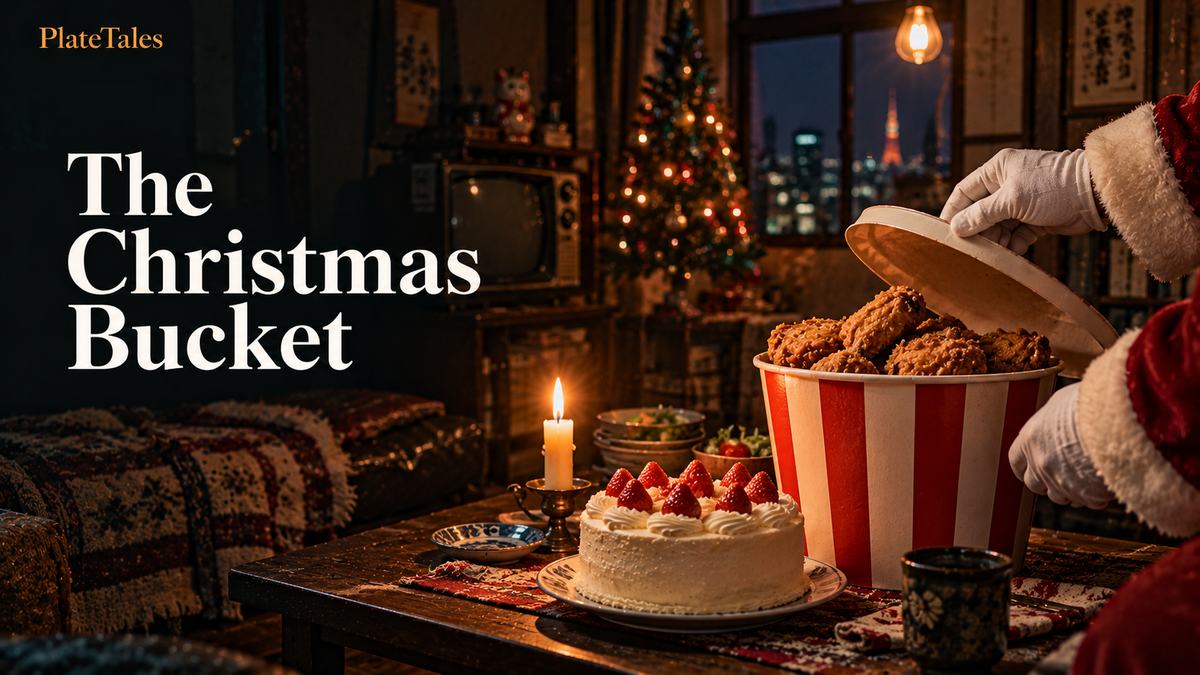
Japan eats KFC on Christmas because of a KFC Japan advertising campaign that began in December 1974 and sold a bucket of fried chicken as the Western Christmas dinner. Takeshi Okawara, manager of the first Japanese store, says the idea was his, and admits part of the pitch was a lie. The chicken was already there: NHK was teaching roast chicken for Christmas in 1959.
So there are three accounts of how the bucket got to the table. The company has one, Okawara has another, and the oldest comes from a cooking show on public television. They do not fit together neatly, which is why the question keeps getting asked.
A failed Nagoya store and the 1974 campaign
KFC came to Japan through the 1970 World Expo in Osaka. The company's own timeline records an American test store at the fair in March 1970, whose best day brought in 2.8 million yen. In July the American parent and Mitsubishi Corporation set up a fifty-fifty joint venture with 72 million yen in capital. On November 21, 1970, the first real store opened in the Meisei shopping center in Nagoya's Nishi Ward.
It flopped. Okawara, born in 1943, had graduated in economics from Sophia University in 1966. Japanese-language accounts have him working for Dai Nippon Printing in 1969 when he met a KFC staffer preparing the American pavilion for the Expo (one English account names Nippon Paper instead). He joined the new company and was put in charge of the first store.
Interviewed for Business Insider's podcast Household Name in 2018, he blamed the look of the place: "First of all, all the signs were written in English." People walked in and asked whether it was a barber, or a shop selling chocolates. He slept in the back of the store to save money and lived on the chicken he could not sell.
The company gave up on the suburbs and moved into city centers. The Aoyama store, KFC's fifth, opened in Tokyo in July 1971. TV commercials started in October 1973, and the hundredth store opened in Akasaka that December. Then comes the line in the company history that matters here, in full: "December 1974, first Christmas campaign."
The slogan is reported in several forms, among them "Kurisumasu ni wa Kentakkii!" (Kentucky for Christmas!) and "Kentucky is Christmas!". Versions of it are still running every December.
The foreigner who missed his turkey
The story KFC prefers is that the idea came from a customer. A foreigner living in Japan could not find a turkey for Christmas, bought fried chicken instead, and the company noticed. Asked about Okawara's version, Yum Brands, which owns the KFC brand, told Business Insider that a foreign visitor had suggested chicken for Christmas dinner.
Even the friendly retellings keep this story at arm's length. J-CAST News, writing up the custom on Christmas Day 2012, ended the turkey anecdote with "it is said". Time Out Tokyo says Okawara "allegedly" overheard an expat saying they missed eating turkey. KFC's own Japanese site calls it one theory among several.
Nobody names the foreigner, the store, or the year. No document from the period has surfaced. It is a pleasant story that cannot be checked.
Who started KFC Christmas in Japan? Okawara's Santa suit
Okawara's own account is better, partly because it makes him look worse. In a 2017 interview with the Nikkei, he said a mission kindergarten in Aoyama, Tokyo, came to him around December 1973. The school would buy his fried chicken for its Christmas party, and it wanted him to play Santa Claus.
He did. On the podcast he described being there "dancing, holding the [bucket] of chicken." Word got around, and other schools started ordering.
Then came the confession. Once the Christmas buckets caught on, a television interviewer asked him whether people in the West really ate chicken at Christmas. He told Household Name it was NHK, the national broadcaster:
"I know that the people are not eating chicken, they are eating turkey, but I said yes. It was lie. I still regret that."
He added, by way of explanation, that "people like it because [it's] something good in the U.S. or European countries." In the Nikkei version the question comes from an unnamed TV station a few years after the kindergarten party, but the yes is the same.
Okawara became president of KFC Japan in 1984 and held the job until 2002. He had every reason to polish the legend, and he chose to dent it. The weak points are the details. English retellings of his podcast drift on small facts (Fox News puts the first store in Osaka, which the company timeline contradicts). Even the Party Barrel wobbles: Some English accounts have him selling party barrels for Christmas from 1970, while Japanese accounts credit him with the Party Barrel product that launched in 1985.
Roast chicken on NHK in 1959
The oldest witness is the television kitchen. Isami Omori, a professor at Mukogawa Women's University, worked on NHK's cooking program Kyou no Ryouri (Today's Cooking) from 1990 to 2005. Omori then went through the Christmas recipes in the December issues of the show's companion textbook from 1959 to 2018. The resulting 2019 paper is the closest thing this story has to an archive.
In December 1959, eleven years before the Nagoya store opened, the program gave Christmas five of its 27 broadcasts and New Year only three. The Christmas main course was a whole roast chicken. It was taught by Tokusaburo Tanaka, head of cooking at the Tokyo Kaikan, with photographs showing how to truss the bird. Ovens were still rare in Japanese homes, so the program spent a separate broadcast on how to use one.
The 1960 textbook went further and ran a column on why people eat roast chicken at Christmas. It did not present chicken as a stand-in for turkey. It said chicken tastes good, and it stressed that in Europe and America the usual Christmas meat was chicken rather than beef. NHK was telling Japanese viewers a tidied-up version of Western Christmas fourteen years before Okawara did.
Through the 1960s the dishes got easier: Western-style chicken with ketchup, chicken stewed in cream. In 1967 fried chicken appeared, and the recipes were now pitched as a Christmas menu "for a family of four" (Omori's wording, translated). By the early 1970s, one December had a single Christmas broadcast against five for New Year. That one was chicken braised in red wine, from the executive chef of the Hotel Okura.
A Christmas nobody gets off work
Christmas in Japan has long been a shopping season rather than a religious holiday for most people. Meidi-ya decorated its Yokohama shop for Christmas in 1886, and its Ginza store, opened in 1900, set other Ginza shops doing the same. Fujiya sold the first Japanese Christmas cake in 1910.
From 1927 to 1947, December 25 was even a public holiday, for a different reason. It was the death day of the Taisho Emperor, who died on Christmas Day 1926. Today it is an ordinary working day.
Omori links the 1970s fade of home-cooked Christmas on the show to eating out. After the oil shock the Christmas mood cooled, and going out to eat became a leisure activity. Omori lists the signs: KFC at the 1970 Expo, the launch of the women's magazines an-an and non-no, and the new word famiresu, family restaurant. A pre-ordered bucket picked up after work fit that kind of evening.
One popular explanation needs trimming. Many articles credit women entering the workforce, but Omori notes that the number of full-time housewives in Japan peaked around 1970. The paper connects working women, and Christmas as a night off from cooking, to the 1986 Equal Employment Opportunity Act, more than a decade after the first campaign. That may help explain why the habit stuck in the 1980s. It does not explain 1974.
Do Japanese people really eat KFC at Christmas?
Fewer than the legend suggests. Metropolis, citing a 2024 Weathernews survey, reports that about 30 percent of respondents planned to eat some kind of chicken dish at Christmas. About one in five of those bought KFC, which puts the bucket on fewer than one table in ten.
The crowds are real, though. Time Out Tokyo reported in 2017 that Christmas orders open from early November and that long queues form outside stores on the day. The wider Japanese Christmas dinner, if there is one, is chicken of any kind plus a strawberry sponge cake.
That matches what Omori found in the textbooks. By the 1990s roast chicken, fried chicken and roast beef were the three standard Christmas mains, and KFC was simply the best-known seller of one of them. The American version of this story, why turkey ended up on the Thanksgiving table, also has a bird fixed to a holiday first and the explanations written later.
So why does Japan eat KFC on Christmas?
Here is how the claims stack up.
| Claim | Evidence | Verdict |
|---|---|---|
| A foreigner missed turkey and bought chicken | Company line, always "it is said" | Unnamed, undated, unproven |
| Okawara's Santa party and TV yes | His own interviews, 2017 and 2018 | Plausible, but self-reported |
| Chicken was already the Christmas bird | NHK textbooks from 1959 and 1967 | Best documented |
| The December 1974 campaign | KFC Japan's company timeline | Documented |
The last two rows carry the most weight. Japanese home cooks had been told since at least 1959 that roast chicken was what Westerners ate at Christmas, and fried chicken was on NHK's Christmas menu by 1967. KFC sold a ready-made version of a dish people already expected, just as families were starting to buy dinner instead of cooking it, and put a national campaign behind it in December 1974. Okawara's Santa act and his yes on television are the most detailed account of how the idea started inside the company. The turkey-starved foreigner may have existed, but no one has ever named him.
For another Japanese favorite whose story is tangled up with the war and its aftermath, see the war-torn origins of ramen. More holiday foods with tangled pedigrees are in the ritual foods collection.
Okawara left the presidency in 2002 and in 2007 became chief executive of JC Comsa, the company behind the Delsole restaurants. In 2015 KFC Japan declared November 21, the day the Meisei store opened in Nagoya, Fried Chicken Day.
Questions people ask
Who started the KFC Christmas tradition in Japan?
KFC Japan launched its first Christmas campaign in December 1974. Takeshi Okawara, manager of the first store in Nagoya, says the idea was his, starting with a Santa Claus act at a Tokyo kindergarten party. KFC's corporate story instead credits a foreigner who missed turkey, but nobody has named that person.
Did Okawara really lie about Christmas chicken?
By his own account, yes. When a television interviewer asked whether people in the West eat chicken at Christmas, Takeshi Okawara of KFC Japan said yes, although he knew they ate turkey. He told the podcast Household Name in 2018 that he still regrets it. The details come from his own interviews.
Was chicken a Christmas dish in Japan before KFC?
Yes. In December 1959, eleven years before the first KFC store opened in Nagoya, NHK's cooking program Kyou no Ryouri taught a whole roast chicken as the Christmas main course. Fried chicken joined its Christmas recipes in 1967, seven years before KFC Japan's December 1974 campaign.
Do most Japanese people eat KFC at Christmas?
No. A 2024 Weathernews survey, reported by Metropolis, found about 30 percent of respondents planned some kind of chicken dish at Christmas, and about one in five of them bought KFC. That puts the bucket on fewer than one table in ten, although long queues still form outside stores.
Filed under Cultural Identity, Ritual Foods
Want more stories like this?
One food history story, every week. No spam, just the stories behind what the world eats.