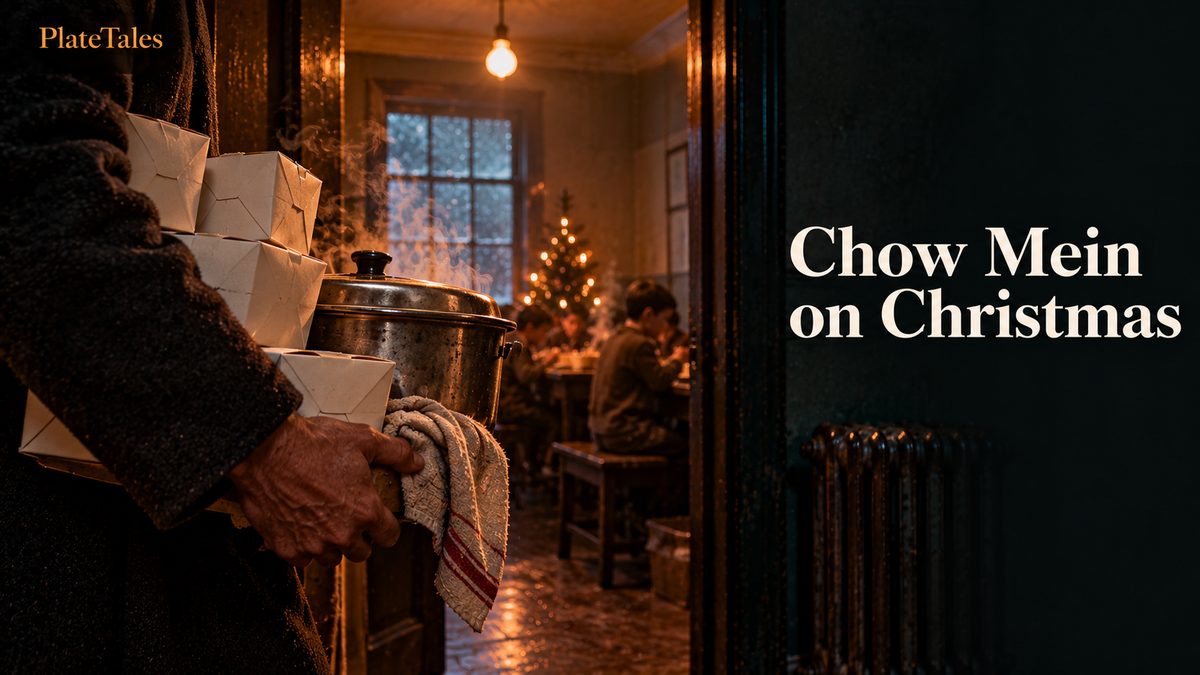
Jews eat Chinese food on Christmas because, in New York a century ago, the Chinese restaurant was one of the few places open on December 25, welcomed them, hung no Christian pictures on the walls, and served food that never mixed milk with meat. The oldest surviving written record is a complaint: in 1899 the New York weekly the American Hebrew scolded Jews for eating at non-kosher restaurants, and singled out the Chinese ones.
The Christmas part shows up in print later, in 1935, in a New York Times story about a plate of chow mein delivered to a children's home in Newark. Between those two dates sits most of the story.
Why do Jews eat Chinese food on Christmas?
Start with a calendar problem. On Christmas, as the Museum at Eldridge Street told History.com, "the City That Never Sleeps" essentially shuts down. For a family that does not celebrate the day, that leaves a long afternoon and no dinner plans. Chinese restaurants, run by people who also did not keep the holiday, stayed open.
That explains why Jews ate somewhere on December 25, and it belongs with the other immigrant stories told through food. It does not explain why they had already been eating Chinese for decades. The reasons historians give for that are practical ones, and most come from Rabbi Joshua Eli Plaut of the Metropolitan Synagogue in New York, whose 2012 book A Kosher Christmas (Rutgers University Press) gives a whole chapter to the subject. Its title is "We Eat Chinese Food on Christmas."
Plaut's list runs roughly like this. In lower Manhattan most immigrant eateries fed their own people, but the Chinese, Plaut writes, "accepted Jews and other immigrant and ethnic groups as customers without precondition." The walls had none of the "pictures or paintings of the Pope" a diner might find in an Italian place. There was no history of antisemitism between the two groups. And the food leaned on onions, garlic and vegetables, ingredients any Eastern European kitchen knew.
One more reason is the one Christmas made visible. Being Jewish in December, in a Christian country, means being outside the main event. Plaut has called the Chinese meal "an insider form of celebrating the holiday," with kung pao chicken standing in for the Christmas ham.
When did Jews start eating Chinese food? The 1899 complaint
Nobody decided it. "There wasn't a mass decision to start eating in Chinese restaurants," Plaut told History.com. What did it, he thinks, was the neighborhoods sitting side by side and the restaurants being there. The proof that the habit was already common by the 1890s is that people were complaining about it.
The American Hebrew piece of 1899 is the item most accounts cite as the first mention. In Plaut's account, the weekly criticized Jews for eating at restaurants that were not kosher and singled out those who flocked to Chinese ones. Scolding of that kind is useful evidence: editors rarely bother to denounce a habit nobody has. Plaut makes the same point, telling History.com that the custom "must have been" growing because the Yiddish and Jewish press in New York discussed it "in unfavorable terms."
By 1903, according to Plaut, the Yiddish daily Forverts (the Jewish Daily Forward) was using the word oysessen, "eating out," for the growing custom of Jews eating away from home.
Jewish Christmas Chinese food history: 1899 or 1935?
Accounts of the custom give two different starting dates, 1899 and 1935. Both are right, because they are counting different things.
| Year | Record | What it shows |
|---|---|---|
| 1899 | American Hebrew weekly | Jews eating in Chinese restaurants, disapproved of |
| 1903 | Forverts coins oysessen | Eating out as a named habit |
| 1928 | Der Tog | A "culinary tug-of-war" in the Yiddish press |
| 1935 | New York Times, Newark | Chinese food reaching Jews on Christmas Day |
| 1936 | East Side Chamber News | At least 18 Chinese tea gardens and chop suey places on the Lower East Side |
The 1899 item is the oldest record of Jews eating Chinese food at all. The 1935 Times story is the oldest record so far tying that food to Christmas. In it, a restaurant owner named Eng Shee Chuck brought chow mein on Christmas Day to the Jewish Children's Home in Newark, New Jersey. ReformJudaism.org calls it the first recorded case of Chinese take-out and home delivery to American Jews on Christmas.
So the better-supported answer to "when did it start" is two answers. The restaurant habit is documented by 1899. The Christmas ritual is documented by 1935, a decade in which Chinese restaurants were firmly settled in Jewish neighborhoods. An earlier Christmas record may still be sitting in the Yiddish press, which has been read far less closely than the English-language papers.
Jews and Chinese food on the Lower East Side
The geography did most of the work. From the late nineteenth century the Lower East Side held one of the largest Jewish communities in the world, as the Museum at Eldridge Street, housed in the 1887 Eldridge Street Synagogue, puts it. Chinatown, with Mott Street at its center, sat next door. By 1910 nearly a million Jews of Eastern European descent lived in New York City, more than a quarter of its population.
Jennifer 8. Lee, the journalist who produced the documentary The Search for General Tso, described the two groups as "bound by proximity and otherness." They were the two largest non-Christian immigrant groups in the city. Both met bigotry, and neither had much use for December 25.
The Chinese side of the street was busy selling itself to outsiders. Brooklyn papers were describing chop suey by 1884 and 1885, and an 1897 menu from Ma Hung Low's restaurant on Mott Street listed "Beef Chop Suey with Bean Sprouts, Water Chestnuts and Boiled Rice." A false story that the Chinese statesman Li Hongzhang ate it on his 1896 visit to the United States helped sell it further; the scholar Renqiu Yu found no record that he did. By 1936 the East Side Chamber News counted at least 18 Chinese tea gardens and chop suey places recently opened in the Jewish part of the Lower East Side, all within a short walk of Ratner's, the Jewish dairy restaurant.
The habit was not confined to Manhattan. Neil Postman, who grew up in a heavily Jewish part of Brooklyn in the 1930s and 1940s, recalled that his family ate at the local Chinese place on Friday nights. The meal cost 30 cents, plus a dime tip.
Is Chinese food kosher? The idea of "safe treyf"
No, not as it was served in New York. Pork and shellfish were all over the menu. What the cooking lacked was dairy, so a Jewish diner never faced the most visible broken rule, meat and milk on one plate.
The sociologists Gaye Tuchman and Harry G. Levine, in a 1993 paper in the Journal of Contemporary Ethnography titled "New York Jews and Chinese Food: The Social Construction of an Ethnic Pattern," gave this a name that stuck: the Chinese restaurant was "safe treyf," treyf being Yiddish for food that is not kosher.
The safety came partly from the knife. Plaut points to ko p'eng, "to cut and cook," the Chinese habit of chopping and mincing that kept pork, shrimp and lobster out of plain sight. Pork wrapped inside a wonton looked a lot like kreplach, the Jewish dumpling. A diner who would never have ordered ham at home could eat a wonton without having to think of it as ham.
For the children of immigrants, that was part of the appeal. Many American-born Jews had come to regard kashrut, the Jewish dietary laws, as impractical, and a night out for chop suey was a cheap way to act modern and cosmopolitan without making a scene at home. In the 1920s Chinese restaurants were popular for dates for much the same reason.
Down with chop suey: the Yiddish press fights back
Not everyone was charmed. In 1928 the Yiddish daily Der Tog ran a piece on what Plaut calls the "culinary tug-of-war," with the battle cry "Down with Chop Suey! Long Live Gefilte Fish!"
They lost. Comedians made the habit into material: Alan King and Buddy Hackett used it on television, and Sid Caesar lampooned it on Caesar's Hour. Philip Roth, in Portnoy's Complaint, has his narrator joke that Chinese restaurateurs took Jews' Yiddish-flavored English for the King's English. A comic convention that durable usually means the audience recognizes itself.
Plaut, writing in 2012, put what the Chinese restaurant became this way: "a place where Jewish identity is made, remade and announced." For more on how food did that work for other immigrant groups, see how immigration built American food culture, and why every culture has its own dumpling, kreplach and wontons included.
How Chinese food on Christmas reached the Senate
The ritual spread well past New York and well past Jews. History.com, looking at Google Trends data from 2006 to 2023, found that searches for "Chinese food" in the United States peak every year between Christmas and New Year's Day. Jews are about 2.4 percent of American adults, according to Pew, which suggests, as History.com notes, that plenty of non-Jews have joined in. The habit has also stretched to Japanese, Vietnamese, Indian, Malaysian and Thai restaurants.
It got its most public airing in 2010, at Elena Kagan's Supreme Court confirmation hearings. Senator Lindsey Graham asked her where she had been the previous Christmas. Kagan answered: "You know, like all Jews, I was probably at a Chinese restaurant." The room laughed. Senator Charles Schumer of New York then explained the custom to his colleagues: Chinese restaurants were "the only restaurants open in New York City."
Questions people ask
Is Chinese food kosher?
No, not as it was served in New York. Pork and shellfish were all over the menu of Chinese restaurants there. What the cooking lacked was dairy, so Jewish diners never saw meat and milk on one plate. Sociologists Gaye Tuchman and Harry G. Levine called these restaurants "safe treyf" in a 1993 paper.
When did Jews start eating Chinese food?
The oldest record is from 1899, when the New York weekly the American Hebrew scolded Jews for eating at non-kosher restaurants and singled out Chinese ones. Rabbi Joshua Eli Plaut, who cites it, says no one made a mass decision. Jewish and Chinese neighborhoods sat side by side on the Lower East Side, and the habit grew from there.
What is the earliest record of Chinese food on Christmas?
A 1935 New York Times story describes restaurant owner Eng Shee Chuck bringing chow mein on Christmas Day to the Jewish Children's Home in Newark, New Jersey. ReformJudaism.org calls it the first recorded case of Chinese take-out and home delivery to American Jews on Christmas. An earlier record may sit in the Yiddish press.
Why were Chinese restaurants open on Christmas?
Chinese restaurants were run by people who did not keep the holiday, so they stayed open while the rest of New York largely shut down on December 25. For Jewish families who did not celebrate Christmas, that left the Chinese restaurant as one of the few places to get dinner.
Do only Jews eat Chinese food on Christmas?
No. Google Trends data from 2006 to 2023 shows searches for "Chinese food" in the United States peak every year between Christmas and New Year's Day. Jews are about 2.4 percent of American adults, according to Pew, so History.com concludes many non-Jews have joined in. The habit has also spread to Japanese, Vietnamese, Indian, Malaysian and Thai restaurants.
Filed under Migration Stories, Cultural Identity
Want more stories like this?
One food history story, every week. No spam, just the stories behind what the world eats.