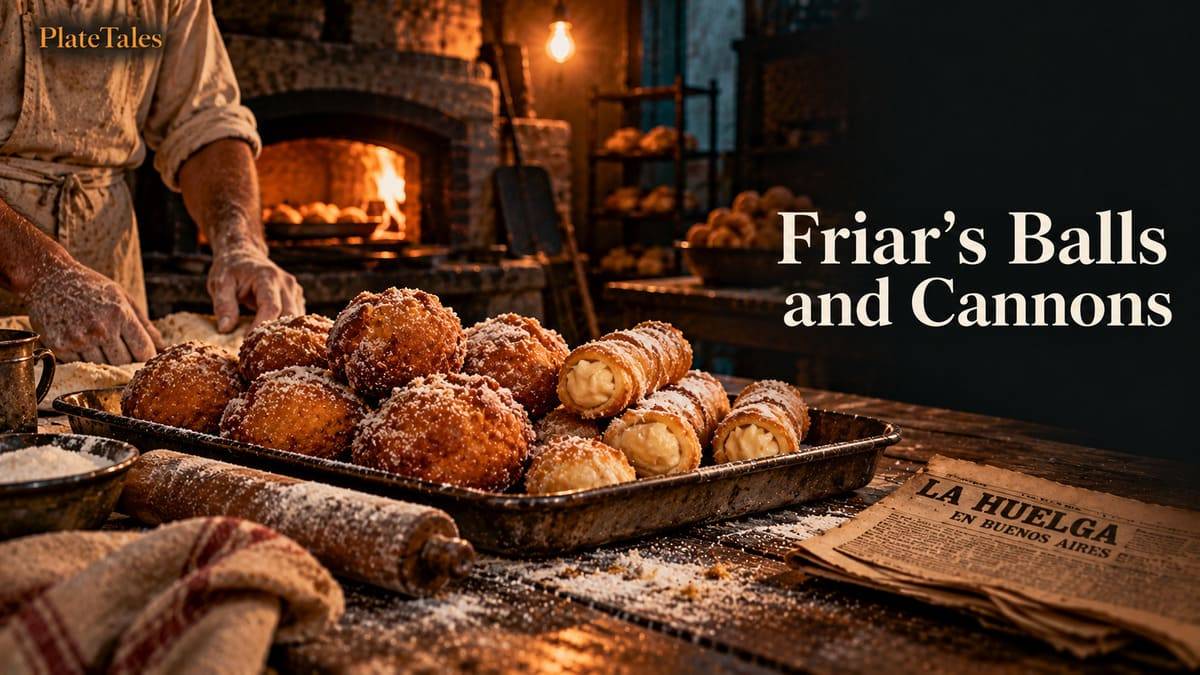
Argentine pastry names such as bolas de fraile (friar's balls), suspiros de monja (nun's sighs) and vigilantes (policemen) are traditionally credited to anarchist bakers in Buenos Aires in the late 1880s, who are said to have mocked the Church, the army and the police by naming their sweets after them. The union and the strike are well documented. The claim that the names were coined as a deliberate joke is a story with no document behind it in any source we found.
A bakers' union founded in Buenos Aires in 1887
Between 1880 and 1930, about six million immigrants arrived in Argentina, most of them from Italy and Spain, with others from Germany, Russia, Armenia and Syria. They brought their ovens with them. The pastries on a Buenos Aires counter still show it: Italian, German and French confectionery, adapted over the years to local taste, with fillings of custard, jam or dulce de leche. Bread had its own long history before that, told in the history of bread, and the crescent shape of the medialuna has a cousin in the croissant.
They also brought politics. Errico Malatesta, an Italian anarchist who left Italy to avoid a prison sentence, reached Buenos Aires in 1885. His English-language biography places him in the city from 1885 to 1889, where he revived his paper La Questione Sociale and worked among Italian emigres. Among the people he joined was Ettore Mattei, who had just organized bakers and pastry workers.
According to a 2025 account in the Argentine daily Infobae, the result was the Sociedad Cosmopolita de Resistencia y Colocacion de Obreros Panaderos, founded on 4 August 1887. It is often described as the first labor union in Argentina. Its statute spoke of the "mejoramiento intelectual, moral y fisico del obrero y su emancipacion de las garras del capitalismo", that is, the intellectual, moral and physical improvement of the worker and his freedom from the claws of capitalism. In 1957 Congress named 4 August the Dia del Panadero, the bakers' day.
The January 1888 strike
Bakers in those years worked night shifts and long hours. On 29 January 1888 the union announced that it would strike unless employers agreed to a list of demands: a 30 percent raise, a kilo of bread a day for each worker, better meals on the job and an end to night work. Employers were given 48 hours.
The strike began at noon on 31 January. The mayor, Antonio Crespo, offered municipal employees to bake bread and staff the shops. Workers raised a strike fund and printed sheets in which donors signed with pseudonyms, among them "Uno que trabaja 16 horas" (One who works 16 hours) and a death-to-the-boss slogan.
How long it lasted depends on who you read. Infobae says the workers went back after about a week, with employers having conceded several demands. Other accounts say the strike ran 15 days. Both agree that it happened and that it was one of the first big labor actions in the city. In the following years, strikes spread to other trades.
The Argentine pastry names that mock priests, police and army
The popular account is that during this period the bakers renamed their products. The tidy version runs like this.
| Name | Literal meaning | Said to mock |
|---|---|---|
| Bolas de fraile | Friar's balls | The Church |
| Suspiros de monja | Nun's sighs | The Church |
| Sacramentos | Sacraments | The Church |
| Cañoncitos | Little cannons | The military |
| Bombas de crema | Cream bombs | The military |
| Vigilantes | Watchmen, policemen | The police |
Libritos, the little folded "books", are read in the Infobae piece as a defense of education and a criticism of how the state ran it. That is a different kind of claim, and a more doubtful one.
The best-known case is the bola de fraile, an Argentine cousin of the German Berliner, a yeast doughnut with no hole. The Berliner itself is old. A jam doughnut recipe appears in a Nuremberg cookbook printed in 1485, and German regions still argue over what to call it: Krapfen in Bavaria, Pfannkuchen in Berlin, Berliner Ballen in the north and west. Argentine bakers filled the same shape with custard or dulce de leche and gave it a name that no priest could have enjoyed. Some histories tie the name to the bakers' union, and the Infobae piece dates the naming to 1888.
What the evidence actually shows
Here the story gets thin. Infobae presents the strike and the union as dated facts, but it offers no named inventor for any of the pastry names, no pamphlet from 1888 that uses them, and no bakery record. The link between the strike and the names is a plausible narrative that has been repeated for decades. Popular accounts of the renaming rest on newspaper and travel pieces rather than archival documents.
Some details look more like folk etymology. Infobae says Malatesta was one of the "autores intelectuales" of the names, but gives no support for it. Malatesta lived in Argentina for only about four years, and the pastry names are in no document connected to him that we read.
A few more guesses circulate and the Infobae article flags them as theories:
- Cremona. The salty twisted roll, it is said, looks like a row of capital letter A's, the anarchist symbol. The article itself calls this theory "mucho mas criptica", far more cryptic. Another account says the name came from an immigrant from the Italian city of Cremona.
- Factura. The word means "invoice" or "bill" in Spanish, and Argentina is the only country that uses it for pastries. One theory says it comes from the Latin facere, to do or make, and that the union pushed the word to remind workers of the value of what they made.
The most likely reading is a mixed one. A militant, largely immigrant trade, in a city with a strongly Catholic establishment, probably did enjoy irreverent names. Whether anyone planned it in 1888 is another matter. Humor of this sort tends to spread through a trade by word of mouth, which leaves no records.
From bakers' slang to every breakfast counter
Whatever their origin, the names stuck. In Argentina today facturas are the pastries bought by the half dozen and eaten with mate or a cortado. Common sweet ones include cañoncito, churro, vigilante, bolas de fraile, sacramento and the dark-topped tortita negra, and savory ones like the cremona and the librito. Neighboring Uruguay calls similar baked goods bizcochos.
Many Argentines can still tell a visitor that the vigilante is a joke about the police. That is a strange thing for a pastry to carry, and it says something about how the city sees its own working-class history, much as food shapes cultural identity elsewhere. The union that the story is built on kept going too: on 4 August every year Argentina still marks the bakers' day that Congress set in 1957.
Questions people ask
Why are bolas de fraile called friar's balls?
Bolas de fraile is the Argentine name for a hole-less yeast doughnut related to the German Berliner. The name means friar's balls. The usual story says anarchist bakers in Buenos Aires coined it around 1888 to mock the Church, though no document from the time has been shown to support that.
Who founded the bakers' union linked to the Argentine pastry names?
The Sociedad Cosmopolita de Resistencia y Colocacion de Obreros Panaderos was founded in Buenos Aires on 4 August 1887, according to Infobae. It is credited to the Italian anarchists Errico Malatesta and Ettore Mattei. It is often called the first labor union of Argentina.
What does the word factura mean for Argentine pastries?
In Spanish factura means invoice or bill, and Argentina is the only country that uses it for pastries. One theory traces it to the Latin facere, to make, and says the bakers' union used it to stress the value of their labor. That origin is a theory, not a documented fact.
What did the strike of 1888 in Buenos Aires demand?
On 29 January 1888 the bakers' union demanded a 30 percent raise, a kilo of bread a day for each worker, better meals at work and an end to night shifts. Employers were given 48 hours to answer, and the strike began on 31 January 1888.
Filed under Cultural Identity
Want more stories like this?
One food history story, every week. No spam, just the stories behind what the world eats.