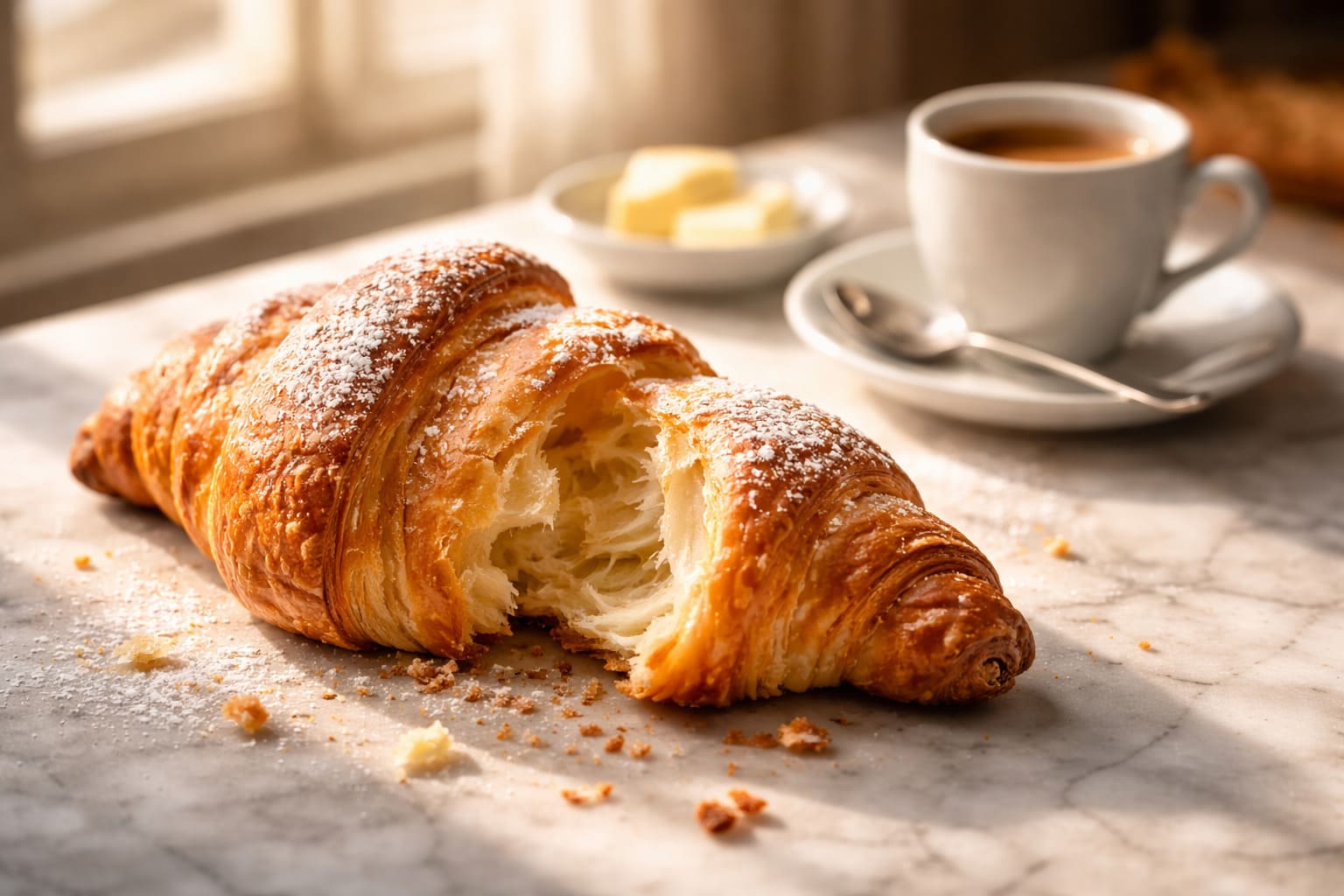
The croissant's origin is Austrian in shape and French in substance. Bakers in Vienna and elsewhere in the German-speaking lands made crescent rolls called kipferl for centuries, and an Austrian officer named August Zang sold them in Paris from 1838 or 1839. The buttery, flaky croissant we know came later, in French kitchens, in the early 1900s.
The two stories everyone tells, about a siege and a queen, are the weakest parts of the record.
Did a siege of Vienna in 1683 create the croissant?
The popular version goes like this. During the Ottoman siege of Vienna in 1683, a baker working at night heard the enemy tunneling under the walls and raised the alarm. To celebrate, bakers shaped a roll like the crescent on the Ottoman banners, so that Viennese could eat the enemy for breakfast.
Nobody has found a contemporary source for it. The Europeana cultural heritage platform sums it up as a story that is "generally believed" to be nothing more than a good one. The food writer who did most to spread it was Alfred Gottschalk. In the first Larousse Gastronomique, in 1938, he told a version set in Buda in 1686, where bakers supposedly sold crescent rolls the day after the city was freed. In a 1948 book he moved it to Vienna in 1683. The Oxford Companion to Food, edited by Alan Davidson, is the usual citation for that trail.
The deeper problem is that the roll is older than the siege.
What a kipferl was before 1683
The word comes from Old High German for a horn or prong, and the shape was a familiar bread form long before anyone fought at the gates of Vienna. A 10th-century convent food list names a small crescent-shaped roll, panis lunatis, eaten during fasts. In 1227 a verse by Jans der Enikel mentions chipfen in Vienna under the Babenberg dukes. And in the seventeenth century the Austrian preacher Abraham a Sancta Clara wrote that the moon in its first quarter shines "like a kipfl."
So the crescent is a bread shape with medieval roots, not a victory pastry. Austrian sources quoted in the scholarship describe the kipferl as probably a traditional monastery roll baked for Easter. Kipferl could be sweet or savory and made from several doughs. Order one in Austria today and you may be handed a cookie, the vanillekipferl, or a brioche-style roll.
For the wider story of why bread keeps taking such shapes, see the history of bread.
Marie Antoinette did not bring it to Paris
The second legend says the Austrian-born queen of Louis XVI missed home and had the court bakers copy a kipferl. There is no historical evidence for it, as Europeana says plainly.
The date also works against it. Zang's bakery opened about fifty years after Marie Antoinette's execution, and Chevallier's argument is that the real arrival came through him, not the court.
August Zang's bakery on the rue de Richelieu
Zang was an Austrian artillery officer. Probably in 1837 he went to Paris to set up a bakery, the Boulangerie Viennoise, which opened in 1838 or 1839 (some sources say 1840). It stood at 92 rue de Richelieu. Jim Chevallier's 2009 book, August Zang and the French Croissant, is the fullest account of him.
The shop sold kipferl and Vienna bread, and it drew customers. French competitors copied the idea, which is why bakers still talk about viennoiserie, the family of rich, sweetened breakfast breads. Chevallier's account also credits Zang with bringing in the steam oven and with the polished marble, glass and brass look that French bakeries adopted.
Zang did not stay. In 1848 he went back to Vienna and founded the newspaper Die Presse. He grew wealthy and, reportedly, did not much want to be remembered as a baker.
Chevallier's argument, in short, is that until his 2009 book the history of the croissant revolved around a siege and a queen, when a real man with a real shop was the better answer.
The word and the pastry arrive in French
French bakers named the roll for its crescent shape, croissant. Printed references begin to appear by the middle of the century. Croissants are listed among "fantasy or luxury breads" in 1853, and a source from 1869 treats the croissant as a breakfast staple.
But the Paris croissant of the 1850s was still close to the Viennese roll, made with a brioche-style dough. It was a soft bread, not yet a pastry of shattering layers.
When the croissant became a laminated pastry
The change came in the early twentieth century, when French bakers swapped the enriched dough for a yeast dough folded around butter, a technique known as lamination. Food historians point to different books as the first recipe for the modern thing.
| Date | Book | What it is credited with |
|---|---|---|
| 1905 | Unnamed recipe | Called the earliest known recipe for the present-day croissant in one account |
| 1906 | Auguste Colombie, Nouvelle Encyclopedie culinaire, Paris | First recipe matching the modern shape, dough texture and taste, per the Oxford Companion to Food |
| 1915 | Sylvain Claudius Goy, La Cuisine Anglo-Americaine | Laminated yeast dough, pate feuilletee levee, in place of Zang's brioche |
So the answer to "who invented the croissant" has no single name. Goy is often named, though others argue for Colombié's earlier book, and the lamination technique itself appears in a French cookbook of 1680 (La Varenne's Le Cuisinier francois), though not for croissants. What is clear is that the flaky version is French work, finished decades after Zang opened his shop.
From Paris cafe to every breakfast table
By the 1920s, Europeana notes, the croissant was a staple in Parisian cafes, where it sat next to a cup of coffee. Its place in the French breakfast belongs to the twentieth century, not to the court of Louis XVI. To see where the pastry sits in the wider French table, read French cuisine history, and for the drink beside it, the history of coffee.
Siege legends cling to food because they make a snack feel like a victory. Siege food history shows how many real stories of hunger and defiance there are to choose from instead. The croissant needed none of them. It needed an Austrian officer with a bakery on the rue de Richelieu and, decades later, French bakers willing to fold butter into dough.
Questions people ask
Is the croissant really French?
The modern croissant is French. Bakers in Paris developed the butter-laminated version in the early twentieth century, with recipes printed in 1906 and 1915. Its ancestor, the crescent-shaped kipferl, is Austrian and was made in Vienna as early as the thirteenth century, so the pastry has both a French and an Austrian parent.
Who brought the croissant to Paris?
August Zang, an Austrian artillery officer, opened the Boulangerie Viennoise at 92 rue de Richelieu in Paris in 1838 or 1839. It sold kipferl and Vienna bread and inspired French imitators. Marie Antoinette is often credited, but Europeana says there is no historical evidence for that story.
What is the difference between a kipferl and a croissant?
A kipferl is a crescent roll that can be sweet or savory and is made from several doughs, including brioche-style dough. A croissant is made from a yeast dough folded around butter in layers. French bakers adopted that laminated method in the early twentieth century, and Sylvain Claudius Goy's 1915 book describes it.
Was the croissant invented to celebrate the defeat of the Ottomans?
No evidence supports it. The story ties the crescent shape to the Ottoman siege of Vienna in 1683, but the kipferl is documented in Vienna in 1227, centuries earlier. The tale spread through twentieth-century writing, including Alfred Gottschalk's 1938 and 1948 versions, without any contemporary source.
Filed under Origin Stories, Accidental Inventions
Want more stories like this?
One food history story, every week. No spam, just the stories behind what the world eats.