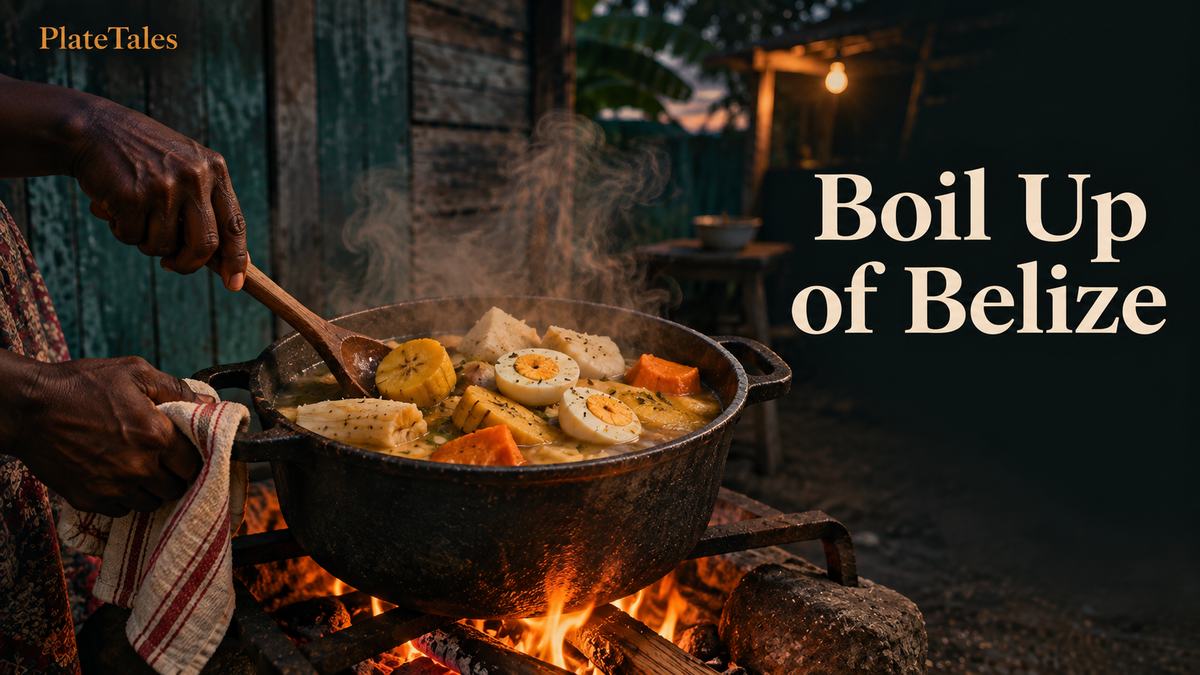
Belize's boil up (also spelled bile up) is the one-pot dish of the Kriol people: boiled eggs, fish and often pig tail, served over a heap of boiled root vegetables and plantains with tomato sauce. Its history is only partly written down. The ingredients point to the Africans, Scots and English who shared the logwood settlements, but no source we could open gives a first date or an inventor.
What is boil up, exactly?
It is the cultural dish of the Belizean Kriols, made with boiled eggs, fish and/or pig tail, and a starch such as cassava, yams or sweet potatoes, plus plantains and tomato sauce. One recipe page from Belize News Post adds a small piece of salted pork, green bananas, onion, and flour "boil cakes," which are the dumplings. Another, nationalfoods.org, calls it a traditional national dish and says it grew into a practical, affordable one-pot meal for large families, now often made on weekends or for gatherings.
The name needs no mystery. Belize News Post says it comes from "the boil," which sounds like "bile" when spoken in Kriol, and that boil up and bile up are the same thing. Both spellings are in common use.
Do not confuse it with the Maori boil up of New Zealand, which has a similar name and a similar idea (meat, greens, potatoes and dumplings in one pot) but no connection to Belize that any source shows. Two countries reached for the same method because boiling everything together is what you do when you have one pot and many mouths.
Who the Kriols are, and why that matters here
The dish cannot be told apart from its cooks. Kriols are primarily mixed-race descendants of enslaved West and Central Africans brought to what became British Honduras, along with the English and Scottish log cutters known as Baymen. The earliest reference to enslaved Africans in the settlement dates to 1724. Most of them were born in Africa, mainly in what is now Ghana, Nigeria, the Congo and Angola.
The settlement itself grew out of timber. English buccaneers began cutting logwood, a dye wood, in the early 1600s. The 1763 Treaty of Paris gave Britain the right to cut logwood while Spain kept sovereignty. The 1786 Convention of London allowed timber cutting and export but banned plantations, and by then mahogany had replaced logwood as the main export. Because treaties barred plantation crops, slavery in Belize was tied to timber extraction rather than sugar or cotton.
So the people who made the first boil ups were, in the main, people working in forestry under bondage. That is the setting. What the sources do not do is name a camp, a year or a cook.
Belize boil up history: the logging camp story and the evidence
A popular version says boil up was born in the logging camps, a way to feed a crew from a single pot in the bush. It is plausible. The history of Belize shows the labor, and a pot of boiled provisions suits a camp. But no page we could open documents boil up in a camp. No account we read quotes a camp cook, a ration list or a dated mention of the dish there.
What the sources do say is more modest, and it is about ancestry rather than a place. Nationalfoods.org reads the dish as a blend: ground provisions such as cassava, yam and plantain reflect African-derived Caribbean cooking, while salted pork and plain boiling reflect Scottish and British boiled meals, with fish, boiled eggs and tomato sauce as later local additions. Familia Kitchen's history of Belize cuisine likewise says the dish has both Scottish and African influences. These are interpretations by food writers, not archival findings, and they are fair to treat as a good guess.
The Garifuna thread
Another influence sits beside the Scottish and African ones. Belize News Post says the dish is influenced by various cultures, including the Garifuna, and that its ground provisions are common in Garifuna cooking. Bammy, a fried cassava cake, was inherited from the Garifuna, and a Kriol fish seré resembles the Garifuna hudut. Kriol and Garifuna cooking borrowed from each other for generations.
Why a Belizean kitchen had no single national food
It helps to know that "national dish" is a recent idea. Familia Kitchen says that while Belize was a British colony there was no singular national cuisine. The wealthiest urban Belizeans ate mostly imported ingredients and dishes, rural Belizeans ate local game, fish and fruit, and the middle class mixed both. Belize was called British Honduras until 1973 and became independent in 1981.
Dishes like boil up rose into national symbols as the country built an identity of its own. The anthropologist Richard R. Wilk wrote about this in a 1999 paper in American Anthropologist titled "Real Belizean Food," which looks at how local identity was built in the transnational Caribbean. The paper itself was not available to read, so its argument is left out here. Reference works on the dish cite it.
Rice and beans, the Sunday meal, is the other claimant. Familia Kitchen says the first recorded serving of red beans and rice is from 1895, which gives that dish a paper trail that boil up lacks.
What goes in the pot, and what it tells you
Look at the list and you can read a bit of the colony's supply lines. Cassava, yam, sweet potato and plantain are ground provisions, the starchy staples of West African and Caribbean cooking. Salted pork is the preserved meat of a ship-supplied colony. Fish and eggs came from the coast and the yard. Nationalfoods.org treats the fish, eggs and tomato sauce as later local additions. The mix looks layered over time, which may be why no one has dated it.
The same logic ties boil up to other one-pot stories on this site. Compare it with Brazilian feijoada, another dish with a contested origin and enslaved cooks, or the history of soul food in the United States, where African-descended cooks made a cuisine from what was available. The broader pattern of dough dropped into broth appears in the history of dumplings, and the starch at the center of many Caribbean plates connects to the history of rice.
Questions people ask
Is boil up the national dish of Belize?
Boil up is the cultural dish of Belize's Kriol people, and nationalfoods.org calls it a traditional national dish of Belize. Rice and beans with coconut milk is the other common Sunday staple.
Why is it called bile up?
Belize News Post says the name comes from "the boil," which sounds like "bile" when pronounced in the Belizean way. Boil up and bile up are the same dish. Both spellings appear in print.
What does boil up have in it?
The base is boiled eggs, fish and/or pig tail, with cassava, yams or sweet potatoes, plantains and tomato sauce. Belize News Post adds salted pork, green bananas, onion and flour dumplings called boil cakes. Recipes differ from kitchen to kitchen, so the exact mix of root vegetables varies.
Who are the Kriols of Belize?
The Kriols, also called Belizean Creoles, are mostly descendants of enslaved West and Central Africans and of the English and Scottish log cutters known as Baymen. The earliest reference to enslaved Africans in the settlement dates to 1724, and they later intermarried with Miskito, Garifuna, Maya and other groups.
Filed under Forgotten Recipes, Cultural Identity
Want more stories like this?
One food history story, every week. No spam, just the stories behind what the world eats.