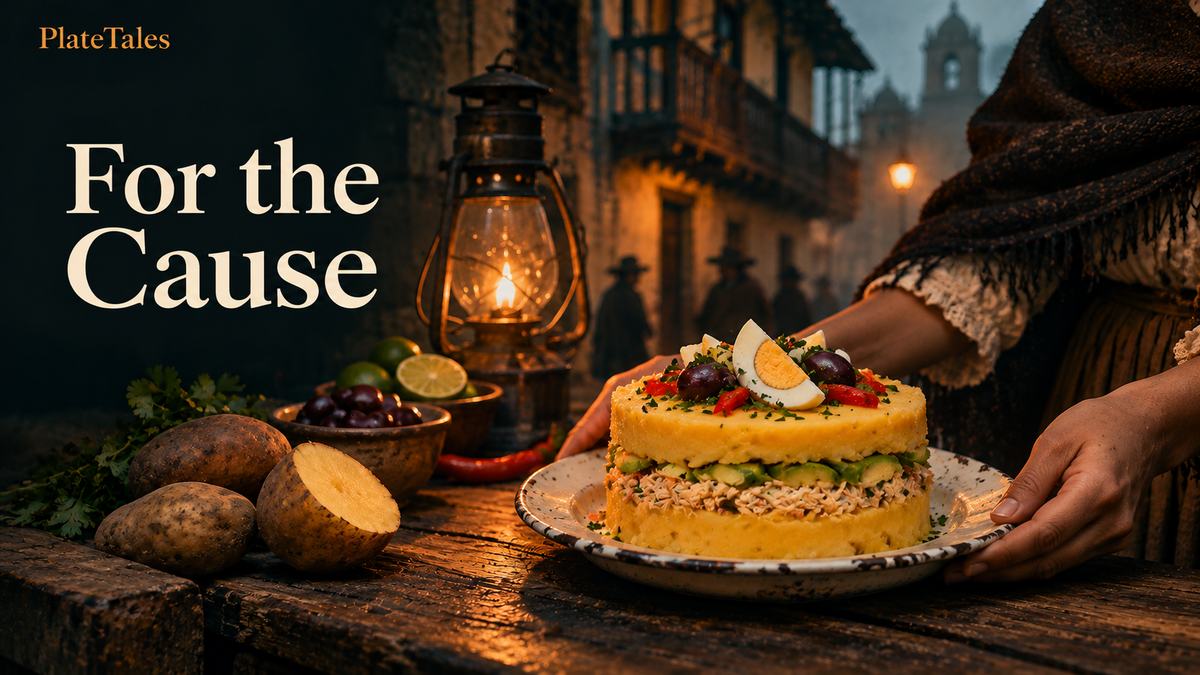
The history of causa limeña, a cold Peruvian dish of seasoned yellow potato layered with a filling, has no settled answer on why it is called "causa". Three explanations circulate: the Quechua word for sustenance, a fund-raising scheme for the 1820 independence army, and a ration scraped together for soldiers in the War of the Pacific. Each is told with confidence. None comes with a document.
Causa limeña history: the Quechua word theory
Start with the least dramatic theory, because it needs no battle. One account derives the name from the Quechua word kawsay, glossed as necessary sustenance or food, which was also a name for the potato. Aida Tam Fox's Vocabulario de la cocina limeña (2010) is the source given for this.
A Lima restaurant, Avenida Peru, repeats a close version. It credits the Peruvian food historian Rodolfo Tafur with the idea that causa comes from kausay, "life" or "giver of life", another word for the potato. In that telling the original was boiled potato served with slices of chili.
The appeal is obvious. A dish made of the potato, named for the potato in the language of the people who first grew it. But a sound-alike is not a paper trail, and the pages opened for this article give no date when anyone first wrote the word down in this sense. It remains a plausible derivation, not a proven one. El Comercio, the Lima daily, reports the same theory in a different spelling: an Inca origin, with the name from the Quechua kausaq, "sustento de vida" (sustenance of life), and an Inca boiled potato with chili called rokro or ruxru.
The 1820 story: Lima sells potatoes for the cause
The patriotic version goes like this. El Comercio presents it as the account "according to historians", though it cites none. In 1820 the general José de San Martín set out to free Peru from Spain. The women of Lima, wanting to help, cooked mashed potato dishes and sold them on street corners, and the money went to the army. They called what they were doing "la causa", and the food took the name.
The campaign itself is well documented. A treaty of 5 February 1819 between Chile and the United Provinces of the Rio de la Plata created the joint force. The expedition sailed from Valparaiso on 20 August 1820 and landed at Paracas Bay, about 100 miles southeast of Lima, on 8 September. Of 4,118 soldiers, about 4,000 were Chilean. Independence was proclaimed on 28 July 1821. The costs fell mostly on Chile's government, to be repaid later by an independent Peru.
So the army and the expense are real. What is missing is the link to a potato stall. The theory circulates only in the form "the dish was sold on Lima street corners to fund the campaign" and rests on a 2013 television report and a 2017 piece on a Valencia news site, not with a letter, a ledger or a newspaper from 1820.
What a source would have to show
A contemporary account of women selling potato terrines in Lima, or a menu or diary entry using "causa" for a dish before the 1870s, would settle a lot. Neither turned up in the pages read for this article. The earliest written use of the word on offer is a line from the writer Ricardo Palma, a remark about regional specialties that does not explain the dish's origin.
The 1879 story: scraps for hungry soldiers
The second war story moves the setting nearly sixty years forward. Here, in the War of the Pacific, supplies ran short and the women who followed Peruvian soldiers pooled what they had. Avenida Peru lists potatoes, chili, lime, salt and pepper, mixed together and handed over with the words "para la causa". A variant has market women, vivanderas, selling the cold dish to support the cause against Chile, citing a 2017 article in La República.
The war is solid history. Chilean forces seized the Bolivian port of Antofagasta on 14 February 1879, and Chile declared war on Peru on 5 April. After the Chilean navy captured the ironclad Huascar at Angamos on 8 October 1879, Peru was left fighting almost entirely on land. Chilean troops occupied Lima in January 1881, and the Treaty of Ancon, signed on 20 October 1883, handed Tarapaca to Chile. A hungry, cut-off capital is easy to picture.
Still, the same gap appears. The restaurant's version gives no year and no name. El Comercio also files the 1879 account as one of "otras historias": citizens collected food to turn into dishes for sale, women did the cooking, and the street cry was "Para la causa, para la causa". It names no source for it either. Neither version quotes a witness. If you want other food stories shaped by shortage, the wartime foods and siege food pieces here cover cases where the paperwork survives.
A third kind of story: the kind hostess
Avenida Peru also tells a story with no general in it. A well-off Lima hostess had to feed a battalion of soldiers celebrating Independence Day. With what she had in the house she mashed and seasoned potatoes, sliced boiled eggs and topped the plate with olives. The article does not name her, does not give a year, and does not say which independence celebration is meant.
It reads like the other two: a patriotic occasion, a shortage, a woman improvising. That sameness is itself informative. Stories that explain a dish by a moment of national emergency are common in food history, and they tend to appear long after the event, in newspaper features and restaurant menus rather than in the records of the time.
What the evidence does support
Some parts are firmer. The dish has roots in the pre-Hispanic Andes, where a yellow potato was kneaded with crushed aji. The viceroyalty, the 16th to 19th centuries, then added lime, a fruit that came originally from Asia, to produce something close to the modern dish. Erika Fetzer's Sabores del Peru (2004) is the source given for this, and the pre-Columbian recipe itself is marked as lacking a citation. For the wider story of the tuber, see how potatoes changed Europe.
There is also a regional wrinkle. In Lima the word names the potato dish, but in Trujillo, on Peru's north coast, causa can mean any spicy dish. Palma is quoted writing "Trujillo para la causa", from a line that also names Chiclayo for arroz con pato and Lima for tamales. That suggests the word was already in use for food in Palma's time, though not what it first meant.
Ration food has its own history; the military rations story shows how often soldiers' meals get credited with inventing a dish.
The honest summary is a short one. The dish is old, the word may be Quechua, and the two war stories are traditions of unknown age. When Peruvians sell causa around the 28th of July, they are repeating one of them. The Palma line about Trujillo and Lima is the earliest written use of the word for food that these sources turn up, and it explains nothing about the name.
Questions people ask
Why is causa limeña called causa?
No one knows for certain. One theory derives the name from the Quechua kawsay or kausay, meaning sustenance or life, which was also a word for the potato. Two others say Lima women sold or served the potato dish "for the cause", either of independence in 1820 or the War of the Pacific from 1879. None has a contemporary document behind it.
Is causa limeña from Lima or from somewhere else?
The name points to Lima, but the roots are older and wider. The dish has roots in the pre-Hispanic Andes, where yellow potato was kneaded with crushed aji, and lime arrived during the viceroyalty. In Trujillo on the north coast, the word causa can also mean any spicy dish.
Did women really sell causa to fund San Martin's army?
It is a popular story, but the sources read for this article do not prove it. San Martin's expedition did land at Paracas Bay on 8 September 1820, and Peru declared independence on 28 July 1821. The claim that Lima women sold potato terrines to pay for it rests on a 2013 television report and a 2017 news article, not on records from the period.
What does Ricardo Palma say about causa?
The Peruvian writer Ricardo Palma wrote about regional specialties: Chiclayo for arroz con pato, Trujillo for the causa, and Lima for tamales. The line shows the word was used for food in his time, but it does not say where the name came from or describe the Lima potato dish.
Filed under Origin Stories, War & Famine
Want more stories like this?
One food history story, every week. No spam, just the stories behind what the world eats.