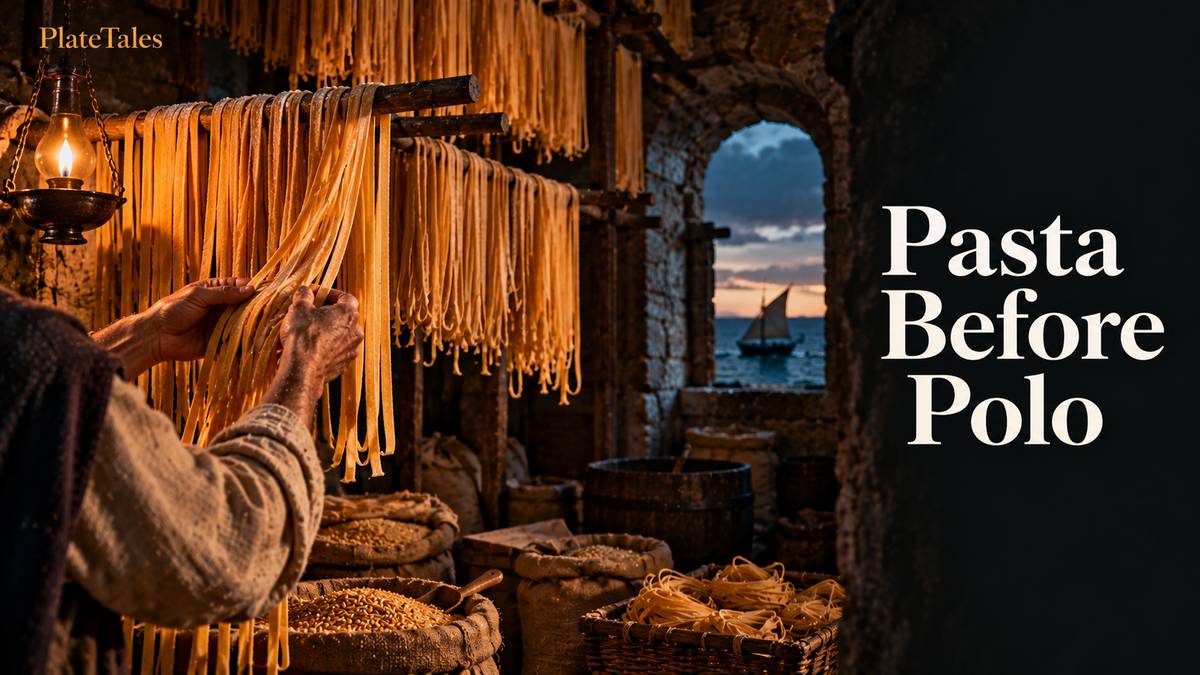
No, Marco Polo did not bring pasta to Italy. In 1154, in Palermo, the geographer al-Idrisi finished a book of the world for King Roger II of Sicily, and in it he described a place called Trabia where dried pasta was made in bulk and shipped abroad. That was about a hundred years before Polo was born and 141 years before he came home to Venice in 1295.
The Polo story has two layers. The first is a few lines added to his book in an Italian edition of 1559. The second, with a sailor named Spaghetti, comes from an American pasta trade magazine in 1929. Both can be read today, and neither says what the legend claims.
The sailor named Spaghetti, October 1929
The issue of The Macaroni Journal dated October 15, 1929, was put out for American pasta manufacturers. On page 13, printed beside advertisements for lithographed cartons and King Midas semolina from Minneapolis, sits a short piece headed "A Saga of Cathay".
It opens with two words that should have settled the matter: "Legend has it." Polo's ship is near the coast of Cathay when the water runs low, so a boat goes ashore. "One of the sailors in the party was a Venetian named Spaghetti," the journal explains. He wanders into a village and sees "a native man and woman working over a crude mixing bowl", with strings of dough drying hard in the warm air.
By signs and gestures he gets some of the grain, a batch of dough and a few dried strings. Back on board he hits on the idea of "boiling the strips in sea water". Home in Italy, the food takes his name. The piece ends by announcing that Gragnano, near Naples, "is the leading macaroni and spaghetti center of the world."
The magazine offered no source, and it did not need one. Its readers were selling an Italian food to Americans, and here was a medieval explorer for a founder. Nine years later Hollywood told its own version. In The Adventures of Marco Polo, which opened in New York on April 7, 1938, Gary Cooper plays Polo, and a Chinese philosopher played by H. B. Warner invites him home for a meal of spaghetti.
Who actually started it
Here the sources disagree a little. Alan Davidson's Oxford Companion to Food (1999) quotes the Italian food writer Massimo Alberini, who told an audience at Oxford that the story came from "A Saga of Cathay". Alberini remembered "a Chinese girl" making the pasta, which is not quite what the journal printed. Davidson added that the Macaroni Journal explanation "may itself be a myth; but no better explanation has been offered."
Jeffrey Steingarten, in The Man Who Ate Everything (1998), reports a rival claim. Jane Grigson thought the story began in an advertisement for a Canadian spaghetti company in the 1920s or 1930s. The 1929 article has the advantage of existing: anyone can read it in the archive the National Pasta Association keeps online. That makes it the best documented candidate, though not a proven first.
Did Marco Polo bring pasta to Italy, by his own account?
Polo dictated his book in a Genoese prison in the late 1290s, to a writer of romances called Rustichello da Pisa. In Henry Yule's English translation of the main text, there is no scene of Polo meeting Chinese noodles.
The passage people point to is about Sumatra, not China. In the chapter on the kingdom of Fansur, Polo says: "They have a kind of trees that produce flour, and excellent flour it is for food." The trees are sago palms, whose trunks are packed with starch. And what did Polo's party make of it? Bread. They "did sundry times partake of this flour made into bread, and found it excellent."
Ramusio's edition of 1559
The pasta arrives later, in print. Giovanni Battista Ramusio, a Venetian geographer, collected travel accounts in a series of volumes. The one with his Italian Polo came out in 1559, two years after Ramusio died and 235 years after Polo did.
Ramusio's text, quoted in Yule's notes, adds a whole process for the sago. The pith is beaten in tubs of water until the bran floats off, and "the cleaned flour that remains is taken and made into pasta in strips and other forms." Marco, it says, "often partook of, and brought some with him to Venice." Elsewhere Ramusio has Polo note that in China wheat is used "only to make vermicelli, and pastes of that description."
Read closely, these lines work against the legend. Ramusio reaches for pasta and vermicelli because his Venetian readers already knew those foods. You compare a foreign dish to something familiar from home, the way an Italian might call a Japanese noodle a kind of spaghetti. What Polo carried home, if anything, was a sample of sago.
Trabia, 1154: did Arabs bring pasta to Sicily?
The book al-Idrisi finished in 1154 is known in Arabic as Nuzhat al-mushtaq, and in Europe as the Tabula Rogeriana, after the Norman king who paid for it. Roger II had invited al-Idrisi to his court in Palermo around 1138. The king died a few weeks after the work was done.
In the section on Sicily, in the translation quoted by the historian John Dickie, al-Idrisi writes: "West of Termini there is a delightful settlement called Trabia. Its ever-flowing streams propel a number of mills." Then the lines that matter: "Here there are huge buildings in the countryside where they make vast quantities of itriyya which is exported everywhere: to Calabria, to Muslim and Christian countries. Very many shiploads are sent."
Itriyya was the Arabic name for strings of dough dried before cooking. A ninth-century Arabic dictionary already defines it that way, as string-like shapes of semolina. So by the middle of the twelfth century, Sicily was making dried pasta by the shipload.
The best answer to the Arab question is that they brought this kind of pasta, with its Arabic name. Muslim rulers held Sicily from the ninth century until the Normans took it in the eleventh. The mills at Trabia were still running under Norman rule when al-Idrisi wrote. What the Arabs did not do, on the evidence, was invent dough boiled in water. The Jerusalem Talmud mentions a boiled dough called itrium centuries earlier.
A basket of macaroni in Genoa, 1279
The second problem for the Polo story is a dead man's belongings in Genoa. In 1279 a notary, Ugolino Scarpa, drew up the inventory of what a Genoese soldier named Ponzio Bastone left behind. Among his few things was "una bariscella plena de maccaroni", a basket full of macaroni.
In 1279 Marco Polo was in the service of Kublai Khan, with sixteen more years to go before he saw Venice again. Meanwhile a soldier in Genoa had a basket of pasta at home, and a notary listed it as property worth passing on.
In medieval Italian, maccheroni meant long pasta in general, not the short tubes the word suggests now. Bastone's basket probably held something closer to vermicelli.
Who invented pasta, China or Italy?
Neither country gets the whole idea. Different people made noodles and dough strips a long way apart, and the record looks like this:
| Date | Place | What the record shows |
|---|---|---|
| about 2000 BC | Lajia, northwest China | A bowl of millet noodles about 4,000 years old, buried by a natural disaster, reported in 2005 |
| 1st century BC | Rome | Horace mentions lagana, thin sheets of fried dough |
| 3rd to 5th centuries AD | Palestine | The Jerusalem Talmud records itrium, a boiled dough |
| 1154 | Trabia, Sicily | Al-Idrisi describes itriyya made and exported in bulk |
| 1279 | Genoa | A soldier's inventory lists a basket of maccaroni |
| 1295 | Venice | Marco Polo comes home |
So where did pasta originate? China holds the oldest surviving noodle, but that says nothing about how pasta reached Italy. Chinese millet noodles and the Mediterranean line of lagana, itrium and itriyya look like separate answers to the same problem: flour, water, a shape, and some way to cook it.
The food historian Gil Marks argued for a single route instead. In his account, noodles traveled from China along the Silk Road to Persia by the fourth or fifth century, then west with the Arabs to Sicily and Spain. That is possible but unproven, and it still puts pasta in Sicily centuries before Polo. The Roman dough dishes suggest Italy had its own starting point anyway.
When did pasta come to Italy for good?
By the time Polo was dictating his book, pasta was ordinary enough to joke about. In the Decameron, written around 1350, Boccaccio describes a land of plenty called Bengodi. There a mountain of grated Parmesan stands over people who do nothing but make macaroni and ravioli, cook them in capon broth and throw them down the slope.
In the fifteenth century the cook Maestro Martino wrote out how to make "Sicilian macaroni", dried in the sun, and told his readers to boil it for two hours. By the late seventeenth century pasta had become the everyday food of ordinary people in Naples.
The red sauce came last. Tomatoes reached Italy from the Americas in the sixteenth century, and the first written recipe for pasta with tomato sauce is in L'Apicio moderno, a 1790 cookbook by the Roman chef Francesco Leonardi. By then Italians had been making dried pasta for more than six hundred years, and Marco Polo had been dead for 466 of them.
Questions people ask
Did the Arabs bring pasta to Sicily?
The best reading of the evidence is that they brought dried pasta with its Arabic name. Muslim rulers held Sicily from the ninth century, and in 1154 al-Idrisi described mills at Trabia making vast quantities of itriyya, dried dough strings, for export. Boiled dough itself was older, since the Jerusalem Talmud mentions itrium.
Where did the Marco Polo pasta story come from?
It has two layers. Giovanni Battista Ramusio's Italian edition of 1559 added lines about sago flour being made into pasta and brought to Venice. The sailor named Spaghetti comes from "A Saga of Cathay," printed in The Macaroni Journal, an American trade magazine, on October 15, 1929.
Is pasta from China or Italy?
Neither country gets the whole idea. China holds the oldest surviving noodle, a bowl of millet noodles about 4,000 years old found at Lajia. Italy's pasta follows a separate Mediterranean line: Roman lagana, the Talmud's itrium, and Sicilian itriyya. Gil Marks argued for one route along the Silk Road, but that is unproven.
When did pasta become an everyday food in Italy?
By about 1350, Boccaccio's Decameron joked about a land of plenty where people made macaroni and ravioli. In the fifteenth century Maestro Martino wrote out a recipe for Sicilian macaroni, and by the late seventeenth century pasta was the everyday food of ordinary people in Naples.
Filed under Origin Stories, Trade Routes
Want more stories like this?
One food history story, every week. No spam, just the stories behind what the world eats.