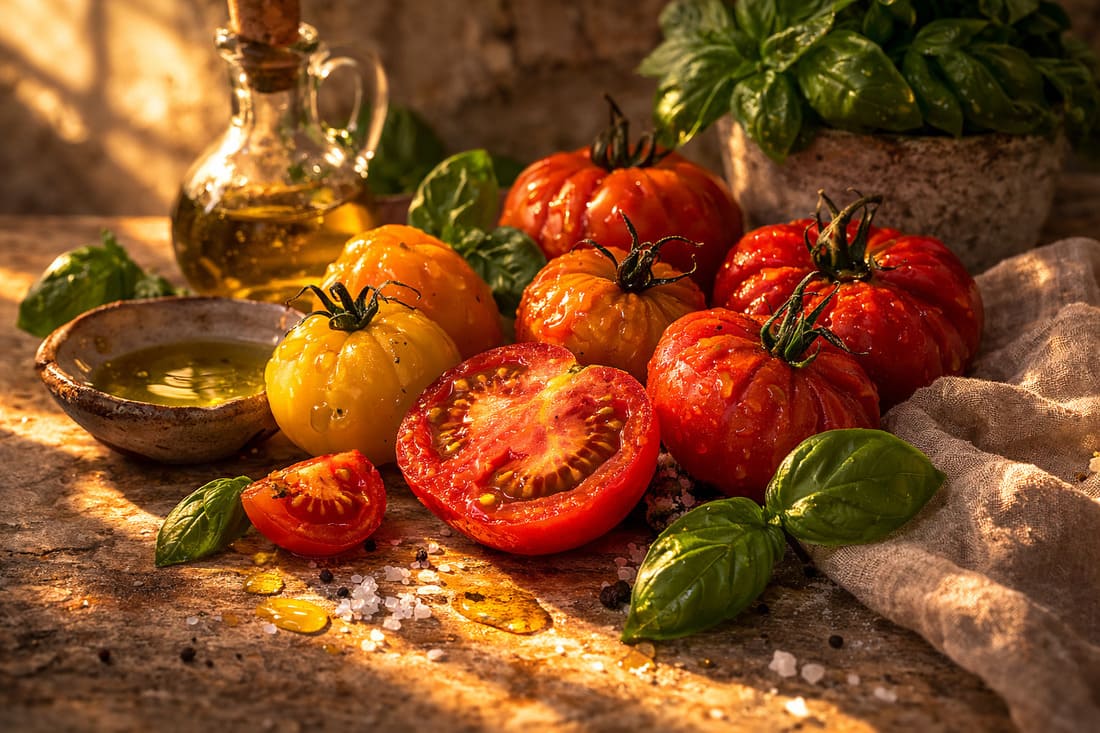
The history of tomatoes in Italy starts in the 1540s, when plants from the Americas, grown from seed in Spanish-ruled Europe, turned up in the gardens of Italian scholars and nobles. A physician named Pietro Andrea Mattioli described one in print in 1544. Tomato sauce, though, does not appear in an Italian cookbook until 1692, and tomato on pasta not until 1790.
That gap is the real story. The popular version has Italians afraid of a poisonous fruit until hungry peasants dared to eat it. The documents tell a slower, odder tale.
The first tomato in print: 1544
The Aztecs and their neighbors grew tomatoes in many sizes and colors. After Hernan Cortes took Tenochtitlan in 1521, the friar Bernardino de Sahagun later wrote that the markets sold a great variety. The Spanish took the Nahuatl word tomatl and made it tomate. Italians never adopted that word.
Nobody recorded the tomato's arrival at the port of Seville, the main entry point for American goods. Plant transfers were rarely thought worth writing down. The botanists Tinde van Andel and colleagues, who surveyed the surviving sixteenth-century evidence in a 2022 paper, note that many Italian merchants sailed under Spanish and Portuguese flags and that the Kingdom of Naples was under Spanish rule, so new plants reached Italy quickly.
The first European to describe one was Mattioli, in an Italian commentary on the ancient herbal of Dioscorides published in 1544. He tucked it into the chapter on mandrake as a new kind of eggplant, flattened and segmented, green at first and golden when ripe, "eaten in the same manner" as eggplant: fried in oil with salt and pepper. In a Latin edition of 1554 he added that some turned red, and that people called them pomi d'oro, golden apples.
So the Italian name does not prove the first tomatoes were yellow, though Britannica notes that some have guessed so. Mattioli's own words say golden ones and red ones were both arriving.
Tomatoes in Italy: a history of looking before eating
Mattioli did not grow the plants himself. His teacher Luca Ghini ran the university botanical garden at Pisa, which the Medici duke Cosimo supported and stocked with American plants. A surviving garden catalogue lists a plant called "Thumatulum pomum", red and yellow, and a letter of 31 October 1548 from Pisa to the ducal household in Florence, about tomatoes shown to the duke, spells the word pomidoro. It is the earliest written form of the modern Italian name.
The evidence after that is mostly about looking, not eating:
| Year | What the record shows |
|---|---|
| 1544 | Mattioli's first description, as a kind of eggplant |
| 1548 | The Pisa letter using the word pomidoro |
| about 1551 | Ulisse Aldrovandi presses a tomato in his herbarium in Bologna, the oldest specimen that survives |
| 1553 | Rembert Dodoens, a Flemish doctor, prints the first picture of a tomato |
| 1692 | Antonio Latini's cookbook in Naples prints tomato sauce |
| 1790 | Francesco Leonardi's cookbook describes pasta with tomato sauce |
Van Andel's team found that these early tomatoes came in more shapes and colors than the lumpy red one in the famous woodcut. That woodcut is often credited to Mattioli, but it was published in 1586, eight years after his death.
Were Italians afraid of the tomato?
In northern Europe, yes. Britannica says that in France and northern Europe the tomato was grown as an ornamental and viewed with suspicion because botanists recognized it as kin to deadly nightshade. In Britain and its American colonies it stayed out of kitchens for a long time.
Italy is harder to pin down. Britannica judges that the Spanish and the Italians seem to have been the first Europeans to adopt it as food, and Mattioli himself described eating it. But not everyone liked it. The Venetian naturalist Pietro Antonio Michiel, who grew exotic plants, judged that slices of the fruit cooked in a pan with butter and oil would be "injurious and harmful" to himself. That is one man's stomach, though, not a ban.
There is also a gap in the written record. For more than a century after Mattioli, the tomato is mostly a plant in gardens, not an item in recipes. In Florence it served as a table decoration until the late seventeenth or early eighteenth century, when it began to enter local cooking. If poor Italians were eating tomatoes widely in that long gap, the cookbooks did not notice.
Latini's sauce "in the Spanish style" (1692)
The earliest surviving recipes for tomato sauce come from Lo scalco alla moderna, a cookbook printed in Naples in 1692 by Antonio Latini. One is called "alla spagnuola", in the Spanish style. The name fits the political map: Naples was Spanish territory then, and the sauce was filed as a foreign idea.
What the recipe is not matters just as much. Latini did not suggest putting it on pasta. For a century, the red sauce and the noodle lived in separate chapters of Italian cooking.
The first pasta with tomato (1790)
The first written record of pasta with tomato sauce is credited to Francesco Leonardi, a Roman chef, in his 1790 book L'Apicio moderno. That is about 246 years after Mattioli, and roughly 98 years after Latini.
This is why "Italian food without tomatoes" stops being a thought experiment and becomes a plain fact about the past. Before the tomato, pasta was dressed in other ways, and the dish we now picture, spaghetti under red sauce, is a late arrival compared with the pasta itself. Cooks in the later eighteenth century were doing something new, not preserving something ancient.
Pizza: the marinara of 1734 and the Margherita of 1889
Pizza had been a Neapolitan street flatbread long before the tomato touched it, topped with things like garlic, salt, lard and cheese. The earliest attested tomato pizza is the marinara (tomato, olive oil, oregano and garlic, no cheese), first mentioned in Naples in 1734. Even that date is described as "supposedly" the oldest. Until about 1830 pizza was sold from open-air stands and bakeries, when Naples pizzerias began offering rooms with tables.
The story everyone knows is the Margherita. In it, the pizzaiolo Raffaele Esposito bakes a pie of tomato, mozzarella and basil for Queen Margherita of Savoy in 1889, in the colors of the Italian flag. The first attestation of the pizza dates to June 1889, but later research casts doubt on the tale: newspapers of the time did not report the royal visit, the authenticity of the queen's letter of thanks is questioned, and the story and the Margherita name were promoted in the 1930s and 1940s. For the rest of pizza's tangled history, see the origin of pizza.
A food that arrived by the same road as the potato
The tomato is one of the New World crops that moved across the Atlantic after 1492 and changed what Europeans ate. Its slow acceptance echoes that of the potato, which met its own suspicion and delay, as the story of how potatoes changed Europe shows. For older Roman habits before any of this, there is ancient Roman cooking.
In Naples, the pizza maker who is said to have fed a queen in 1889 worked three centuries after the first tomato was pressed flat between the pages of a Bologna herbarium.
Questions people ask
When did Italians start eating tomatoes?
Italians were growing tomatoes by the 1540s, and Pietro Andrea Mattioli described eating them in 1544. Wide use in cooking came much later. The earliest surviving tomato sauce recipes appear in Antonio Latini's cookbook printed in Naples in 1692, and in Florence tomatoes were still table decorations into the late seventeenth or early eighteenth century.
Why is the tomato called pomodoro in Italian?
Pomodoro means golden apple. Mattioli reported in 1554 that people called the new fruit pomi d'oro, and a letter of 31 October 1548 already spells the word pomidoro. Britannica notes that some have taken the name to mean the first tomatoes were yellow, though Mattioli described both golden and red ones.
Who wrote the first Italian tomato sauce recipe?
The earliest surviving tomato sauce recipes are in Lo scalco alla moderna, a cookbook by Antonio Latini printed in Naples in 1692. One is called alla spagnuola, meaning in the Spanish style. Latini did not serve it with pasta. The first written record of pasta with tomato sauce is Francesco Leonardi's 1790 book.
Was the Margherita pizza really invented in 1889 for a queen?
The legend says Raffaele Esposito made a tomato, mozzarella and basil pizza for Queen Margherita of Savoy in Naples in 1889. The first attestation of the pizza dates to June 1889, but newspapers of the time did not report the visit, and the story and the name were promoted mainly in the 1930s and 1940s.
Did Europeans think tomatoes were poisonous?
In northern Europe many did. Britannica says botanists in France and northern Europe saw the tomato as a relative of deadly nightshade and grew it as an ornamental. The Spanish and Italians seem to have been the first Europeans to adopt it as food, so the fear was not equal everywhere.
Filed under Origin Stories, Trade Routes
Want more stories like this?
One food history story, every week. No spam, just the stories behind what the world eats.