The Feast of the Seven Fishes has its origin in the meatless Christmas Eve vigil of southern Italy, but the name and the fixed count of seven were added by Italian Americans, and nobody has found the phrase in print before 1983. By then the Church rule behind the meal was gone. Pope Paul VI's 1966 constitution Paenitemini made Fridays and Ash Wednesday the only required penitential days, so Christmas Eve had not been an obligatory meatless day for at least seventeen years when the phrase "Feast of the Seven Fishes" turns up.
In short, the dinner came over with the immigrants. The name was coined later, in America.
The feast of the seven fishes origin story on the menus
The version on most menus and in most December explainers goes like this: an ancient Italian tradition, seven fish for the seven sacraments, carried across the Atlantic by poor families from Naples, Sicily and Calabria. Eataly's magazine adds a date, saying that "the official 'Feast of the Seven Fishes' first emerged" in the early 1900s. It calls the feast "one of the oldest Italian traditions" and, in the same sentence, gives America the credit. It cites no source for any of this.
The story bundles a meal, a number and a name. The meal, a Christmas Eve supper of fish with no meat, is old and Italian. The fixed seven and the name are not, as far as anyone has shown.
Was Christmas Eve really a fast day?
Yes, and that is the whole reason the menu is fish. Before the reforms of the 1960s, December 24 was the Vigil of the Nativity, one of a short list of vigils that required fasting, alongside Pentecost eve, All Saints' eve and the eves of the Immaculate Conception and the Assumption. Rachel Bundang, a Catholic ethicist writing for the Paulist site Busted Halo, describes how the old all-day fast before Christmas Communion softened into a vigilia di magro, a lean vigil on which meat was given up as a penance. "Meat was not consumed or even prepared until after midnight," she writes. Whatever the family ate on the evening of the 24th had to be lean.
The rule loosened in stages. By 1959 American Catholics had the Christmas fast moved to December 23. Then came Paenitemini, dated February 17, 1966. Its rules list no vigils at all, and it let national bishops' conferences adjust the details.
The supper outlived its legal reason by decades. Plenty of other ritual foods have done the same.
What Naples ate on Christmas Eve in 1847
The best evidence that the meal is Italian is a Neapolitan cookbook. Ippolito Cavalcanti, Duke of Buonvicino, published Cucina teorico-pratica in Naples; the fifth edition, printed by the Tipografia de' Gemelli in 1847, ends with a section written in Neapolitan dialect giving "Tutti li Pranzi di uso della nostra Bella Napoli," all the customary dinners of the city. One of them is headed "Vigilia de lo S. Natale."
The menu runs to eight dishes:
- broccoli fried with salted anchovies
- vermicelli with toasted breadcrumbs, or fried with salted anchovies
- fried eels
- boiled spiny lobsters with oil and lemon
- a casserole of small squid and cuttlefish
- a fish pie with escarole, olives, capers, pine nuts and raisins
- roast capitone, the big eel Naples still eats on that night
- struffoli
There is no meat on it. The very next menu, for Christmas Day, brings back boiled beef, salame, capons, wild boar and pork chops.
There is also no number anywhere. Cavalcanti does not count his fish or say the total means anything. Count them yourself and the answer depends on whether anchovies, eels and capitone are separate fish. The only seven on those pages is a coincidence: he wants squid of the size that runs "sette, otto a ruotolo," seven or eight to the rotolo, the old Neapolitan unit of weight.
Is the Feast of the Seven Fishes actually Italian?
Half of it. Italians have a Christmas Eve meal, called la Vigilia or il cenone, and in much of the south it is a fish meal. Michael Di Giovine, an anthropologist at West Chester University, told National Geographic that "you won't hear about 'festa dei sette pesci' in Italy," and that fish "is really only eaten in Southern Italy on the holiday."
What Italy lacks, as a national custom, is the name or the number. Gabriella Mileti, writing in La Gazzetta Italiana in 2012, put it bluntly: "some Italians won't even know what you're talking about if you ask them." She places the fish tradition in the south, "specifically Sicily and Calabria," and adds that "in Calabria, most families make 13 varieties." In Philadelphia, the restaurateur Carlo Sena told Billy Penn in 2015 that his father's family ate fish on Christmas Eve in Italy, "but not always seven."
Thirteen turns up again and again. The blog Pensieri Meridionali, whose author began researching the custom in 2017, describes exactly 13 fish dishes as the Calabrian rule. Elsewhere in the south, it says, the count might be 13, 12, 9 or 7, and one reader from the province of Naples reports that his family "has had 7 courses since the olden days."
The blog calls the Calabrian custom centuries old but cites no document for that. It is good evidence of living memory, not of age. Some write-ups call the custom "well-documented in Calabria," but the sources behind that claim are this blog and a few magazine pieces.
Further north the picture changes completely. Pellegrino Artusi, whose Florentine cookbook taught middle-class Italy to eat after 1891, gives a menu for Christmas Day built on cappelletti, capon, hare pie and guinea fowl, and no Christmas Eve menu at all. That fits the larger point that much of what Americans call Italian food is the food of the south, a story that also runs through how the tomato reached Italy.
When "Feast of the Seven Fishes" first appears in print
The Denver Public Library's history blog and Tasting Table both say the earliest written mention is a 1987 article in The New York Times. That is Craig Claiborne's "A Seven-Course Feast of Fish," printed December 16, 1987. It is about the artist and cookbook author Ed Giobbi, born in Waterbury, Connecticut, in 1926, who every year served "a holiday feast of seven fish dishes (seven for the seven sacraments)."
The Philadelphia Inquirer has an older clipping. In 2021 its food writer Nick Vadala reported that the earliest newspaper reference he knew of was "a December 1983 Inquirer story mentioning a take on it" from La Buca, a Center City restaurant. Mental Floss says the earliest article it found with the phrase was "a 1983 advertisement for a restaurant in Philadelphia." It does not name the restaurant, so it may or may not be the same item. Either way, both point to Philadelphia in 1983, four years before the Times.
Blaise Tobia, a Drexel professor emeritus quoted by Vadala, suspects the feast began, or at least became popular, in Philadelphia before New York. Vadala is careful to add that there is no conclusive proof.
The timing matters. The people who brought the vigil supper over arrived mostly between 1880 and 1924, about four million of them by the count both Mental Floss and Tasting Table repeat. The name surfaces roughly sixty years after that wave ended, in a restaurant listing. It is part of the larger American story of immigrant cooking turned into a national habit, with the restaurant trade doing the naming.
Why seven fishes on Christmas Eve?
Nobody knows, and the candidate answers multiply each December. Claiborne's 1987 piece gives the sacraments. Maria Laurino, writing in the Times in 2008, offered the sacraments, the seven hills of Rome and the seven deadly sins, and picked none of them. Eataly notes that seven appears more than 700 times in the Bible.
Bundang adds the days of the week and the days of creation, and lists other Italian counts of three, nine, twelve and thirteen, tied to the Trinity, the Magi, the apostles and Jesus. Mileti mentions families who do twelve for the apostles or ten for the Stations of the Cross. Mental Floss records the least pious theory, that seven is "just a good marketing tool used by restaurants."
The Denver library's researchers looked through their Western History index and the 2008 book Italy in Colorado and found nothing; their own summary is "no one really knows." The oldest Neapolitan menu has eight dishes and no count, and Calabrian families talk about thirteen. On the evidence so far, seven looks like a late American standard laid over a meal that once had no fixed number.
What are the seven fishes?
Whichever seven the family says they are. Gerald Etter of the Inquirer wrote that "talk with 10 Italian-Americans about the special feast, and you could come up with 10 dinner menus." Baccala, salt cod, is close to universal, followed by fried smelts, calamari, clams, shrimp, mussels, whiting and, in older Philadelphia and New York households, eel. John Tenaglia told the Inquirer that "you can't have Christmas Eve without eel."
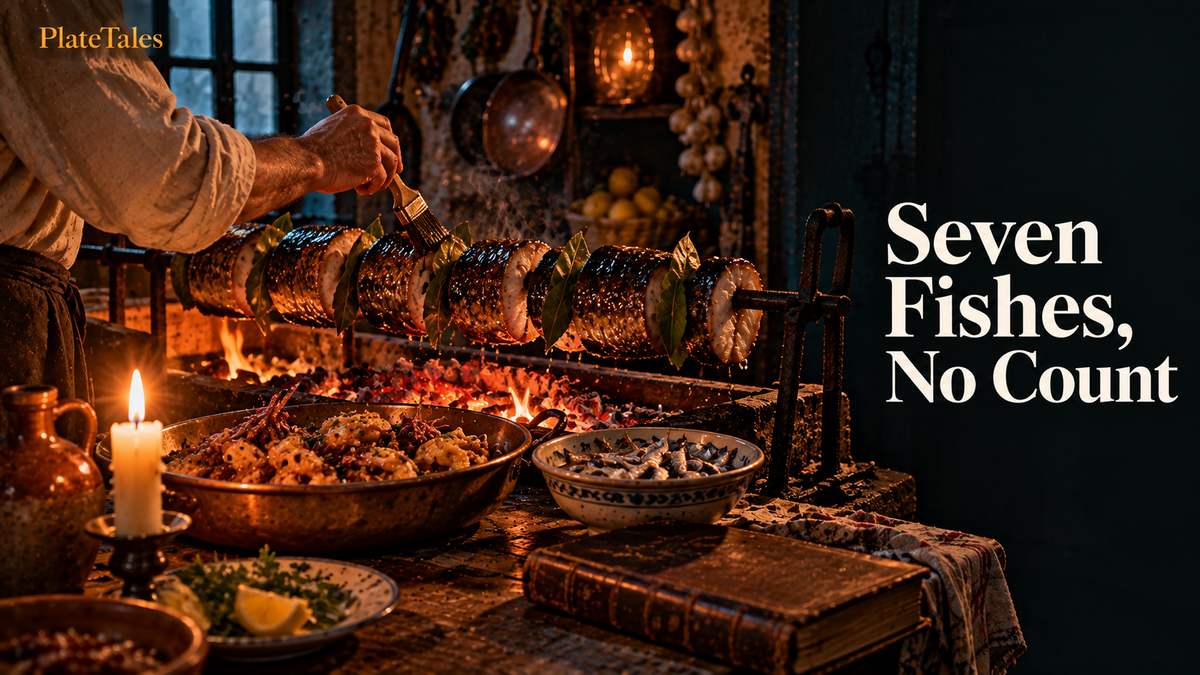
On that point he and the Duke of Buonvicino would have agreed. Cavalcanti's 1847 instructions call for three large capitoni of a rotolo each, cut in pieces and threaded on the spit with a bay leaf between them, then basted with salted water and oil until done.
Questions people ask
Why do Italians eat fish on Christmas Eve?
Before the 1960s reforms, December 24 was the Vigil of the Nativity, a day of fasting and abstinence from meat. In southern Italy the evening meal became the vigilia di magro, a lean vigil of fish. A Neapolitan cookbook from 1847 lists a Christmas Eve menu of eels, squid, lobster and fish pie with no meat at all.
Do people in Italy celebrate the Feast of the Seven Fishes?
Not under that name. Italians have a Christmas Eve meal called la Vigilia or il cenone, and in much of the south it is a fish meal. Anthropologist Michael Di Giovine says you will not hear about a "festa dei sette pesci" in Italy. The name and the fixed number of seven are Italian American.
How many fishes do Italian families actually serve on Christmas Eve?
It varies by region and by family. Calabrian families are often said to serve thirteen fish dishes, and elsewhere in the south the count might be twelve, nine or seven. The oldest Neapolitan menu in the article, from 1847, has eight dishes and no stated count, so seven is not a long-standing rule.
When did the phrase "Feast of the Seven Fishes" first appear in print?
The earliest mention known so far comes from Philadelphia in 1983, either a December 1983 Philadelphia Inquirer story or a restaurant advertisement, depending on the source. Craig Claiborne's article in The New York Times followed on December 16, 1987. Nobody has found the phrase in print before 1983, so it is a recent American name for an older Italian custom.
What is the traditional Christmas Eve menu in Naples?
The 1847 Neapolitan cookbook by Ippolito Cavalcanti gives eight dishes: broccoli fried with anchovies, vermicelli with toasted breadcrumbs, fried eels, boiled spiny lobsters, a casserole of small squid and cuttlefish, a fish pie, roast capitone eel and struffoli. Naples still eats the big eel on that night.
Filed under Ritual Foods, Migration Stories
Want more stories like this?
One food history story, every week. No spam, just the stories behind what the world eats.