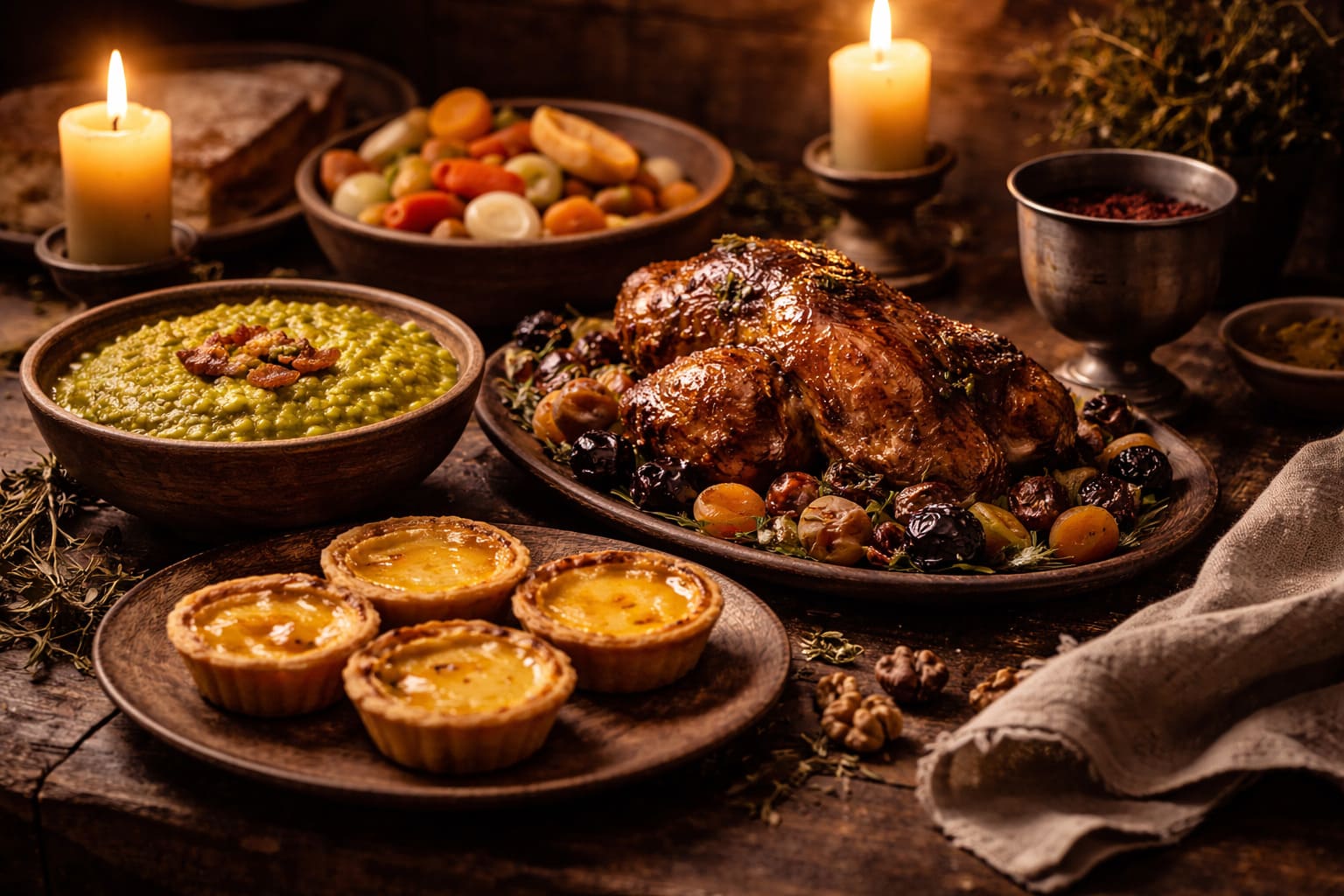
Medieval recipes survive in handwritten rolls and household manuals, and the best known English one is The Forme of Cury, a collection of 196 recipes credited to the master cooks of King Richard II around 1390. Read today, they describe sweet-sour stews, almond-thickened white dishes and spiced wine, not the grim gruel of popular memory.
The roll that Samuel Pegge named
The original manuscript is lost. The text survives in nine copies, and the version most readers meet is the one Samuel Pegge edited in 1780 for Gustavus Brander, a trustee of the British Museum. Pegge printed it from a roll whose headnote credits "the chief Master Cooks of King Richard II." He also gave the collection its name.
Pegge counted 196 recipes in the roll. That is a working kitchen's file, not a diary. The recipes are short, often a few lines, and the cook was expected to know what a good result looked like.
France has two cousins. Le Viandier, credited to Guillaume Tirel, called Taillevent, has a text that predates him: the earliest version dates to about 1300, roughly ten years before Tirel was born, so the original author is unknown. The oldest manuscript, in Sion, Switzerland, has about 130 recipes. After printing began, a Paris edition of about 1486 added 142 more, and 24 editions appeared between 1486 and 1615.
Le Menagier de Paris and the cook who was also a husband
The third famous source is a different animal. Le Menagier de Paris, dated to 1393, is written in the voice of an elderly husband for his much younger wife, with advice on how to be a good spouse, run a household and garden. The recipes sit in one section of a book about marriage. They cover soups, meats, eggs, fish, sauces, drinks, pastry and tarts, and many are presented as remedies. It was first printed in 1846 by Baron Jerome Pichon, and Eileen Power's 1928 English version, The Goodman of Paris, stood as the most complete until Greco and Rose published the full text in 2009.
So the surviving record leans toward the rich and the literate: royal cooks, a Parisian householder with money. What ordinary people ate at home mostly went unwritten.
Did medieval recipes use spices to hide rotten meat?
The best-known claim about medieval cooking is that spices covered the taste of spoiled meat. It is repeated so often that people stop asking who would have paid for it. Spices came from far away and cost a great deal, and for centuries only the wealthy could buy them, the people least likely to be eating bad meat. The writer Bill Bryson makes this point, and Frank Clark of Colonial Williamsburg adds that some spices slow spoilage a little but cannot make tainted meat safe. Spice on the table was closer to a display of money.
That fits what the roll shows. The Forme of Cury notes that spices added rich colour, which Pegge described as "gratifying the sight." Yellow came from saffron or egg yolk, red from sanders or alkanet, green from minced parsley, and some dishes were gilded or silvered. Taillevent's book likewise treats spice, separate sauces and showy presentation as the marks of grand cooking.
For more on the price and politics of one such spice, see the story of black pepper, and of cinnamon.
What compost really was
Modern lists of medieval recipes often include compost, described as sweet pickled vegetables. The text in Pegge's edition reads a little differently. Compost, number 100 in his numbering, mixes parsley and parsnip roots, cabbage and pears in a pot of vinegar, spices and saffron, and the footnote calls it "a composition to be always ready at hand." Its last step is to cast it all together in a pot of earth.
It was a standing preserve, then, something to draw from over days. The name is a form of the word we use for rotting garden waste, but the cook meant a compound, a thing put together.
White food: blank mang and its relatives
Blancmange is the clearest case of a dish that changed beyond recognition. The Forme of Cury has "Blank Mang(er)" beginning "Take Capouns and seeþ hem," with almonds, rice, sugar and salt. A neighbouring recipe, Blank Dessorre, uses almonds, capon meat, sugar and salt. These were not puddings. They were meat dishes in white, thickened with rice, and made on fast days with fish and almond milk in place of animal products.
The dish is older than the English roll. Its oldest known recipe appears in the cookbook of the Danish writer Henrik Harpestraeng, who died in 1244, which puts it in the early 13th century at the latest. It was long said that Arab traders brought rice and almonds to Europe; more recent work points toward Persian dishes such as muhallebi as possible ancestors. Medieval texts also treated it as a food for the sick. In 14th-century France two contrasting colours on one plate were popular. Only in the 17th century did it become a meatless pudding of cream and eggs, and arrowroot and cornflour in the 19th century gave the modern version.
For the bread that often sat under such sauces, see the history of bread.
Bukkenade, daryols and a pea purée
Other favourites in modern lists fare worse when held against the roll. Bukkenade (Pegge's number 17) opens "Take Hennes oper Conynges oper Veel," that is hens, rabbits, veal or other flesh cut into pieces. It calls for almonds, raisins of Corance, sugar, ginger, herbs stewed in grease and onions, and is thickened with rice flour if too thin. No egg-yolk velvet sauce appears in that text, though the idea is easy to repeat.
Daryols, number XX.IX.III in the manuscript's own numbering, are custard tarts of a kind: a pastry case, called a coffin, filled with cow's milk or almond cream, eggs, sugar, saffron and salt, baked until set. A link to Portuguese pasteis de nata is plausible to the eye but not something the text itself says.
Peas are the everyday end of the roll. Perrey of Pesoun has peas boiled until they burst, strained through cloth, then mixed with onions, oil, sugar, salt and saffron; the footnote reads "perrey" as pulp. Peson of Almayne uses white peas finished with almond milk, rice flour, ginger and saffron. Even a pea dish, in this kitchen, got saffron.
Hippocras, a wine for the end of the feast
The spiced wine called hippocras left a good paper trail. Recipes appear from the end of the 13th or early 14th century, and from 1390 they are called "ipocras" or "ypocras." The Forme of Cury has "Pur fait Ypocras," with ginger, spikenard, galingale, cloves, long pepper, nutmeg and cardamom among the spices. Pegge's footnote says a whole pipe of it was prepared for the feast of Archbishop Nevill around 1466.
The name is usually tied to Hippocrates and a cloth bag, the "Hippocratic sleeve", used to strain the spices. That tale is told on the strength of one encyclopedia page, so treat it as a folk etymology until a dictionary confirms it. What is certain is that the drink was served at banquets across Europe, that doctors prescribed it for digestion, and that it fell out of fashion in the 18th century. Basel revived its New Year hippocras tradition in 1996.
Questions people ask
What is The Forme of Cury?
The Forme of Cury is an English recipe roll from about 1390, credited to the master cooks of King Richard II. The original is lost and it survives in nine manuscripts. Samuel Pegge published an edition in 1780 and named the collection; his preface counts 196 recipes.
Did medieval cooks use spices to hide rotten meat?
There is no good evidence for it. Spices were costly imports bought mostly by the rich, who could afford fresh meat. Some spices slow spoilage slightly, but none make bad meat safe. The Forme of Cury treats spices as a source of colour and display, not a disguise.
Was medieval blancmange a pudding?
No. The English blank mang of about 1390 was a white dish of capon, almonds, rice, sugar and salt. The oldest known blancmange recipe is in a Danish cookbook of Henrik Harpestraeng, who died in 1244. The sweet milk pudding came later, in the 17th and 19th centuries.
What was hippocras in the Middle Ages?
Hippocras was wine sweetened with sugar and flavoured with spices, then strained. The Forme of Cury recipe lists ginger, cloves, long pepper, nutmeg and cardamom among its spices. It was served at banquets, and a whole pipe was made for Archbishop Nevill's feast around 1466.
Filed under Forgotten Recipes
Want more stories like this?
One food history story, every week. No spam, just the stories behind what the world eats.