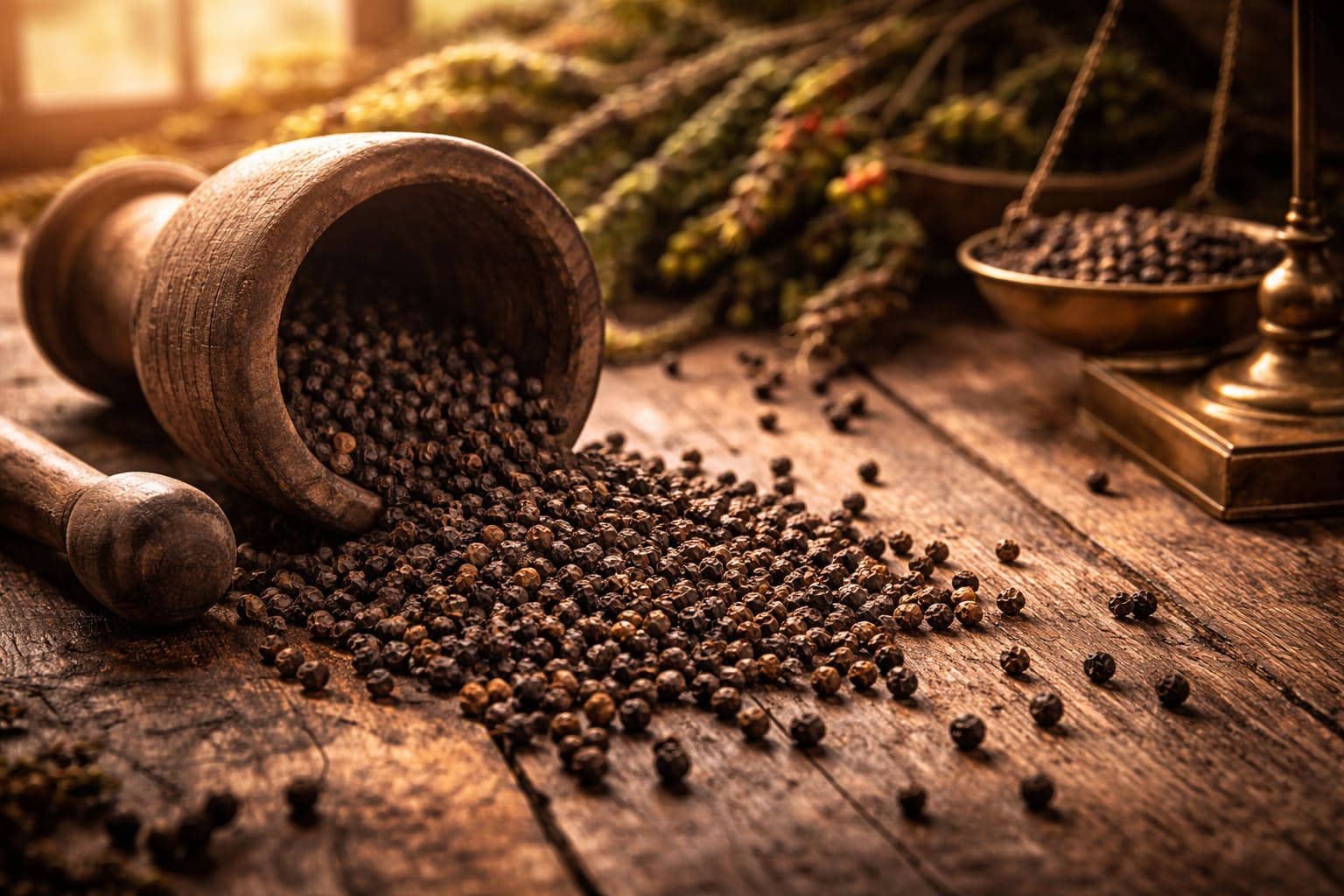
Black pepper comes from the Malabar Coast of southwestern India, and it has been traded around the world for well over two thousand years. Egyptians, Greeks and Romans bought it, Venetian and Genoese merchants controlled its last leg into Europe, and the search for a direct sea route to its source sent Portuguese ships to India in 1497. It is now grown mostly in Vietnam.
Where does black pepper come from?
The vine, Piper nigrum, is usually said to be native to the tropical forests of the Malabar Coast, in what is now Kerala. One reference entry adds a caution: it may instead be native to Southeast or South Asia, so the exact birthplace is less settled than the tidy version suggests. What is firm is that India was the source of the pepper that moved west in antiquity.
The oldest physical trace we have of it outside India is in Egypt. Black peppercorns were reportedly found in the nostrils of Ramesses II, placed there during mummification after his death in 1213 BCE. The reference cited for this is Stephanie Fitzgerald's 2008 book on the pharaoh. By the 4th century BCE pepper was also reaching Greece, where it was probably a purchase for the very rich.
Muziris and the Roman pepper trade
The Roman appetite is where pepper first becomes a story with numbers in it. The Periplus of the Erythraean Sea, a first-century AD sailing guide, describes Muziris, a port of the Chera dynasty on the Malabar Coast, as a major outlet for pepper grown in the surrounding hills. The pepper sat in warehouses waiting for Roman buyers. Shallow water kept the big ships out, so cargo went out to them on smaller boats.
Greek writers noticed the scale. Strabo reported that a fleet of about 120 ships sailed to India and back every year in the early Roman Empire. Pliny the Elder complained that India drained the empire of 50 million sesterces a year.
Pliny also gives us prices, around 77 CE, per pound:
| Kind | Denarii per pound |
|---|---|
| Long pepper | 15 |
| White pepper | 7 |
| Black pepper | 4 |
Black pepper was the cheapest of the three. That detail tends to disappear when people say pepper was worth its weight in gold. In Pliny's own figures it was the budget option.
The papyrus that lists a single ship
A Greek papyrus from the second century AD, known as the Muziris papyrus, records a contract between an Alexandrian importer and a financier over cargoes of pepper and other spices from Muziris. It describes a load on a ship called the Hermapollon, valued at roughly 9 million sesterces. Historians have studied it at length because it is one of the few documents that shows how the money side of the trade worked, with loans, ships and customs duty in one place.
Did Alaric really demand 3,000 pounds of pepper?
Yes, according to the sources we can check, though the figure rests on a single chain of evidence. When the Visigoth king Alaric besieged Rome in 408, the price of lifting the siege is given as 5,000 pounds of gold, 30,000 pounds of silver, 4,000 silken tunics, 3,000 scarlet-dyed hides and 3,000 pounds of pepper. The reference we checked cites the historian John Julius Norwich for the list, and the ancient writer Zosimus for other details of the siege. The senators were asked to contribute according to their means, the collection fell short, and statues of the old gods were melted down to cover the gap. The Goths withdrew to Etruria in December 408.
The pepper was a sensible thing to ask for. It was light, it kept, and it was worth carrying.
How pepper reached medieval Europe
Cosmas Indicopleustes indicates that India was still exporting pepper in the 6th century. After that, Persians and then Arabs took over the middle stages of the trade. By the end of the Early Middle Ages, Islamic powers controlled the central routes, while Venice and Genoa dominated the Mediterranean end. A pound of pepper changed hands several times before it reached a European kitchen, and each hand took a cut.
Asia had its own pepper appetite. Marco Polo reported that about 43 loads, roughly 101 kg each, came into the city he called Kinsay (Hangzhou) every day in the 13th century. The same source says the early 15th century voyages of Zheng He brought back so much pepper that it became a common commodity in China.
The old port of Muziris did not last. It is presumed to have been finished by a major flood of the Periyar River in 1341, though historians Rajan Gurukkal and Dick Whittaker argue that silting of the river mouth also played a part. The flood is thought to have opened the harbour at Kochi.
Da Gama at Calicut, 1498
Pepper's high price is one of the reasons the Portuguese wanted a sea route to India. Vasco da Gama sailed from Lisbon on 8 July 1497 with four vessels and reached Calicut on 20 May 1498. Asked what had brought them, the Portuguese reportedly said they had come in search of Christians and spices. Britannica says they had mistakenly believed the Hindus to be Christians.
It went badly. Britannica says the Zamorin's welcome was dispelled by da Gama's insignificant gifts and rude behaviour, and that the cheap trade goods he carried were hardly in demand in India. He failed to conclude a treaty. He sailed home against the monsoon, and of his original crew of 170, only 55 men survived. Yet the small return cargo still showed that future trade could be very profitable, and Portugal went on to monopolise the spice trade for about 150 years.
Our stories on cinnamon and on the foods of the Silk Road follow the same overland and sea routes from a different angle.
The Dutch, the English and the fall in price
In the 17th century the Dutch and English took most of Portugal's Indian Ocean trade. Malabar pepper ports began trading more with the Dutch from 1661 to 1663. The English East India Company received its charter on 31 December 1600, and its first voyage under Sir James Lancaster left in 1601 and returned in 1603. Lancaster seized a Portuguese carrack carrying pepper and spices, and the proceeds let the voyagers set up a trading post at Bantam on Java.
As supply to Europe grew, prices fell, and pepper turned from a luxury into an everyday seasoning. The same thing happened to sugar and tea in their turn.
Where black pepper grows now
In 2023 world production was 855,105 tonnes. Vietnam grew 257,427 tonnes of it, about 30 percent of the total. India, where the story started, is no longer the leader.
The old value left one odd trace in English law. A peppercorn rent is a nominal rent, a token that still counts as a real payment. In 1960 the House of Lords remarked, in Chappell & Co Ltd v Nestle Co Ltd, that "a peppercorn does not cease to be good consideration". And since 1816 a Masonic lodge in Bermuda has rented the Old State House for one peppercorn a year, handed to the Governor around 23 April.
Questions people ask
Why was pepper so valuable in ancient Rome?
Pepper grew in India and reached Rome through a long chain of sailors, merchants and customs officers. In 77 CE Pliny the Elder gave black pepper at four denarii a pound, and complained that India drained Rome of 50 million sesterces a year. Cost came from distance and middlemen rather than rarity alone.
Which country is the biggest producer of black pepper?
Vietnam is the largest producer. In 2023 it grew 257,427 tonnes, about 30 percent of the world total of 855,105 tonnes, according to the figures we checked. India, where black pepper is generally thought to have originated on the Malabar Coast, is no longer the leader.
Who controlled the pepper trade before the Portuguese?
Persians, then Arabs, took over the middle stages of the trade after late antiquity. By the end of the Early Middle Ages, Islamic powers controlled the central routes, and Venice and Genoa dominated the Mediterranean end. Pepper passed through many hands before reaching European buyers.
What is a peppercorn rent?
A peppercorn rent is a nominal rent, a token payment that satisfies the legal need for consideration without matching the property's real value. A Masonic lodge in Bermuda has rented the Old State House for one peppercorn a year since 1816, presented to the Governor around 23 April.
Filed under Trade Routes
Want more stories like this?
One food history story, every week. No spam, just the stories behind what the world eats.