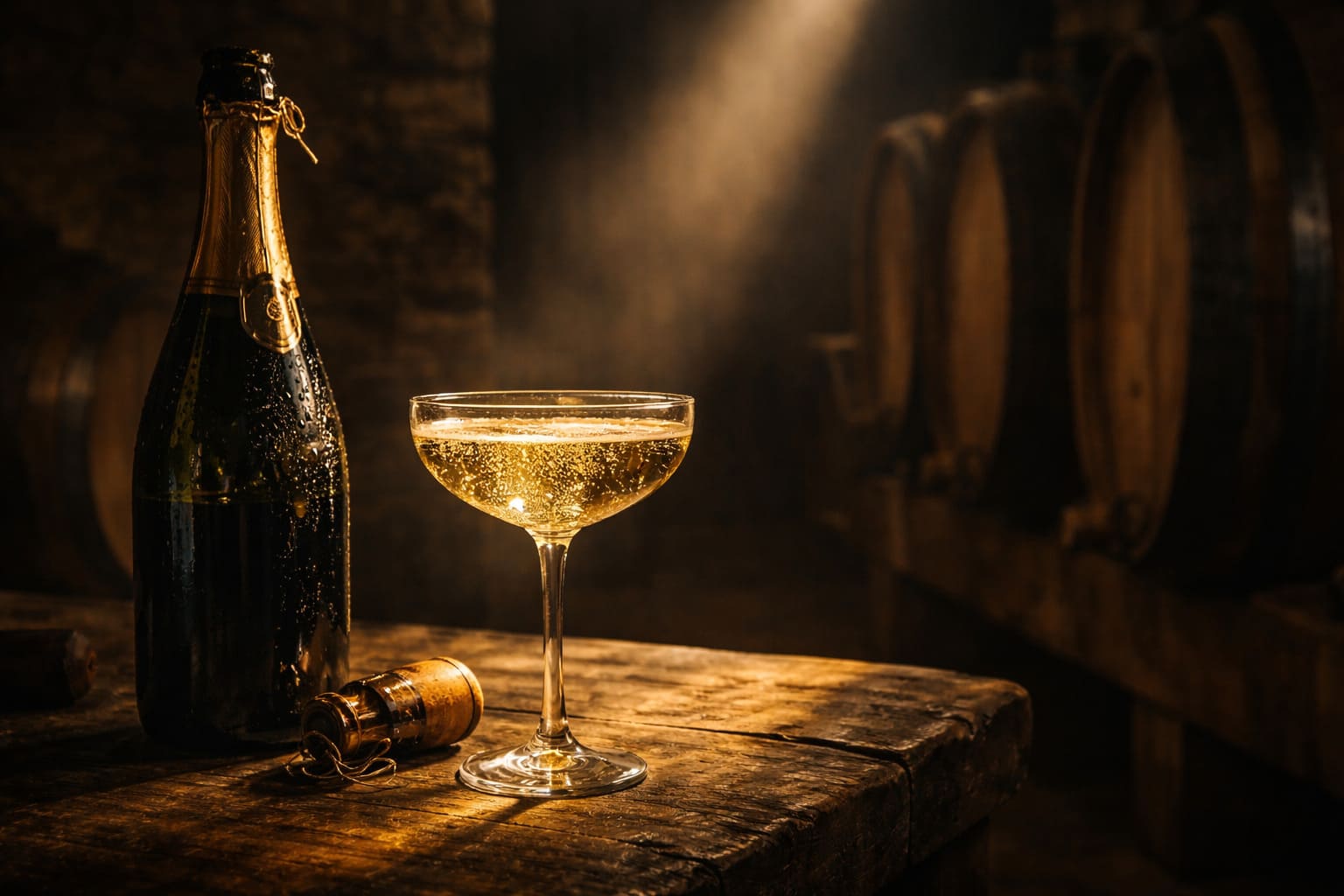
Champagne was not invented by Dom Perignon. The first written recipe for deliberately sparkling wine came from an English scientist, Christopher Merret, in 1662, six years before the monk reached the abbey of Hautvillers. In Champagne itself the bubbles began as a cellar fault, and the monk's superiors reportedly wanted them gone.
Where "I am tasting the stars" really comes from
The legend is tidy. A Benedictine cellarer tastes the first sparkling wine and calls out to his brothers, "Come quickly, I am tasting the stars!" It is also almost certainly false. Reference works on the monk say the line first appeared in a late 19th-century print advertisement, which is roughly two centuries after the man himself. No one has found it in his own time.
Dom Pierre Perignon was real. He was born in December 1638 in Sainte-Menehould, entered the Benedictine order at 17, and in 1668 moved to the abbey of Saint-Pierre at Hautvillers, where he served as cellarer until he died on 14 September 1715. The abbey's vineyard holdings roughly doubled under his management. He is remembered for blending grapes from different vineyards, for preferring Pinot noir, and for pruning hard. The popular tale that he went blind and judged wine by taste alone is also a misreading: the "blind tasting" stories refer to tasting grapes without knowing which vineyard they came from.
Why the bubbles were a problem
Champagne is far north for wine, and its cellars are cold. In a cold autumn, fermentation could stall with sugar still in the wine. When spring warmed the cellars the yeast woke up and started again, now inside sealed bottles. The carbon dioxide had nowhere to go, and the glass burst.
Critics called the result "the devil's wine," le vin du diable. According to the encyclopedia entry on Champagne, the monk's superiors originally wanted him to get rid of the bubbles, because the pressure was bursting bottles in the cellar. That is the odd center of the story. The man credited with sparkling wine was, at least in part, employed to prevent it.
He also steered clear of white grapes, which tended to re-ferment. The pale wine he is known for was made from black grapes pressed with care.
The Englishman with the sugar
On 17 December 1662, Christopher Merret presented a paper to the Royal Society in London titled Some Observations concerning the Ordering of Wines. He described winemakers adding sugar and molasses to make wines "drink brisk and sparkling." That is the second fermentation in the bottle, the same step that Champagne is made with today. The paper was found again much later by the wine writer Tom Stevenson.
Merret was a physician and scientist who seems to have cared more about glass than wine. In the same year he published his translation of Antonio Neri's The Art of Glass, adding 147 pages of his own. The glass matters. English makers, working in Newcastle upon Tyne, were producing bottles strong enough to take the pressure of a deliberate second fermentation, which French bottles often could not.
So the written method was English, and so was some of the hardware. That does not mean the English invented bubbles. They were the first to put the procedure on paper that survives.
A rival from the south: the monks of Limoux
There is a second claim, and it makes the Champagne story look younger still. One encyclopedia entry reports that the oldest recorded sparkling wine is Blanquette de Limoux, made in 1531 by Benedictine monks at the abbey of Saint-Hilaire near Carcassonne, who bottled the wine before its first fermentation had finished. That date rests on a single general reference, so treat it as a lead rather than settled fact. It points the same way as the rest of the evidence: sparkling wine was around before Hautvillers, and no single person woke up and invented it.
Champagne itself stayed mostly still for a long time. Sparkling wine did not become the dominant style there until the mid-19th century.
The widow and the kitchen table
The change from cellar nuisance to luxury was a matter of craft and sales. Early sparkling wine was cloudy, full of dead yeast. Barbe-Nicole Clicquot was born in Reims in 1777 and was widowed in October 1805, when her husband Francois died and left her with a six-year-old daughter. She ran the business, launched in 1810 as Veuve Clicquot-Ponsardin, and is credited with the first known vintage Champagne that same year.
In 1816 she is credited with a riddling table. The version told by the site This Day in Wine History has her cutting angled holes in a kitchen table and standing bottles neck-down, then turning and tilting them a little each day so the sediment slid into the neck, where it could be removed. The result was a clear wine.
A second fix followed the bursting problem. In 1844 Adolphe Jaquesson invented the muselet, the wire cage that holds the cork in place. Production was about 300,000 bottles a year in 1800 and 20 million by 1850, according to the encyclopedia entry. In fifty years, a fault had become an industry.
Who gets to say "Champagne"
As the name gained value, it was borrowed. The answer in France was law. Champagne is now a single appellation d'origine controlee, and the rules require grapes from designated places, secondary fermentation in the bottle and at least fifteen months of aging. This Day in Wine History dates the protection to 29 June 1936.
The monk who is meant to have discovered all this died on 14 September 1715, and the abbey where he spent his working life, Hautvillers, now belongs to the house that put his name on a bottle.
If you like stories where a flaw turned out to be the product, see foods invented by accident. The chemistry behind the cork's pop is covered in the history of fermentation, and for the larger national setting, read French cuisine history.
Questions people ask
Did Dom Perignon invent sparkling wine?
No. Dom Perignon, a Benedictine cellarer at Hautvillers from 1668 to 1715, improved Champagne through blending and careful pressing. Sources say he did not invent the sparkling style, and his superiors reportedly wanted the bubbles removed because they burst bottles in the cellar.
Who wrote down the method for sparkling wine first?
Christopher Merret, an English scientist, presented a paper to the Royal Society on 17 December 1662. It described adding sugar and molasses to wine so that it would "drink brisk and sparkling," which is the second fermentation used for Champagne today. That was six years before Dom Perignon reached Hautvillers.
Did Dom Perignon really say he was tasting the stars?
There is no evidence he did. The line "Come quickly, I am tasting the stars!" first appeared in a late 19th-century print advertisement, roughly 200 years after his time at Hautvillers. Historians treat it as marketing copy that was later told as an anecdote about the monk.
What did Madame Clicquot change about Champagne?
Barbe-Nicole Clicquot ran Veuve Clicquot after her husband died in 1805. She is credited with the first known vintage Champagne in 1810 and a riddling table in 1816, which gathered sediment in the bottle neck so the wine could be made clear.
Filed under Accidental Inventions
Want more stories like this?
One food history story, every week. No spam, just the stories behind what the world eats.