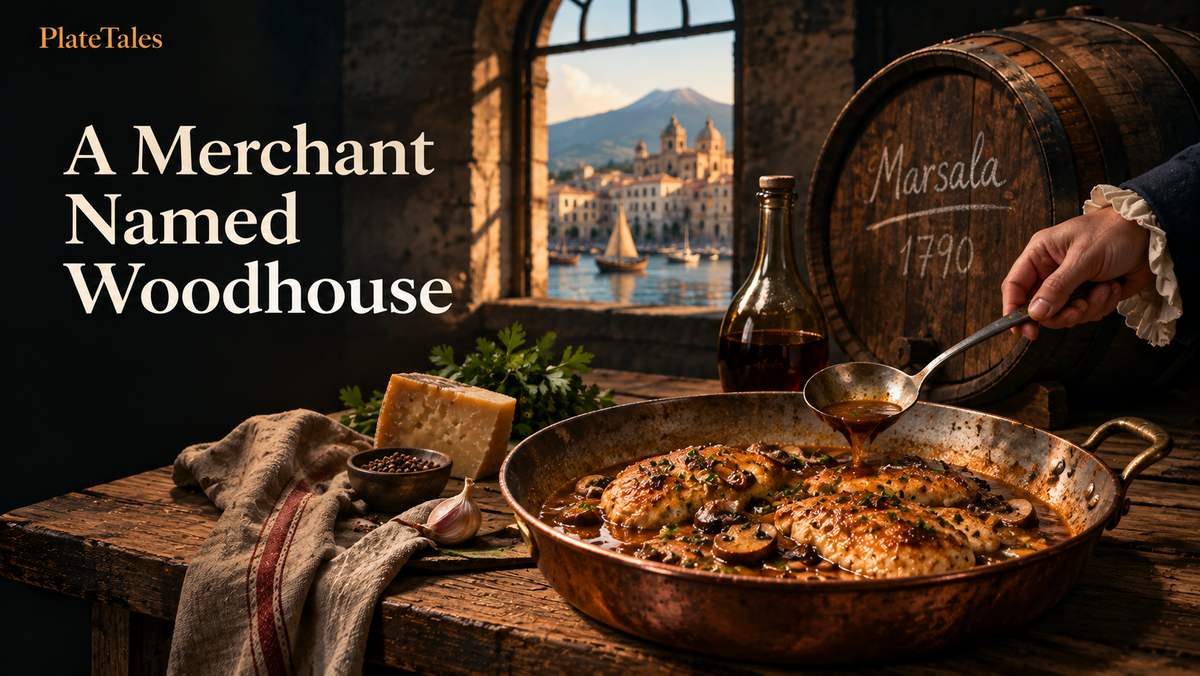
Chicken Marsala history starts with the wine, not the chicken. The dish takes its name from Marsala, the fortified wine of western Sicily, which an English merchant named John Woodhouse is said to have begun shipping from the port of Marsala in 1773. The wine's story is well documented. The dish's own story, who first sauteed a cutlet in it and where, is not.
An English merchant at the port of Marsala
The traditional account, repeated by Gambero Rosso in October 2025, has Woodhouse arriving in the port of Marsala in 1773 and finding the local wines to his taste. He added alcohol to help the wine survive the sea voyage, sent barrels home, and they sold. Other Englishmen followed.
Accounts differ on the date. The wine writer Henry Jeffreys, who visited the Florio cellars in Marsala in 2014 while researching his book Empire of Booze, places Woodhouse's visit in the 1780s instead. He also describes the wine as a madeira substitute: Woodhouse tasted the local wine, noticed a likeness to madeira, which was fashionable in Britain, and fortified and sweetened it for British tastes before exporting it.
That is the first useful fact for anyone asking whether Marsala is Italian. The grapes and the place are Sicilian, and the region's wine-making goes back to the Greeks and Carthaginians. But Gambero Rosso quotes Jeffreys saying the British were the ones who turned it into a consistent product that could be sold across the world, and calls Marsala "an Anglo-Sicilian wine." Sweetening came from heated grape must, called mosto cotto, according to the fortified wine educator Demetri Walters, who is quoted in the same piece.
Nelson's order
Britain was at war with France, and the Royal Navy needed wine that would not spoil in a ship's hold. Jeffreys told Gambero Rosso that Marsala was a perfect ship's wine because it was stable, and that, like madeira, it was close to unbreakable. Sicily also never fell to Napoleon, so the port stayed friendly.
Horatio Nelson met Woodhouse's family in 1798. The Drinks Business, drawing on Jeffreys's book, says Nelson met Woodhouse in Naples and ordered two pipes, signing the contract with his left hand because the right had been lost at Tenerife the year before. Gambero Rosso gives a larger figure, 200 pipes, and says Nelson was dealing with John Woodhouse Junior, son of the Liverpool merchant. The sources do not agree on the size of the order or on which Woodhouse he dealt with, so the number stays loose here.
Both pieces agree on the letter. Nelson wrote to his superior, Lord Keith, that the wine was good enough for any gentleman's table and would be of real use to the seamen. In 1799 Nelson was made Duke of Bronte, and according to Gambero Rosso, Woodhouse Junior set aside a cask of particularly good Marsala and named it Bronte Marsala in his honor.
Did Marsala toast Nelson at Trafalgar?
Not as far as the record shows. Nelson's body was placed in a cask of brandy for the trip home, and Gambero Rosso is blunt that it was brandy, "not rum, nor indeed Marsala." The popular tale that sailors drank the brandy afterward is, in that piece's words, likely untrue.
The Drinks Business has a smaller, more careful point. As Nelson lay dying he was given lemonade or watered-down wine to drink, and the writer adds a question mark after Marsala. Nobody can say which wine it was.
Marsala also lost its place on the Trafalgar table. Gambero Rosso cites a 1958 Trafalgar Night dinner menu held by the National Museum of the Royal Navy: it opened with sherry and finished with 1942 vintage port.
The English families who stayed
Woodhouse was not alone for long. Jeffreys writes that Benjamin Ingham, from Yorkshire, arrived, and that the merchants married into local families and formed an Anglo-Sicilian merchant aristocracy. The Whitakers, relatives of Ingham, built the Villa Malfitano Whitaker in Palermo. Not all the merchants were British: the Florio family came from Calabria in 1833.
If you visit the harbor at Marsala, Jeffreys says, you can still see two huge abandoned stone warehouses that belonged to the Woodhouse firm and to Ingham and Whitaker.
How an English wine became a cooking wine
Phylloxera, the vine-eating pest, reached Sicily in 1893, and according to Jeffreys the vineyards were replanted with lesser grape varieties, with producers going for quantity over quality. The Whitaker and Woodhouse families sold to Cinzano in 1929. Marsala, once drunk by connoisseurs, he writes, became an industrial wine "mainly used for cooking."
That sentence matters for the dish. By the time Marsala was a standard bottle on a restaurant shelf, it was a cooking wine in the reputation of its buyers, not the drink of Nelson's gentleman's table. Jeffreys notes that a few producers still make the unsweetened vergine style, and that Marco de Bartoli was making it in the traditional way, with solera aging and no sweetening must. De Bartoli, he adds, held a grudge against the British for ruining his native wine by fortifying it.
Is chicken Marsala Italian?
Here the honest answer thins out. The wine is from Sicily and its merchants were English. Beyond that, the sources read for this article do not describe the dish at all: they give no first recipe, no restaurant, no year, and no cook who first put the wine to a cutlet. Several websites assert an origin for chicken or veal Marsala, but none of the ones that surfaced cited a document, and a claim without a document is not history.
For how Italian immigrants shaped restaurant cooking in America, see how immigration changed American food, or the migration stories section. Other stories of Italian food and its travels include fettuccine Alfredo, pizza and mac and cheese.
What can be said is narrower. A sauce of Marsala and meat could only exist after the wine became an export product in the late 1700s.
Questions people ask
Who was John Woodhouse and what did he have to do with Marsala?
John Woodhouse was a Liverpool merchant who, by the traditional account, arrived at the port of Marsala in Sicily in 1773, fortified the local wine to survive the sea voyage to Britain and began exporting it. Henry Jeffreys dates his visit to the 1780s, so the exact year is disputed.
Is chicken Marsala Italian?
The wine in chicken Marsala comes from Sicily, but it was shaped for export by English merchants, which is why Gambero Rosso calls it an Anglo-Sicilian wine. The sources behind this article do not document where or when the chicken dish itself began, so its Italian credentials are unproven rather than disproven.
Did Nelson really order Marsala for the Royal Navy?
Yes, two sources say he ordered Marsala from the Woodhouse firm after meeting a Woodhouse in 1798, though they disagree on the amount: two pipes in one account, 200 pipes in another. He wrote to Lord Keith that the wine would be of real use to the seamen.
Why is Marsala used for cooking?
Marsala became cheap and industrial after phylloxera reached Sicily in 1893 and the Whitaker and Woodhouse families sold their business to Cinzano in 1929. Henry Jeffreys writes that the once-prized wine ended up mainly used for cooking, although a few producers still make traditional versions.
Filed under Migration Stories
Want more stories like this?
One food history story, every week. No spam, just the stories behind what the world eats.