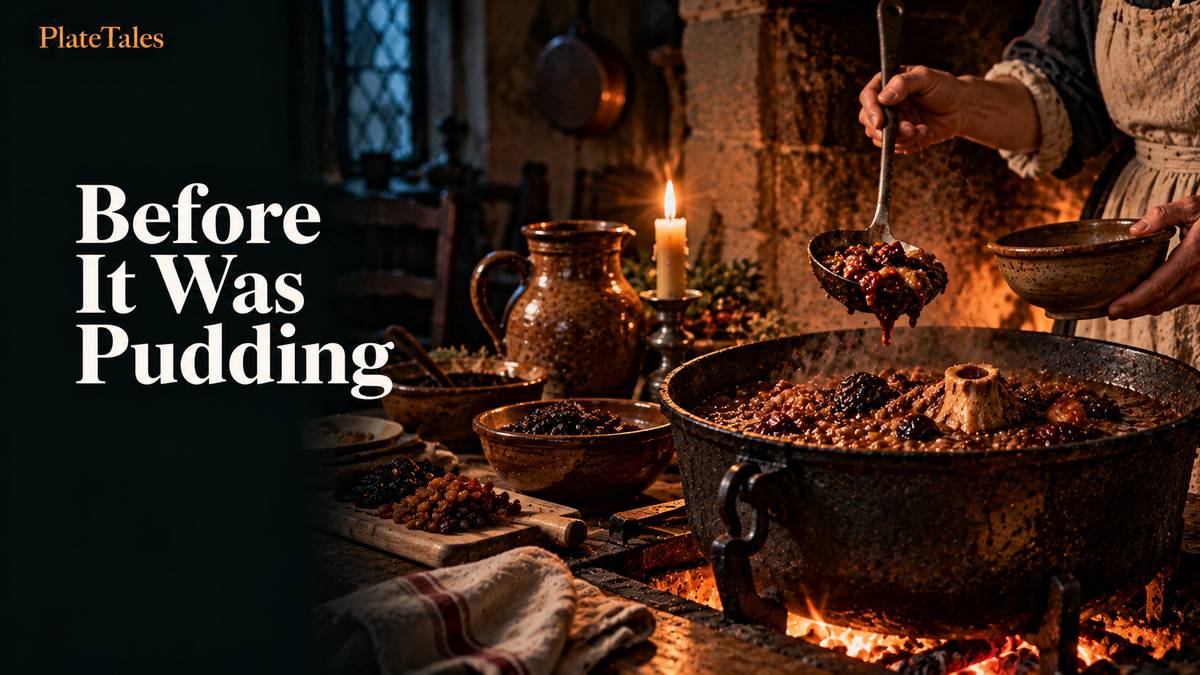
The history of Christmas pudding starts in a soup pot. In 1747 Hannah Glasse printed a recipe called "Plum-Porridge for Christmas" in The Art of Cookery, Made Plain and Easy, and it begins with a leg and shin of beef boiled in eight gallons of water. The round, dark, flaming pudding came later, and the name "Christmas pudding" reached print through Eliza Acton in 1845.
Everything in between has been decorated as heavily as the pudding itself. There is a medieval church decree, a German king who ordered the first one, and a Sunday when families have supposedly stirred since the Middle Ages. Some of that holds up. A surprising amount of it was written in the last few decades.
The church decree that nobody can find
The most repeated version goes like this. In the Middle Ages, the Roman Catholic Church ruled that the pudding must be made on the 25th Sunday after Trinity, with thirteen ingredients for Christ and the twelve apostles, and that every member of the family must stir it from east to west in honor of the Magi. The food site lovefood dates the decree to "around the 1540s." Dozens of Christmas pages copy it.
In February 2012 the food historian Ivan Day went looking for the document. He traced the claim back to Andrea Broomfield's Food and Cooking in Victorian England (2007), which gave as its source Simon Callow's Dickens' Christmas (2003). Callow, Day noted, gives no reference for it. Day offered $1000 to the first person who could find the original medieval text and point him to the library that holds it, with a deadline of midnight on 24 December 2012. He called the decree "spurious." The post records no winner.
The dating sinks it on its own. By the 1540s the Church in England had stopped taking orders from Rome. Henry VIII broke with the Pope in 1534. The label "25th Sunday after Trinity" is also the Prayer Book's way of counting. The old Roman Missal called the same Sunday the 24th after Pentecost. The 1540s may be a garbled memory of 1549, the year the first English Book of Common Prayer put the words "Stir up" into the service for that day, but that is a guess, and the prayer said nothing about food.
The other famous legend fares no better. Britain's first Hanoverian king, George, crowned in 1714, is often called "the Pudding King" for supposedly demanding plum pudding at his first English Christmas. The Old Royal Naval College at Greenwich looked into it and found no written records from the eighteenth or nineteenth century to suggest he deserved the title.
What plum porridge actually was
The real ancestor was a spoon food. Samuel Pepys ate it on Christmas Day 1662, sitting by his wife's bed because she was unwell: "a mess of brave plum-porridge and a roasted pullet for dinner, and I sent for a mince-pie abroad." The porridge was the Christmas dish; the mince pie was bought in.
Glasse's recipe, printed 85 years later, gives a fair idea of what Pepys had in his bowl. The beef broth is thickened with six penny loaves, sliced thin and soaked. Into it go five pounds of currants, five pounds of stoned raisins and two pounds of prunes, then mace, cloves and two nutmegs, three pounds of sugar, a quart of sack, a quart of claret and the juice of two or three lemons. The finished batch went into earthenware pans to "keep them for Use": a sweet, spiced, boozy meat soup, made by the gallon.
Medieval English cooks had been mixing meat, dried fruit and spice for centuries before Glasse, which is why so many of the forgotten medieval recipes look strange now: sweet and savory had not yet been separated onto different plates. The sugar was the expensive part. Three pounds of it in one pot was money on display, and the story of how sugar got to England is a darker one than the pudding.
Why is it called plum pudding when it has no plums?
Because in the seventeenth and eighteenth centuries "plum" meant a raisin, or dried fruit generally, in a pudding or cake. The Oxford English Dictionary records that sense from 1653. Glasse's own book shows how the word worked. Her "Boiled Plumb-Pudding," a few pages after the porridge, is a pound of suet, a pound of currants, a pound of stoned raisins, eight eggs, a grated penny loaf, nutmeg, ginger, flour and milk, boiled five hours. Not one plum in it, as we would use the word.
There is a small irony in the porridge, though. Glasse's plum porridge did contain two pounds of prunes, which are dried plums. So the soup sometimes held the fruit its name promised, and the pudding that inherited the name never did.
The pudding also turns up in places nobody serves it now. Glasse gives instructions for skinning a pig "up to the Ears whole," filling the skin with "a good Plumb-pudding Batter" of beef fat, fruit, eggs, milk and flour, sewing it up and baking it, so that it would look like a pig. In these books it is a pudding for any time of year, served at the end of a meal, often beside the beef.
What is Stir-up Sunday, really?
Stir-up Sunday is the last Sunday before Advent, which in 2026 falls on 22 November. Its name comes from the collect, the short prayer set for that day in the Book of Common Prayer: "Stir up, we beseech thee, O Lord, the wills of thy faithful people; that they, plenteously bringing forth the fruit of good works, may of thee be plenteously rewarded." It is an English version of an older Latin prayer that begins "Excita, quaesumus." The stirring it asks for is spiritual.
The kitchen joke came much later. The Oxford English Dictionary says the name is "jocularly associated with the stirring of the Christmas mincemeat, which it was customary to begin making in that week." Mincemeat, not pudding. In the comments under his 2012 post, Ivan Day replied to a reader who had found the name in books printed between 1830 and 1854 that nineteenth-century references were, as far as he knew, the earliest known. "Like a lot of traditions," he wrote, "Stir Up Sunday is not as old as many think."
Nobody has produced an early source for the thirteen ingredients or the east-to-west stirring. One of Day's readers suspected the thirteen was an invention of the 1980s. The timing itself makes sense without any legend: a rich boiled pudding needs weeks to mature, and five Sundays before Christmas is about right.
How Christmas pudding got its name in 1845
By the 1830s the boiled plum pudding was settling into its Christmas role. The old sailors living as Greenwich Pensioners at the Royal Hospital were served it at Christmas, and a poem printed in 1838, said to be by one of them, remembers Christmas at sea "With beef, plum-pudding to afford."
Then came the cookbook. Eliza Acton's Modern Cookery for Private Families is usually credited as the first to use the name "Christmas pudding," and the 1845 second edition has three. "Ingoldsby Christmas Puddings" is built on a very large scale: two pounds each of raisins, currants and suet, sixteen eggs and four glasses of brandy, enough for three puddings boiled six hours apiece.
"Cottage Christmas Pudding" stretches the flour with a quarter pound of mashed potatoes. "The Author's Christmas Pudding," Acton's own, is small, with minced apples and candied orange rind, boiled three and a half hours. She calls it "a remarkably light small rich pudding."
She also printed a recipe for using up the leftovers, lining a mould with slices of cold plum pudding and filling it with custard. She called it "The Elegant Economist's Pudding."
Why set Christmas pudding on fire, and why the coin?
Two years before Acton, Charles Dickens had already put the pudding at the center of A Christmas Carol (1843). Mrs. Cratchit leaves the room alone, too nervous to bear witnesses, the pudding comes out of the copper smelling of "a washing-day," and she returns with it "like a speckled cannon-ball, so hard and firm, blazing in half of half-a-quartern of ignited brandy, and bedight with Christmas holly stuck into the top."
A quartern was a quarter of a pint, so the Cratchits set theirs alight with a very small splash. Bob regards it as the greatest success Mrs. Cratchit has achieved since their marriage. Dickens did not claim to have invented anything, but the book did a great deal to make the pudding, flame and holly included, part of an English Christmas.
The coin has a clearer ancestry than the fire. Silver threepences and sixpences went into the mix to promise wealth in the coming year, along with charms like a thimble or a wishbone. The habit is usually traced to an older custom of hiding tokens in a cake, which had died out by the twentieth century. The likeliest candidate is the Twelfth Cake of Twelfth Night, baked with a bean and a pea inside to crown a king and queen for the evening, which faded in Victorian times. Christmas pudding is not the only one of the ritual foods to pick up a custom from a dish that disappeared.
Is figgy pudding the same thing?
Figgy pudding, the one the carol demands, is a separate dish. Medieval cooks made a dish of figs, raisins, ground almonds, wine, ginger and honey, recorded as "fygey" in the fourteenth-century Forme of Cury. It counts as a forerunner of plum pudding, plainer and less rich, and the "figgy pudding" demanded in "We Wish You a Merry Christmas" is not the dark Christmas pudding on the table.
The King's pudding and a ten-ton sequel
The pudding's last big promotion was political. In 1927 the Empire Marketing Board, set up to persuade Britons to buy goods from the colonies, asked the Royal Household for the royal family's Christmas pudding recipe. The royal chef, Cédard, supplied it, and the Board rewrote both its scale, from forty servings down to eight, and its shopping list: currants from Australia, raisins from South Africa, apples from Canada, rum from Jamaica, brandy from Cyprus. George V ate that Empire pudding on Christmas Day 1927, and the Greenwich historians suggest he has a better claim to "Pudding King" than his Hanoverian ancestor ever did.
Four years later the idea went industrial. At the People's Dispensary for Sick Animals' Christmas market in the Royal Albert Hall, in November 1931, a ten-ton "Prince of Wales' Empire Christmas Pudding" was mixed, with ingredients supplied by the High Commissioners of the Dominions and Colonies. It was cut into 11,208 smaller puddings and handed out to poor families across Britain in the middle of the Depression. Manchester and Salford got 512 each.
Questions people ask
Why is Christmas pudding called plum pudding if it has no plums?
In the seventeenth and eighteenth centuries, "plum" meant a raisin or dried fruit in general. The Oxford English Dictionary records that sense from 1653. Hannah Glasse's 1747 "Boiled Plumb-Pudding" in The Art of Cookery is made of suet, currants, raisins and eggs, with no plums as we would use the word.
What is Stir-up Sunday?
Stir-up Sunday is the last Sunday before Advent. Its name comes from the opening words of the Book of Common Prayer collect for that day, "Stir up, we beseech thee, O Lord," which asks for spiritual stirring. The kitchen joke came later, and the Oxford English Dictionary links it to making mincemeat, not pudding.
Was there a medieval church decree about Christmas pudding?
No medieval decree has ever been found. The popular story of thirteen ingredients stirred from east to west traces back to a 2003 book that gives no source. In 2012 the food historian Ivan Day offered $1000 for the original text, called the decree "spurious," and the post records no winner.
Who first called it Christmas pudding?
Eliza Acton is usually credited as the first cookbook author to use the name "Christmas pudding." Her Modern Cookery for Private Families, in its 1845 second edition, includes three recipes with that name, among them "The Author's Christmas Pudding," a small rich pudding boiled for three and a half hours.
Is figgy pudding the same as Christmas pudding?
No. Figgy pudding is a separate, plainer dish. Medieval cooks made it from figs, raisins, ground almonds, wine, ginger and honey, and it appears as "fygey" in the fourteenth-century Forme of Cury. It is a forerunner of plum pudding, not the dark Christmas pudding served on the table today.
Filed under Origin Stories, Ritual Foods
Want more stories like this?
One food history story, every week. No spam, just the stories behind what the world eats.