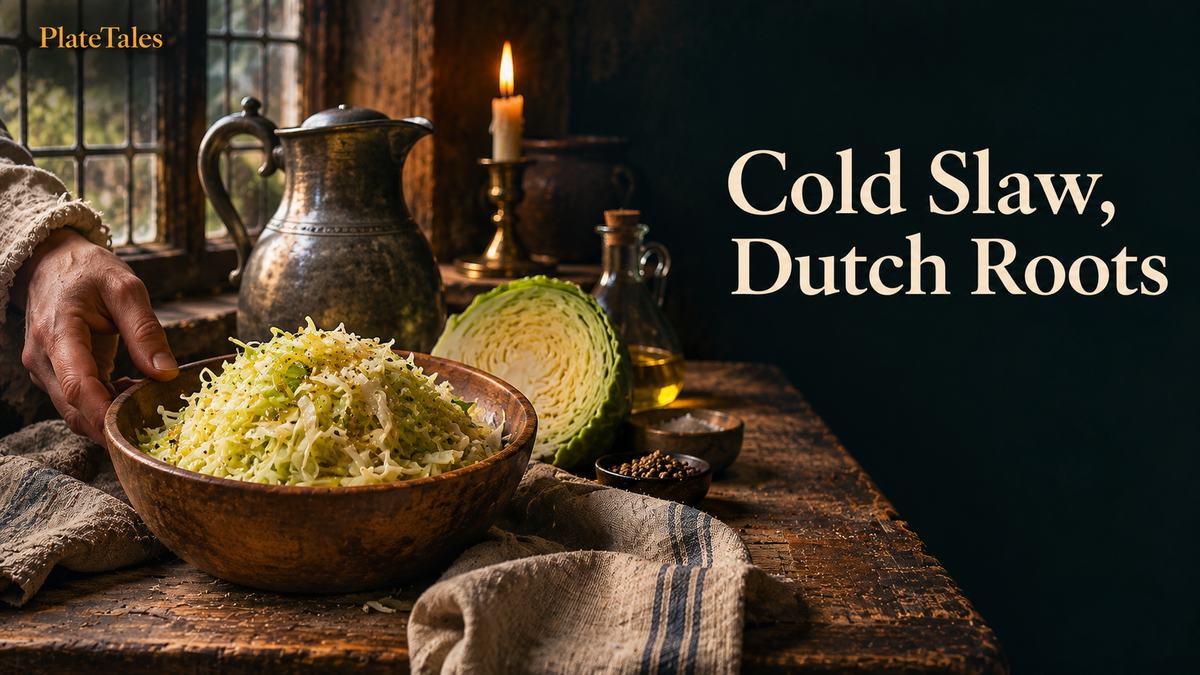
Coleslaw comes from the Dutch word koolsla, "cabbage salad," and reached English-speaking America through the Dutch settlers of New Netherland along the Hudson. English speakers bent the word into "cold slaw," and by 1794 it was in American print under that spelling, according to the barbecue historian Robert F. Moss. The mayonnaise version most people picture is a later arrival.
A Dutch word for coleslaw, and perhaps older cabbage
The food-history site Food Timeline notes that Apicius, the Roman cookery collection, describes shredded cabbage dressed with vinegar, eggs and spices. That makes cabbage salad old. It does not make coleslaw Roman, because the name is the thing that is Dutch.
John Ayto, in An A to Z of Food and Drink (2002), puts it plainly: coleslaw means literally "cabbage salad," and English took the word from Dutch koolsla at the end of the 18th century. Kool is cabbage and sla is salad. John F. Mariani, in The Encyclopedia of American Food & Drink (1999), says the dish was in American print by 1785. Moss gives 1794. The two dates differ by nine years, which is the usual spread for a word that was spoken long before anyone wrote it down.
Andrew F. Smith, in the Oxford Encyclopedia of Food and Drink in America (2004), says Dutch settlers in New Netherland grew cabbage along the Hudson and served koolsla, and that the dish spread through the colonies from there.
The landlady in Peter Kalm's account
The best-known early description is not a recipe but a travel report. The English edition of Peter Kalm's Travels in North America (1770) describes a Dutch landlady serving an unusual salad of cabbage cut in thin strips, dressed with oil, vinegar, salt and pepper. Food Timeline quotes this through Peter G. Rose, whose The Sensible Cook (Syracuse University Press, 1989) translates Dutch foodways in the Old and New World and builds a modernized "Cabbage Salad" on the same lines: green and red cabbage, wine vinegar, oil or melted butter, salt, pepper, mixed ahead so the flavors can "marry."
Note what is missing. No cream, no sugar, no mayonnaise. The Dutch dish was cabbage, fat, acid and seasoning.
Some popular pages say the Dutch cookbook De Verstandige Kock contains the first coleslaw recipe, with dates that wander between 1667, 1669 and 1770. The 1770 in that tangle belongs to Kalm's English edition, not to a cookbook, and the cookbook claim could not be traced to a source read for this article, so it is left out.
How "kool" turned into "cold"
English ears did the rest. Waverley Rood and Richard de Rochemont, in Eating in America: A History (1976), say households forgot that kool meant cabbage. The salad became "cold slaw," and once it was cold slaw, someone naturally invented "warm slaw."
Mariani adds a useful caution: the name does not refer to temperature, even though "cold slaw" survived on menus and in cookbooks for a long time. Moss notes that "cold slaw" stayed the most common spelling until the 20th century.
The warm version was real. Lettice Bryan, in The Kentucky Housewife (1839), prints both. Her "Cold Slaugh" calls for firm cabbage shaved thinly, vinegar, salt, pepper and whole white mustard seed, garnished with pickled eggs. Her "Warm slaugh" heats the cabbage with butter, salt, pepper and vinegar and tops it with minced hard-boiled yolks. She warns: "Never put butter on cabbage that is to be eaten cold." Neither recipe uses mayonnaise.
Was cabbage ever a problem?
Smith adds one detail on the other side of the ledger. By the 1880s, he writes, cabbage had fallen out of favor with the upper class because of the smell it gave off in cooking. Raw cabbage salad dodged that complaint, which may be part of why slaw outlived the boiled cabbage dinner as a side dish.
Slaw joins the barbecue
Robert F. Moss, who has combed old newspapers for barbecue menus, traced slaw at a barbecue back to 1880. A delegation from the Cincinnati Board of Trade attended a barbecue on the Augusta Canal in Augusta, Georgia, and the menu listed "cold slaw" among the relishes.
| Year | Place | What Moss found |
|---|---|---|
| 1880 | Augusta, Georgia | "Cold slaw" among the relishes at a barbecue for a Cincinnati delegation |
| 1890 | Chattanooga, Tennessee | The Chattanooga Daily Times reports cold slaw at a butchers' association barbecue |
| 1900 | Swift Creek Township, near Raleigh, North Carolina | Homemade cold slaw at a community barbecue |
| 1915 | Orlando, Florida | Slaw planned for 5,000 people, with a "cold slaw and pickle committee" |
Moss calls slaw "the OG barbecue side," since it has been served with barbecue far longer than hushpuppies, macaroni and cheese or banana pudding. In 1984, Craig Claiborne wrote in the New York Times that North Carolina barbecue was best "in a bun with a little cole slaw." The same sandwich logic runs through the pulled pork story, and the ribs have their own side-dish history in the story of barbecue ribs.
Vinegar slaw, white slaw and red slaw
Moss describes two main types: vinegar slaw and the mayonnaise-based "white slaw," though mayonnaise versions usually carry some vinegar too. Either can be tinted yellow with mustard. Around the point where Tennessee, Alabama and Georgia meet, within about 50 miles, a bright yellow, pepper-laced "hot slaw" turns up.
In the North Carolina Piedmont, Lexington barbecue comes with "red slaw," chopped to BB-sized bits and seasoned with barbecue sauce, so it is hot, tangy and sweet. Bob Garner described it in North Carolina Barbecue: Flavored by Time (1996) and criticized central North Carolina spots that serve white slaw with Piedmont barbecue. In 2018, Cecil Conrad, owner of The Bar-B-Q Center in Lexington, admitted to Our State magazine that white slaw had been "snuck" onto the menu.
When mayonnaise entered the slaw bowl is the loose end. Food Timeline observes that mayonnaise is an 18th-century invention, so a mayonnaise coleslaw is a newer thing than the Dutch original. No dated source for the first mayonnaise slaw turned up, so this article does not give one.
Questions people ask
Is coleslaw Dutch or American?
Both, in a sense. The word comes from the Dutch koolsla, "cabbage salad," and Andrew F. Smith says Dutch settlers in New Netherland grew cabbage and served the dish along the Hudson. The name "cold slaw" and the barbecue side dish that grew from it are American developments.
Why was it called cold slaw?
According to Waverley Rood and Richard de Rochemont in Eating in America (1976), households forgot that kool meant cabbage, so the word became "cold slaw," and people then began speaking of "warm slaw." John F. Mariani notes the name never referred to temperature. Moss says "cold slaw" stayed the most common spelling until the 20th century.
Did the original coleslaw have mayonnaise?
No. The Dutch dish described in Peter Kalm's Travels in North America (English edition, 1770) used oil, vinegar, salt and pepper on thin strips of cabbage. Lettice Bryan's 1839 Kentucky Housewife recipes for cold and warm slaw use vinegar and butter, and neither calls for mayonnaise.
What is the difference between white slaw and red slaw?
Robert F. Moss describes white slaw as the mayonnaise-based kind, usually with some vinegar. Red slaw is the Piedmont and Lexington, North Carolina style: cabbage chopped to BB-sized bits and seasoned with barbecue sauce, so it tastes hot, tangy and sweet. Bob Garner described it in his 1996 book on North Carolina barbecue.
Filed under Migration Stories
Want more stories like this?
One food history story, every week. No spam, just the stories behind what the world eats.