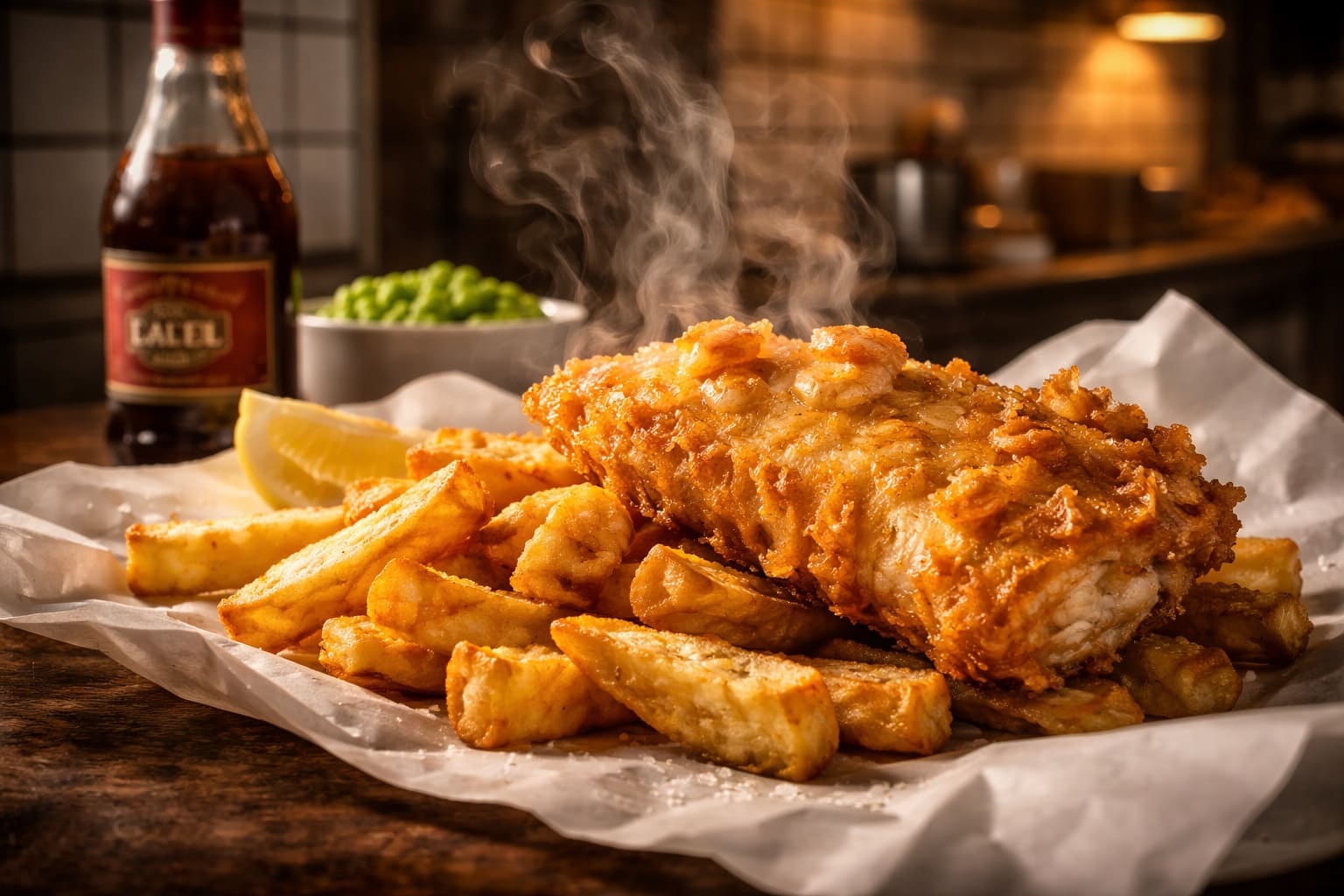
Fish and chips came together as a shop meal in Britain around 1860, when a fried-fish tradition linked to Sephardic Jewish cooks met the fried potato chip in the industrial cities. Joseph Malin, a Jewish immigrant in East London, is the name most often given as the first to sell the two together. John Lees of Mossley, Lancashire, is the other.
The neat version of that story has loose ends. Nobody agrees on where Malin came from, the dates wobble by a few years, and the best-known quotes attached to the dish are shakier than they look.
Where did the fried fish come from?
Britannica says it is believed that the fried fish half draws on a style brought by Sephardic Jews, who arrived in England after being expelled from Iberia in the late 1400s and early 1500s. Fish already battered and fried was an old habit among them, possibly because it could be cooked before the Friday sabbath and eaten cold the next day without breaking the rules of rest. Fish cooked "in the Jewish manner", Britannica adds, was a popular street food in London.
The Jewish link is written down in a Victorian cookbook. In 1845 the French-born chef Alexis Soyer published A Shilling Cookery for the People, which includes a recipe for "Fried Fish, Jewish Fashion". According to a retelling in The Nosher, Soyer notes that the Jewish way uses oil rather than meat fat, which tasted better but cost more. Charles Dickens, in Oliver Twist (1838), already mentions "fried fish warehouses".
There is also a story that Thomas Jefferson ate "fish in the Jewish fashion" in London. The Nosher passes it on from Claudia Roden's The Book of Jewish Food, without a year. We have not seen Jefferson's own words, so treat it as a nice rumor with a respectable citation.
The chip is the murkier half
Where the potato strip came from is argued. Many historians point to Belgium, and The Nosher repeats a version in which fried potatoes stood in for fish when fish was scarce. Others say France. The sources we read do not settle it, so neither do we.
The word is easier to pin down. The Nosher gives Dickens's A Tale of Two Cities (1859) as the first use of "chips" for fried potato, in the line "husky chips of potato, fried with some reluctant drops of oil". That is a first appearance in a famous book, not proof that nobody said it earlier. Still, it fits the timing: the chip is in the language just before the first shops put it beside the fish. If you want the wider story of how the tuber got to Europe at all, it is told in how potatoes changed Europe.
Joseph Malin and John Lees, the two rival claims
The first recorded shop selling both is usually given as Joseph Malin's, in Bow, East London. Dates differ by source: about 1860 in BBC History and Guardian reporting, 1863 in Britannica and The Nosher. The Nosher says the shop lasted until the 1970s.
Even Malin's origin is disputed. Britannica calls him a Jewish immigrant from Belgium, a country where fried potatoes were and are popular. The summary of BBC History reporting says Eastern Europe. Accounts differ, and we can't choose between them.
Then there is Lees. John Lees is credited with opening a fish and chip business in Mossley, Lancashire, in 1863. Britannica mentions a rival story that attributes the dish to a vendor near Manchester, and Oldham's Tommyfield Market has a blue plaque for the other main contender. One summary of the research adds that the two trades may have been combined earlier than the 1860s.
| Claim | Place | Date given |
|---|---|---|
| Joseph Malin | Bow, East London | About 1860, or 1863 |
| John Lees | Mossley, Lancashire | 1863 |
| Oldham market stall | Tommyfield Market | Plaque, other main contender |
The plain reading is that a pairing this obvious may have happened in several kitchens at once. Malin and Lees are simply the names that were written down.
How did fish and chips become a working-class meal?
Two industries did the rest. In the second half of the nineteenth century, North Sea trawling grew fast, and railways linked ports to industrial cities, so fresh fish could reach people far from the coast. The result was a hot, cheap, filling meal that a mill hand could buy on the way home.
The numbers show how quickly it spread. By 1910 there were more than 25,000 shops in Britain, and by the 1930s more than 35,000, according to figures summarized from Alexander (2009). In The Road to Wigan Pier (1937), George Orwell listed fish and chips among the home comforts of working-class life in the north of England. Not every claim about the dish is that grounded, which is why it is worth keeping the plain figures separate from the tales.
The dish also traveled. The Italian immigrant Giuseppe Cervi is credited with selling the first fish and chips in Ireland in the 1880s, from a handcart in Dublin. Most traditional Irish vendors are migrants or descendants of migrants from southern Italy. The immigrant thread did not end with Malin. For a related look at how newcomers reshaped what a country eats, see how immigration changed American food.
Rationing, Churchill and the newspaper
During the Second World War, fish and chips was among the few British foods not subject to rationing. Britannica says Churchill held that it was good for morale. Churchill is also reported to have called the pairing "the good companions". The government's concern for supplies extended to the First World War too, in Alexander's account. For the wider picture of what people ate under pressure, see wartime foods history.
Newspaper wrapping is the detail everyone remembers. Shops did traditionally wrap the food in old newspaper, and the habit has almost ceased on hygiene grounds, with food-quality paper or cardboard replacing it. It was a custom that faded, not a law that was passed.
Where fish and chips stands now
The peak is long past. Figures from Alexander (2009) put the count at about 10,000 shops in 2009, and Britannica quotes a trade association saying there are more than 10,000 in the United Kingdom. A 2016 study by the UK environment department found that fish and chips had lost market share to pizza and kebabs. Britannica adds that nearly a quarter of Britons eat it at least once a week, according to the same trade body.
One shop in Yeadon, near Leeds and Bradford, opened in 1865 and billed itself as the oldest in the world until it closed in 2016. That is a good place to stop: a chip shop that outlasted the empire, the wars and the rationing, and shut a few years ago.
Questions people ask
Who invented fish and chips?
No single person did. Joseph Malin, a Jewish immigrant who opened a shop in Bow, East London, around 1860 or 1863, is the most common answer. John Lees of Mossley, Lancashire, is credited with a shop in 1863. Accounts differ, and the pairing may have appeared in several places at once.
Is fish and chips really a Jewish dish?
The fried fish half is linked to Sephardic Jewish cooks. Britannica says battered, fried fish was long established among them. Alexis Soyer's 1845 cookbook included a recipe for "Fried Fish, Jewish Fashion". The chip is a separate tradition, and the combination was sold first by Joseph Malin, a Jewish immigrant, in East London.
When was the word chips first used for fried potatoes?
The Nosher cites Charles Dickens's A Tale of Two Cities, published in 1859, as the first use of chips for fried potato, in the line "husky chips of potato, fried with some reluctant drops of oil". That was shortly before the first fish and chip shops opened.
Was fish and chips rationed in the Second World War?
No. Fish and chips was one of the few British foods not subject to rationing during the Second World War. Britannica says Winston Churchill held that it was good for national morale. Supplies were not unlimited, but the dish itself was kept off the ration.
Filed under Origin Stories, Migration Stories
Want more stories like this?
One food history story, every week. No spam, just the stories behind what the world eats.